
 Josh Gold
“Do not stand directly in front of your opponent for you will be at a disadvantage…”
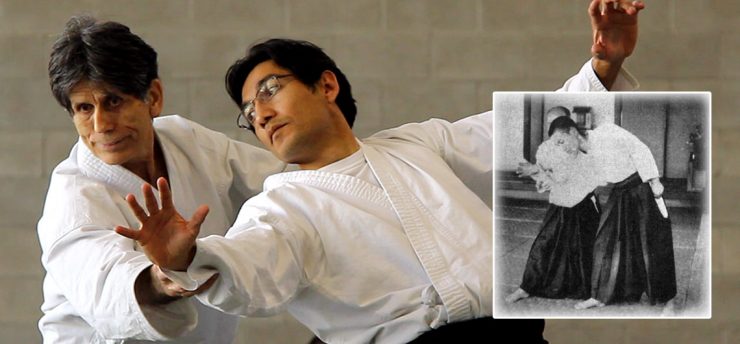
In 2013, I published an online course called the “Zone Theory of Aikido” that has been quite well received. The core of my theory is a concept emphasizing the importance of martial positioning. The “Zone Theory” is based on the assumption that the best strategy for the successful application of techniques is to unbalance your opponent while positioning yourself on his flank at the side rear.
Recently, I ran across two unexpected reminders supporting this theory which both surprised and delighted me. Let me tell you what happened.
Hidden in plain sight!
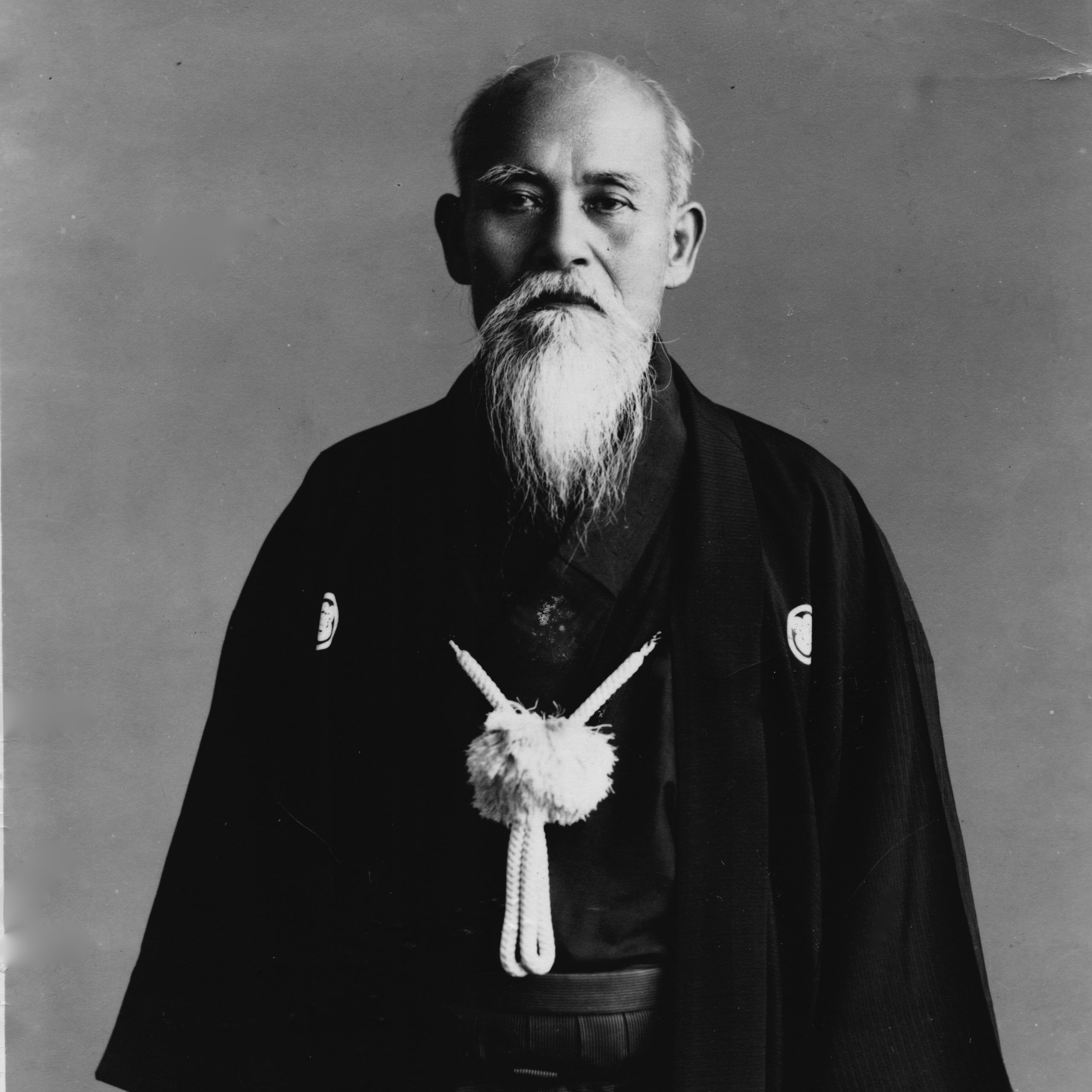
While preparing for my recent seminar in Sweden, I ran across this gem which has long escaped by attention. I was leafing through an original copy of Morihei Ueshiba’s 1938 Budo where I found the following admonition:
“Do not stand directly in front of your opponent for you will be at a disadvantage,” – Morihei Ueshiba “Budo”, page 9.
I could not believe I had overlooked these words of the Founder that encapsulate the “Zone Theory” in a single sentence! I have worked with the text of “Budo” on and off since discovering it in 1981 and yet I had no particular recollection of these words. How true it is that a truth can be staring you in the face but you don’t notice it until you are ready!
What an endorsement!
 Then something happened last night… Sometimes I like to kick back and watch a movie before going to bed. If you must know, I am a classic movie buff and was watching Tyrone Power in the “Prince of Foxes” (1949).
Power as a turncoat emissary of Cesare Borgia gives strategic advice to the elderly count of Citta del Monte about how to prepare for an imminent attack. Look what he says:
“Does the wolf charge headlong at the bull? No, he waits his chance, then rushes in from the side to escape the long, sharp horns and he strikes at the weakest point… always the weakest part.”
Filled with glee and feeling slightly smug, I immediately stopped the movie and transcribed the above words. Watching this scene stimulated me to write this blog!
When things like this happen so unexpectedly, I am constantly reminded of the importance of being a careful observer of all that is happening in my surroundings. This mindset will allow you to better navigate life’s many challenges and is essential to cultivating a martial spirit!




When the student is ready the teacher appears! Thank you Pranin Sensei! Yes, things can be hidden in plain sight until we are ready to see.
Have a look at B.H. Liddell Hart – the Indirect approach:
https://en.wikipedia.org/wiki/B._H._Liddell_Hart#Theory_of_Indirect_Approach
Initiative ! ( control time )
Distraction.! ( control mind)
Position ! ( control body )
And you have ALREADY prevailed
(before applying technique ) !!
Positioning one’s self beside the narrowest base of support of Uke is but the first step as its gets out of the way and is where there power is weakest. Then the biomechanics of a ‘topple vector’ is applied. It’s there in every kata to see. It’s also how Tohei’s Ki tests are passed and how Uke’s power is taken completely from them and they throw themselves.
I like your idea of a “topple vector”. What I am personally working on and have achieved in many cases is the ability to reposition myself and unbalancing uke at the point of contact.
I think it really informs positioning and achieving kuzushi on contact and suddenly the esoteric quotes have a framework for reinterpretation and really start to make sense. I wonder of the old masters had it, but not the framework to communicate it. Instead all they had was the science of the east – which doesn’t help us deductive reductionist western types though the fantasy of mysticism is nice, 😉
Biomechanics of Sport and Exercise by McGinnis has a reasonable treatment of base of support and toppling. I further confirmed it using force plates (under the feet of uke) and mapping the centre of pressure. For measuring and minimising the applied force I used fishing scales. Always meant to write it up properly. Happy to dialogue by email if useful. Here a short illustrative example using a box and then an uke if you have 5 mins of your life you don’t want to get back:
http://www.aikidorepublic.com/how-to-throw-someone
Best,
Dan