
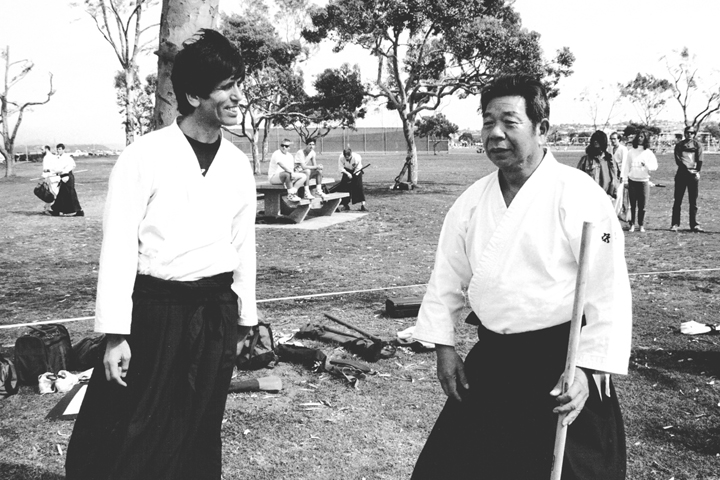
 Josh Gold
The following interview was published in the Swedish publication Iwama Ryu News in 1998 and is posted here with the kind permission of Joran Fagerlund.
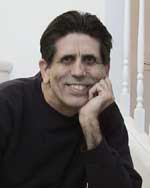 Few people know as much about aikido history as Stanley Pranin. Furthermore, no one has been more important in the search of an accurate writing of aikido history. As editor-in-chief of Aiki News and Aikido Journal he has for more than twenty years documented the life of Morihei Ueshiba, founder of aikido. Stanley Pranin is known for his sense of details and accuracy. Even though his research has got him in to trouble from time to time, since his discoveries sometimes have contradicted the official aikido history, his in-depth knowledge commands great respect throughout the aikido community.
Stanley Pranin summarized the “controversial” conclusions on the founder and his art, that he and the Aiki News staff has made over the years, in the editorial of Aiki News #98 (Spring, 1994):
“Morihei Ueshiba was an eccentric nonconformist who pursued a highly personal path in his development of aikido. Many of the opportunities afforded him in the first half of his life were made possible by the generosity of his loving father, Yoroku, and his considerable means. Ueshiba’s creation of aikido was viewed by the Daito-ryu school as an act of rebellion and show of disrespect towards Sokaku Takeda. Ueshiba was, on the other hand, loyal in the extreme towards Onisaburo Deguchi, and most of his ethical views on budo were derived from this Omoto leader’s teachings. O-Sensei expressed his visionary views on budo as a tool for peaceful resolution of conflict largely through the metaphors and symbols of the Omoto doctrine and this message has been simplified and altered with the elimination of this religious context as aikido has been popularized.
To continue, Ueshiba’s religious and ethical views assumed greater importance in his concept of budo due to the physical and psychological devastation Japan suffered during World War II. Aikido in its modern form developed during the founder’s intensive period of study in Iwama which spanned the period of 1942 through the mid-1950s. Ueshiba’s main impact on aikido during the postwar period was in a spiritual and symbolic sense, rather than technical. The major technical influences after the war and those primarily responsible for the dissemination of the art were Gozo Shioda, Koichi Tohei, Kisshomaru Ueshiba, and to a lesser extent, other second-generation senior instructors.
The aikido seen commonly today differs considerably from that developed by the founder during the Iwama years in the following respects. Atemi (strikes to vital points) have been deemphasized or eliminated. The number of techniques commonly practiced has been reduced. The focus on irimi (entering) and initiation of techniques by tori [person executing the technique] has been lost, and the distinction between omote and ura blurred. Practice of the aiki ken, jo, or other weapons is infrequent or nonexistent. Aikido, although still considered as a budo by some, retains little of its historical martial effectiveness due to the soft, casual nature of practice and as such has been transformed into what could be better called a health or exercise system.”1
Iwama Ryu News met Stanley Pranin for a interview at the Iwama Dojo, at the end of May 1998, after a photo session with Saito Sensei for volume five in the Takemusu Aikido series.
What was your purpose when you started Aiki News in 1974?
What happened was, a few years earlier I got hold of some Japanese documents which was a newspaper series talking about the life of O-Sensei. And there was no English translation of it so with a Japanese friend I went through and translated the 17 articles. I showed this to some people and everybody wanted them, so we started making mimeographed copies of them, and started handing them out and people were very pleased. I’ve always liked writing and there were some events in the Northern California area so I thought “Well, let’s do a little newsletter.”
We used the O-Sensei articles as the main part and then just local area news. I wrote a little editorial and then sometimes people would send in articles. Then a Japanese sensei would come and we’d make an interview and put that in. It started from there. It was just a hobby. It was kind of a way of distributing the research that I have been doing just privately to a wider audience.
What would you say you have achieved with your work?
I got myself into lot of trouble! [laughter] I think that we’ve shown convincingly that historically there is a very important connection between Daito-ryu and O-Sensei and the Omoto religion and O-Sensei. To attempt to remove him from that context is to do a disservice and make it very difficult to understand who O-Sensei was and in what way he was original and what he accomplished. That, and we’ve been able to document historically Saito Sensei’s position in that context. Besides being talented, Saito Sensei happened to be in the right place at the right time. If he did not have the job on the railroad he wouldn’t be where he is today. If he had a nine to five office job, and a family, he could never have trained that seriously.
We discovered some historical things which are probably interesting only to people who like details. There was a strong connection between the Inoue2 family and the Ueshiba family, I’m talking about 70 or 80 years ago, A long time ago, that was very, very important in the early days of O-Sensei’s training. They promoted him and assisted him in many ways.
What would aikido history look like without Aiki News?
Read the Aikikai books or the Yoshinkan books and you’ll see. The Doshu wrote a biography of O-Sensei which was published, I believe, in 1977 and it stayed in print for two or three years. It has a lot of really important historical information and information which also includes things from his experience of being his son.
However, you have to remember that O-Sensei historically had falling outs, quarrels, etc. with various people. Even though they where important people promoting his activities, or family members like the Inoues or the quarrel with Daito-ryu, there was a tendency just to want to ignore them. Even though they were important historically, years later, the Aikikai wanted to basically not mention these things. You can understand this from a standpoint of human nature. But, as a historian, if you eliminate Daito-ryu or the Inoue family you have a totally warped conception of what aikido is and how it came to be. You have to put O-Sensei in his historical context to understand how great he was or how significant the thing he did by creating aikido was. What is aikido? Is it a completely original martial art or is it just warmed over Daito-ryu, what is it? You cannot say unless you study these historical subjects. You have no basis for appreciating what he has done.
Did you have any idea how big Aiki News would be when you started?
No, I don’t think I knew what I was going to do. I had a dojo for a while. I was driven by the fact that I wanted to know more about O-Sensei. When I came to Japan the first time in 1969, I started looking for information and I got nowhere. Very few people wanted to cooperate with me. There was almost nothing in Japanese either. No one had done research. O-Sensei had just died and the Japanese didn’t seem to take research that seriously. So once I became interested and found out something then I found out more and it became more interesting and I wanted to continue.
What are your plans for the future with Aiki News?
To document every aspect of O-Sensei’s life I can. This means documenting Daito-ryu in depth. We’re going to publish an English translation of a biography of Onisaburo Deguchi this year. I want to publish as many volumes of this technical series with Saito Sensei as he would like to do. Some day I would like to do a technical series on Daito-ryu. There are several other senseis who have taken aikido to different directions, which I personally don’t practice but whom I admire and respect. I’d like to do some things with them because I think what they are doing is worthwhile. And then, in a few years I hope to write a biography of O-Sensei which will be serious, and since I’ll publish it myself there’ll be no editor to tell me I can’t do that, or it’s too long or too detailed. I’ll just do what I want to do. I’m thinking more of when I’m dead, of what I can leave behind.
Can you explain the more specific reason for the book series with Saito Sensei, which we’ve been shooting pictures for today?
As I tried to point out in some of my editorials and in Volume One of this series, Saito Sensei, largely because of a historical accident, had a very unique opportunity to study with the founder in more detail than anyone else. He received so much technical instruction directly from the founder and his mind is very methodical so he’s been able to classify it and explain it in a way that is much, much easier to understand. So, by preserving Saito Sensei’s techniques it’s the next best thing to preserving O-Sensei’s techniques. There is no other sensei I can work with that knows this subject to this depth, who can explain it clearly or who saw O-Sensei over a long period of time and could see the changes in his techniques.
We’re in the Iwama Dojo right now. What is the importance of this place for the development of aikido, from your point of view as a historian?
It was probably the place where O-Sensei could relax the most, where he felt the most comfortable himself in his later years. He traveled to Tokyo, Osaka, Tanabe, and Shingu, but his house was here. His house in Tokyo became more the present Doshu’s house than O-Sensei’s house. Of course he could stay there but Iwama was home basically and when he was travelling, his wife, Hatsu, was here. She was not in Tokyo that much. From 1942 this was his home basically.
However, you have to remember that O-Sensei historically had falling outs, quarrels, etc. with various people. Even though they where important people promoting his activities, or family members like the Inoues or the quarrel with Daito-ryu, there was a tendency just to want to ignore them. Even though they were important historically, years later, the Aikikai wanted to basically not mention these things. You can understand this from a standpoint of human nature. But, as a historian, if you eliminate Daito-ryu or the Inoue family you have a totally warped conception of what aikido is and how it came to be. You have to put O-Sensei in his historical context to understand how great he was or how significant the thing he did by creating aikido was. What is aikido? Is it a completely original martial art or is it just warmed over Daito-ryu, what is it? You cannot say unless you study these historical subjects. You have no basis for appreciating what he has done.
The dojo has kept this old flavor. It’s not a modern concrete building. The surroundings are very beautiful and you have got the shrine over there and for O-Sensei, the spiritual aspect was very important. It’s a very special place and probably, after the war, the only home O-Sensei had. Perhaps the people in Tokyo view it differently, but that’s the way I see it.
O-Sensei spent most of his time here in Iwama when he developed his aikido and as you stated in one of your editorials the aikido taught at Hombu Dojo was developed by Tohei Sensei and the Doshu. How was it possible for this big difference in the development of aikido to occur?
A few years ago I would have a great difficulty in answering your question. But basically by talking with many, many people and thinking about these things for years and years I’ve come to a conclusion on this. I tried to point it out in one of my editorials.
If you analyze how long the big name people studied with O-Sensei—by big name people I mean the Doshu, Tomiki, Mochizuki or Shioda—you find that really they trained for a relatively short period of time. Because of the prewar period in which they were trained, they got some instruction, and then were sent out as teachers maybe after six months or a year. O-Sensei himself was travelling around so it’s not like they were getting a steady diet of training from the master. When you come to train in Iwama these days Saito Sensei will teach once or twice a day except when he is travelling. But in those days it would be as if you came here and then after a few months you went to Mito or Tsuchiura [two large cities located near Iwama] two or three nights a week teaching. In such a situation where you are involved in teaching, the amount of instruction you get personally is limited.
Because the art was in its infancy and because of the war later on, the careers of many people who were very talented were cut short. Of course, during the war there was nothing going on at all and after the war O-Sensei was here. He was already an old man and retired so the main figures in Tokyo were Koichi Tohei and the present Doshu Kisshomaru Ueshiba. No doubt about it. Tohei was the one who had the charisma, he was strong, he trained a fair amount under O-Sensei, he traveled abroad, he spoke English, he wrote books. He was everybody’s ideal. Even at Hombu Dojo many of the teachers followed him. Tohei Sensei studied with the Tempukai3. So many members of the Aikikai joined the Tempukai as well. He had a very big influence.
During the same time he was away in Hawaii a lot so the Doshu and people like Tada Sensei and Yamaguchi Sensei had some influence and some followers. But Tohei Sensei was the mainstream. He was the shihan bucho, the chief instructor and the head of the instructors staff.
After the death of O-Sensei, Kisshomaru Ueshiba became doshu and Tohei left the dojo in 1974, and then it becomes Doshu’s era. He wanted to make the techniques easier to understand and less jujutsu-like, more round and circular. Now they are handing things over to his son Moriteru, but his influence is not O-Sensei. It’s not Saito Sensei or Tohei Sense; it’s his father. And they are remolding what aikido is in their image, which is human nature I think. However, it’s cut of from its historical roots as I see it.
To document every aspect of O-Sensei’s life I can. This means documenting Daito-ryu in depth. We’re going to publish an English translation of a biography of Onisaburo Deguchi this year. I want to publish as many volumes of this technical series with Saito Sensei as he would like to do. Some day I would like to do a technical series on Daito-ryu. There are several other senseis who have taken aikido to different directions, which I personally don’t practice but whom I admire and respect. I’d like to do some things with them because I think what they are doing is worthwhile. And then, in a few years I hope to write a biography of O-Sensei which will be serious, and since I’ll publish it myself there’ll be no editor to tell me I can’t do that, or it’s too long or too detailed. I’ll just do what I want to do. I’m thinking more of when I’m dead, of what I can leave behind.
Was O-Sensei aware of the differences developing in the world of aikido?
You have to understand that O-Sensei lived in a dream world in a sense. He viewed himself as a vehicle for various kami or deities. Tohei Sensei says, for example, that O-Sensei would say something and his students would say, “Sensei, I’m sorry I don’t understand,” and he says “It doesn’t matter. I don’t understand what I am saying ether!” Tohei said this critically of O-Sensei. O-Sensei was just thinking in terms of uniting with the universe. His vocabulary and his viewpoint were shaped heavily by the Omoto religion. It’s a Shinto religion, a shamanistic religion and he was in another world.
He was not interested in organization. Even when he was younger he never organized things. He left that to other people. He was interested in training his own self, doing his meditation, his relationship with god. I think he would be upset when he saw people doing things on what he considered a vulgar level. In today’s terms we would think of him as very odd or eccentric. And then he was an older man and after the war he was already in his late sixties.
What do you think will happen in the world of aikido in the future? How will aikido develop?
One nice thing about aikido is that it is spreading internationally and there are people bringing in their training from other fields and other ideas. So, you’re going to find aikido being a part of other disciplines. Maybe the main part or maybe just as an adjunct. I think that certain people will develop aikido as more of a health system. A few will do a harder style. It’s just going to go off in many directions.
It’s strong in one sense because it has some charismatic figures and people tend to practice aikido longer than other martial arts because there is no competition. There is more of a harmonious relationship and it appeals to people of a higher intellect. If it’s karate or something like that, it tends to be young men for a few years who practice and then they leave it. But in the case of aikido, families can do it, and you can practice it for 20, 30, 40 years and in your 50’s and 60’s you can still do good practice. Can you do competitive judo at 60 or even kendo? Not very often. It’s going to keep redefining itself and just spread all over the place.
After the death of O-Sensei, Kisshomaru Ueshiba became doshu and Tohei left the dojo in 1974, and then it becomes Doshu’s era. He wanted to make the techniques easier to understand and less jujutsu-like, more round and circular. Now they are handing things over to his son Moriteru, but his influence is not O-Sensei. It’s not Saito Sensei or Tohei Sense; it’s his father. And they are remolding what aikido is in their image, which is human nature I think. However, it’s cut of from its historical roots as I see it.
What is your advice to all aikidoka in Sweden?
Make it into your own image and do the best you can. Given my own personal character, I would like to add other elements into it because I have other outside interests. It’s not my role necessarily to preserve the aikido of O-Sensei as a practitioner. I’m doing that more as a scholar. Saito Sensei has this role. He has O-Sensei’s house and dojo to watch after. He’s got his mission in life. Hitohiro [Saito] Sensei has his mission in life. Mine is a little different.
I encourage other people to search and if they can find somebody better than O-Sensei to learn with them. If you can’t, at least educate yourself as to who he was and what he did. You don’t have to attempt to do the aikido he did, but at least understand where he was coming from. Then acquire your basics in what ever version of aikido you are doing and make something great from it.
How will the Iwama Ryu aikido develop, and what is our mission?
You are very lucky that the successor of Saito Sensei is so talented and loyal. It doesn’t always happen that way with successors. I have really high hopes, this is just going to expand more and more because it has so much essence in it. There is so much content you can go on for several lifetimes studying Iwama style. I hope there is no movement towards a rigid organizational structure, because that has its own problems.
If Iwama can concentrate on preserving O-Sensei’s aikido and disseminating that, and practice the techniques themselves rather than creating a hierarchical structure, I think the Iwama aikido will do just fine.
Notes
1. Aiki News #98, 1994, Vol. 21:1, p. 4.
2. Inoue, Noriaki. Inoue was a nephew of Morihei Ueshiba, and raised in Ueshiba’s home in Tanabe. Lived in Hokkaido and cooperated with Morihei Ueshiba during the prewar period. Eventually the two went separate ways and Noriaki created Shin’ei taido. Noriaki’s father, Zenzo traveled together with Yoroku Ueshiba (father of Morihei Ueshiba) to Hokkaido around 1917 to visit their two sons. (The Aiki News Encyclopedia of Aikido, p. 45-47, Aiki News, 1991.)
3. Tempukai, A self-development organization built around the activities of Tempu Nakamura (1876-1969) founder of Shinshin Toitsu Do. Nakamura was an acquaintance of Morihei Ueshiba. He attained spiritual enlightenment during a trip to Egypt, trying to cure his tuberculosis, while meditating on Kanchenjunga, the third highest mountain in the world. Shinshin Toitsu Do is based on elements of yoga, marital arts and other oriental disciplines.
Stanley Pranin Profile
Stanley Pranin was born on 24 July 1945. MA in Spanish from the UCLA in 1968. He started in Yoshinkan Aikido in 1962 under Virgil Crank. Later started practicing Aikikai, Hombu-style, and was promoted to first dan in 1965. In 1969 he traveled to Japan for the first time. Promoted to 5th dan in 1983. Established Aiki News in 1974 and has since then been its publisher and editor-in-chief. Stanley moved to Japan in 1977 and started publishing Aiki News in a bilingual format shortly after. He now divides his time between the United States and Japan. Author of the Aiki News Encyclopedia of Aikido, Aikido Masters and co-translator of the Takemusu Aikido technical series by Morihiro Saito Sensei.




To my mind Stanley Pranin was brilliant, to him I was a stranger but I once wanted to quote what he had written and emailed him (somehow!,) within what seemed minutes, I had a pleasant and positive reply. Try and find that with anyone, anywhere. Rare indeed. We all owe him.
Getting to meet Stanley Pranin was wonderful. Several of us from our Kenshinkan Dojo in Vista, California attended his third and last weekend program in Los Angeles. Besides being able to meet with Stanley and talk with him, his program was a terrific training program with hundreds of aikidoka and some very famous sensei. In addition to great training, it was simply fun. What was really fun for us, was we had been reading Stanley’s publications for a very long time and learned a lot from him. I will always be grateful for that terrific weekend training program.