
 Josh Gold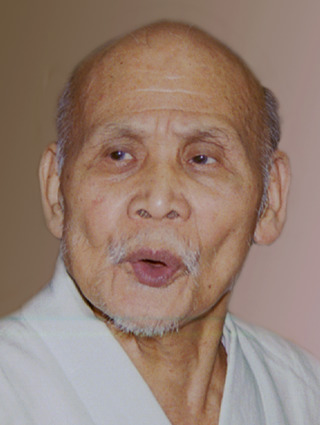
This is the first part of a four-part interview with Noriaki Inoue. Read the second part here.
I was born in Wakayama Prefecture in 1902 and brought up there. At the age of 15 I came to know of the Omoto religion and went to Kameoka at 19 to study under Master Onisaburo Deguchi. Since then, basing myself of the teachings of the Master, I studied on my own and created Shin’ei Taido (Shinwa Taido). From my early days I have devoted myself to budo and engaged in matches in many areas but have never been defeated. Thus I have acquired a reputation in the budo world.
My uncle’s father (Yoroku Ueshiba) was my grandfather. My mother married into our house (Inoue) from the Ueshiba family. She was the eldest Ueshiba daughter. Morihei was the fourth child. There were five brothers and sisters and Morihei was the only son. So, there was not much difference in our ages (eighteen years) even though we speak in terms of uncle and nephew. (Laughter) We all studied in the same way. Ueshiba quit his middle school when he was in the first or second year and came to work in our store in Tokyo. I think he continued his schooling there. I believe that since he had time at night he went to a judo dojo for practice as a dojo was nearby. I had an older brother and, while we were living in Tanabe, my uncle, my brother and I studied old-style Judo. I was only about ten years old then.
Does that have something to do with Kiyoichi Takagi Sensei?
Yes, yes. Mr. Takagi. He was still young then. A teacher was needed in Tanabe so Mr. Takagi was invited. You know the story very well! Is he still alive?
No, but his wife is. In what year did you and Ueshiba Sensei learn Judo?
It was the end of the Meiji period (around 1911) when I was still a boy. My grandfather was a strict person and thought that Judo would be good for us since it was a sport and thought it was a good amusement for boys. He asked the Kodokan to send someone to him. Mr. Takagi came to Tanabe at the request of my grandfather. First, he came to our house. Oh, I see, you (the editor) knew about this. So this kind of thing is recorded in history. (Laughter) I think Mr. Takagi stayed with us for about two years. We took care of him but he suddenly returned home. Ueshiba, too, had various tasks to do and didn’t have time to practice Judo all the time.
Is this the period after Ueshiba Sensei left the army.
Yes… After he came back from the army. Then he had to go to Hokkaido. When we were practicing in the dojo in Sengakuji in Tokyo many years later, Takagi Sensei came to the dojo. Someone came up to me and said, “Oh, it’s been a long time, Bo-chan?” I asked him who he was and he said he was Takagi. I had forgotten about him. (Laughter) I suggested that Takagi Sensei should practice with us but he responded, “Oh, no. If I were thrown by people like you I would not be able to survive.” I told him not to make a joke like that and we laughed. (Laughter) He had brought a team of young Judo students from the Kodokan with him on that occasion. There were also people like Admiral Takeshita, Kosaburo Gejo Sensei of Yagyu and various others. Mr. Takagi observed the class very earnestly. When I told him he should practice with us since it had been a long time, he laughed and replied that the times had changed. Those were the good old days.
Do you recollect anything about Masakatsu Nakai Sensei or Tsuboi Sensei of Yagyu-ryu in Sakai City (near Osaka)?
I will just say that the only person I know of in Yagyu-ryu is Kosaburo Gejo Sensei. Please excuse me for not telling you more than this.
I am a student of the Omoto religion and a believer. I am a student of Onisaburo Deguchi Sensei. It was this teacher who made me realize the essence of budo for the first time. Until then I didn’t understand it at all. I thought that one had to be strong. In the old days, that’s all there was to it. One had to be strong and win and that was all. (Laughter) But where does this strength come from? And where does weakness come from? Is there really any true strength or weakness? This was the first question I dealt with at the age of thirteen. My family had land occupying some 7.90 square kilometers in Hokkaido in those days and I was a child of this influential family. Therefore I thought I was the greatest. I wondered if I was really strong or not compared to other people. I thought I might be strong only because of the power of my family. I believed that the strength I had was only related to this power/or authority. Then I thought that this was not good and felt I had to study what I learned about from my grandfather, that is, “affinity.” This was how I came to study budo.
In the meantime, Morihei Ueshiba Sensei met Takeda Sensei for the first time at the Hisada Inn in Engaru in Hokkaido.
This photo was taken from the “eimeiroku” (student enrollment book) of Sokaku Takeda Sensei.
He made everyone write his name in the eimeiroku. That was a problem for roe too.
He said to me, “Little boy, do you want to practice with me.
I said in response, “I don’t want to be taught by an old man like you!” However, he didn’t become angry at me at all.
He said, “Oh, I see. Do I look that old?”
“You are an old man without any teeth!” (Laughter)
I am not fond of talking about other people. I always tell my students not to lie but to tell the truth. Otherwise, we will be caught by our lies someday. We won’t be able to say anything if we are later told that we said this or that on such and such an occasion. Therefore, I am always strict about these things.
When I was 21 years old, I returned to my birthplace in Wakayama Prefecture after having received permission from Master Deguchi. In order to further my studies on affinity (shinwaryoku), I began what is called “mushashugyo” (ascetic training for warriors) with high ambitions. One can’t know whether what he has acquired is really good or bad, or strong or weak unless he has actually tested it, can he? Those living in my birthplace made light of this. But I was very successful there. Many newspapers came to cover these events and wrote a great deal about it.
Then Ueshiba Sensei, who is also from Tanabe, came back and we practiced together. I didn’t teach only in Tanabe. I also went to various other places inside and outside of Wakayama Prefecture. Then I said to Ueshiba Sensei I would return to Tokyo. My family had a house in Tokyo. Sensei asked me why I wanted to do this. I answered: “If we are to teach the art to everyone, why not do so in Tokyo?”
It was the end of the Meiji period (around 1911) when I was still a boy. My grandfather was a strict person and thought that Judo would be good for us since it was a sport and thought it was a good amusement for boys. He asked the Kodokan to send someone to him. Mr. Takagi came to Tanabe at the request of my grandfather. First, he came to our house. Oh, I see, you (the editor) knew about this. So this kind of thing is recorded in history. (Laughter) I think Mr. Takagi stayed with us for about two years. We took care of him but he suddenly returned home. Ueshiba, too, had various tasks to do and didn’t have time to practice Judo all the time.
My family had houses in Tanabe and Tokyo. It ran a big trading business and had branch offices in many locations such as Osaka, Kobe and Hokkaido. When I returned to Tokyo I announced my intention to teach budo there and asked for their support. They told me they could not support me and instead asked me to run the business. I was told that one could not make money doing martial arts and that business was best for me since this house was mine. However, I insisted that I could not run a business and was not good at that type of thing. Then I began to teach budo at various places in Tokyo.
There was one place in Yotsuya called Aizumi-cho. There lived a certain Kiyoshi Umeda, a dietman elected from Aoyama Prefecture. His wife was really fond of me and asked me to relate various stories when I met her. Mr. Umeda was a member of the “Kojunsha” (the first social club established in Japan. Its members were mainly businessmen). When he returned from club gatherings we chatted about various things. This was around 1925. When I talked about budo these people would gather around me. Then we held the first practice session Tokyo in a large room of another house owned by Umeda Sensei. We also practiced in the mansion of Admiral Takeshita located in Kuruma-cho in Sengakuji.
Sensei, I believe Admiral Takeshita took notes about the contents of daily practice around 1930. Perhaps, they are from the Mejiro Dojo period.
I think they are not from the Mejiro period but rather from the Osaki-cho period. Mr. Shimazu had a mansion in Osaki-cho. We held the first training in the Shimazu Dojo. During this period Ueshiba came to Tokyo several times. He was ill then and very weak. Thus I had to take care of him and had a difficult time. As a result, I taught most of the time at the dojo. From the dojo in Osaki-cho we moved to Mita. A Baron Katsuji Utsumi lived there and, since his mansion was empty, we were offered the use of it. We didn’t teach at only one place in Tokyo but rather at several locations. It was really hard for us to build the dojo. They were no difficulties of common order.
I thought that one had to be strong. In the old days, that’s all there was to it. One had to be strong and win and that was all. (Laughter) But where does this strength come from? And where does weakness come from? Is there really any true strength or weakness? This was the first question I dealt with at the age of thirteen.
At that time there were teachers of various martial arts such as the sword, Judo, and Karate. We couldn’t lose in matches with such people. In those days we had to win. But we had to win fairly and in a dignified manner.
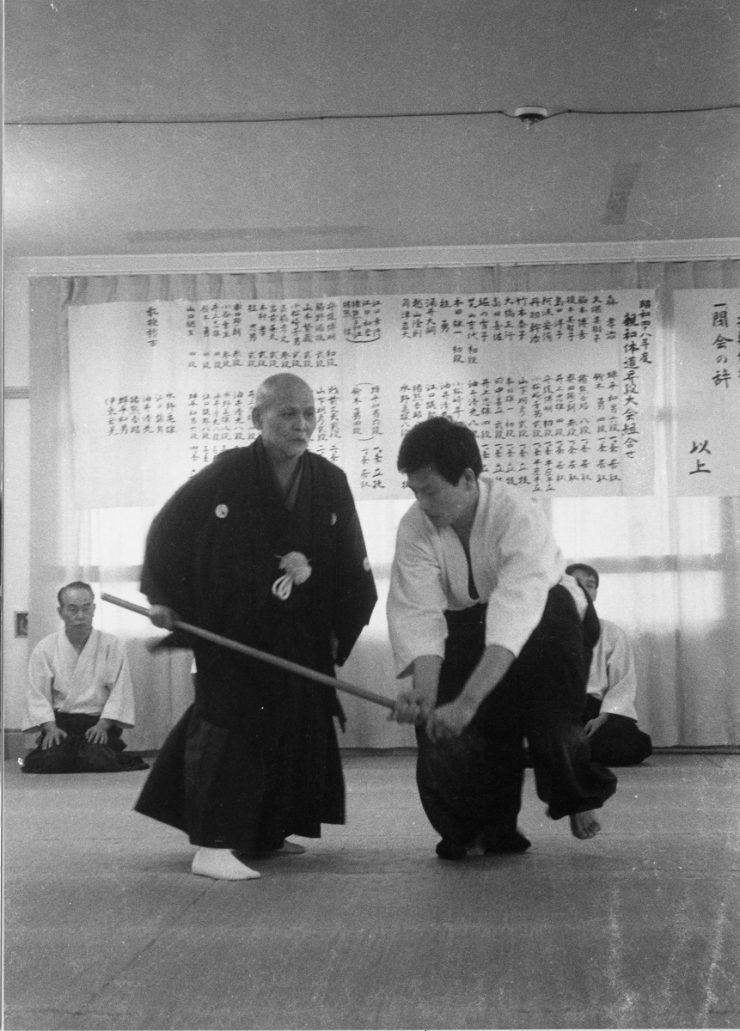
For example, Kosaburo Gejo Sensei whom I mentioned earlier was a naval officer and in the same group with Isamu Takeshita Sensei. He left the navy when he was a lieutenant commander or about that rank. He was the top expert in Yagyu-ryu. I was the first to have a match with him—a small man like me. I looked helpless and that is why he lost. If I were a strong-looking man, he would have fought seriously but he must have thought it would be meaningless to have a match with a small man like me. His sword struck down toward me like this and I held it like this. He couldn’t raise his sword. This principle is also in the theory of affinity I talked about. How much heavier will a several thousand pound stone be if you put a sheet of paper on it? You think that one sheet will only have the power of one sheet of paper. However, it adds one thousand times the power. This is because the paper is coming down from above. You have to study this. For example (holding a sword in his hand), I held his sword like this (from above) in a flash after he came to strike here. Now, he cannot move. If I pull the sword he will be pulled forward or if I thrust at him he will fly back. (Laughter) If I pin him he will go by himself. You’re free to do anything. If you put the sword here, it’s dangerous. It’s safe if you put it here. They say that in the Shinkage-ryu of Yagyu one hits like this and it is called the “mutodori” (no-sword taking technique) of Yagyu but that is ridiculous. If you do it this way he will be thrown.
Since it is a matter of yin and yang it is the actual flow between Heaven and Earth. It goes whoosh … This is the movement of the affinity of the Universe. Mr. Gejo was defeated in one movement and thrown forward. Then he realized that I was holding his sword and was surprised. (Laughter) When I asked him what had happened to him he said he didn’t know and asked to try again. Then I became angry for the first time. I said, “What do you mean let you try again! What an insolent fellow! If you are asking roe to show you my sword technique I might do so. But how can you ask me to do it again just because you don’t understand!” When I said that all of the higher-ups were laughing and clapping their hands. (Laughter)
I won all of my matches. After Ueshiba Sensei returned from Manchuria (in 1924) he became ill and so I taught most of the time. There was also a place called Kuruma-cho near Sengakuji and we stayed there for two or three years. There we practiced with what might be called upper class people and members of nobility.
The last place we taught at was Shimoochiai in Mejiro. This was because there was a certain Shoo Matsui Sensei, a playwright who lived nearby. He has already passed away. Among our students there was also the son of head of the Marumi Soap Corporation. They had a large house in that area, I think it was called Maruyama, and the son knew about my background. I was very surprised. They did business with our family. We had many products they needed. So we were tied up in a business sense. His grandfather was the main one involved. We knew the son and he knew about our family from his grandfather. He remarked, “Oh, it’s you, Mr. Inoue, and you are teaching this kind of thing!”
I answered, “It is not I who am teaching the art. It is my uncle (Morihei Ueshiba). I just accompany him. I don’t do much.”
He continued, “I’m sure you are doing important things too.”
I then replied, “Someone like me can teach the art because nobody knows about these techniques. If they knew them I wouldn’t be able to.”
We laughed a lot over that. During this period while we taught at Shimoochiai, we came to know a budo teacher named Ittoku Oki who was instrumental in the development of Manchuria and Korea. He was a student of Tesshu Yamaoka and was an expert in “tessenjutsu” (iron fan techniques). He also had experience with Kodokan Judo. He was one of a trio of students of Kano Sensei in those days. Oki Sensei taught all over Manchuria and Korea and it might have been there that he heard of our art. The reason for this is that many of those who went to Manchuria and Korea had studied at our dojo.
His sword struck down toward me like this and I held it like this. He couldn’t raise his sword. This principle is also in the theory of affinity I talked about. How much heavier will a several thousand pound stone be if you put a sheet of paper on it? You think that one sheet will only have the power of one sheet of paper. However, it adds one thousand times the power. This is because the paper is coming down from above.
In 1933 when I was about 31 years old I also went to teach in that area. Thanks to Oki Sensei things went very smoothly for me. When he went there for instruction, he talked up the art wherever he went. What I still remember roost from this period is that there was a school called the Daido Gakuin in Manchuria. The location is now used as an airport. This school was a place attended by bright university graduates. When they graduated from this school, they all became top-level executives in Japan. I was invited there to teach.
There was one occasion when I was surrounded by Russians. I went to a tea stall one day because I was thirsty. It was awfully quiet there. When I took a good look around I noticed that Russians were staring at me from everywhere, even from second floors. I found it interesting. After all, we all die once. I thought I was going to die in an interesting place. I left quietly after paying. I was wearing Japanese clothes then. I never wear European clothes. Since I went into the tea stall in Japanese clothing they may have simply been watching me out of curiosity. However, if they had shot at me, there is no way I would have survived. (Laughter) In any event, I managed to escape death. The students of Daido Gakuin were surprised to learn about this incident. I was told that many people had been killed in that stall. The provost marshal at that time was a Mr. Toranosuke Hashimoto who practiced with us when he was a colonel. He expressed amazement that I had managed to survive the incident. (Laughter) Since he was a high-ranking official of the military police he introduced me to the Emperor of Manchuria and several higher-ups. I had a very successful trip to Manchuria and returned to Japan. I visited Korea for a short period on the way back. It was not that I was strong but somehow I have managed to survive up to today.
Mr. Eguchi: Sensei, wasn’t the school in Manchuria you mentioned Kenkoku University?
Actually Kenkoku University was built much later. (Daido Gakuin was opened in 1932 and Kenkoku University in 1938). The war had already broken out during the Kenkoku University period. There were sword experts and Judo experts among the students of Daido Gakuin. They were not just strong academically. The students were somewhat conceited types. The school was different from a university. Anyway, it took a long time for me to return home. They insisted that I stay longer and wouldn’t let me go back to Japan. They said they wanted to listen to my lectures. Of course they said they wanted to train but they also wanted to listen to ray lectures. I don’t give practices without also giving lectures. It is meaningless unless you transform what you talk about into a concrete from. This is what we do in budo—transform concepts expressed verbally into physical things. Giving a lecture is something simple that anyone can do. All you have to do is read a book. (Laughter) My view was that the things one says should always be transformed to a concrete expression. That was the reason my lectures pleased army and navy officials. They were professional in this sense.
I first taught the military police in Japan. The lieutenant general was Mr. Hata in those days. I went to the military police accompanied by Admiral Takeshita. That’s how it began. I came know to Hakudo Wakayama Sensei in that connection. So I went around teaching in a number of locations. However, it was all thanks to the greatness of my uncle, not me. So to tell you the truth, I don’t really like to be written about. (Laughter)
This is the first part of a four-part interview with Noriaki Inoue. Read the second part here.




Add comment