
 Josh Gold
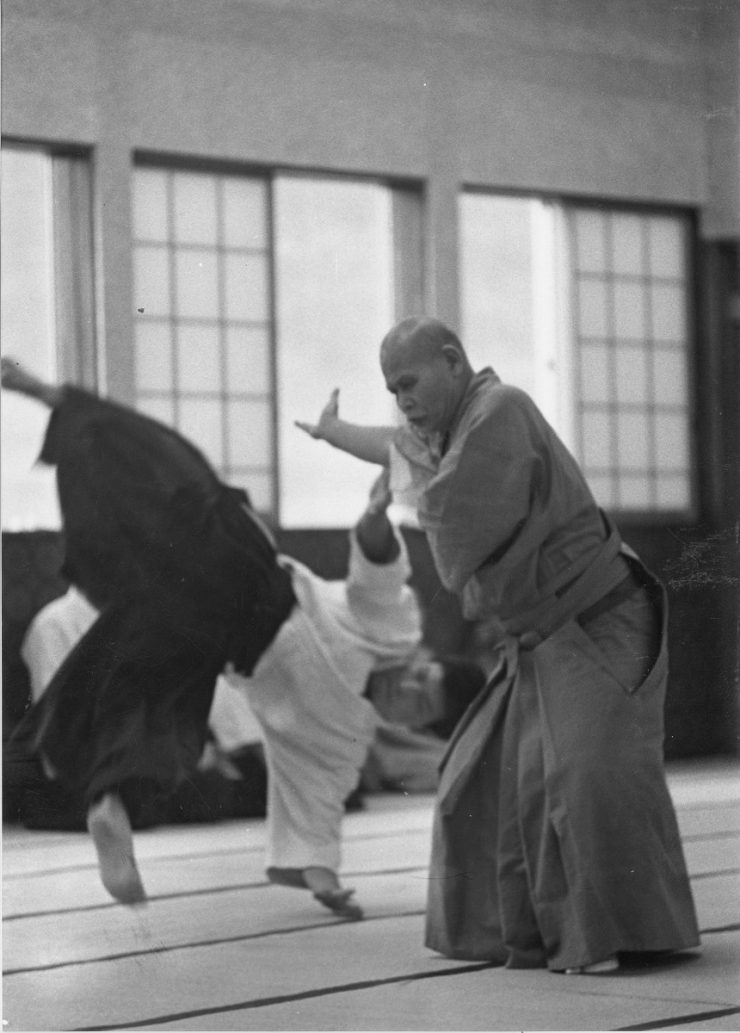
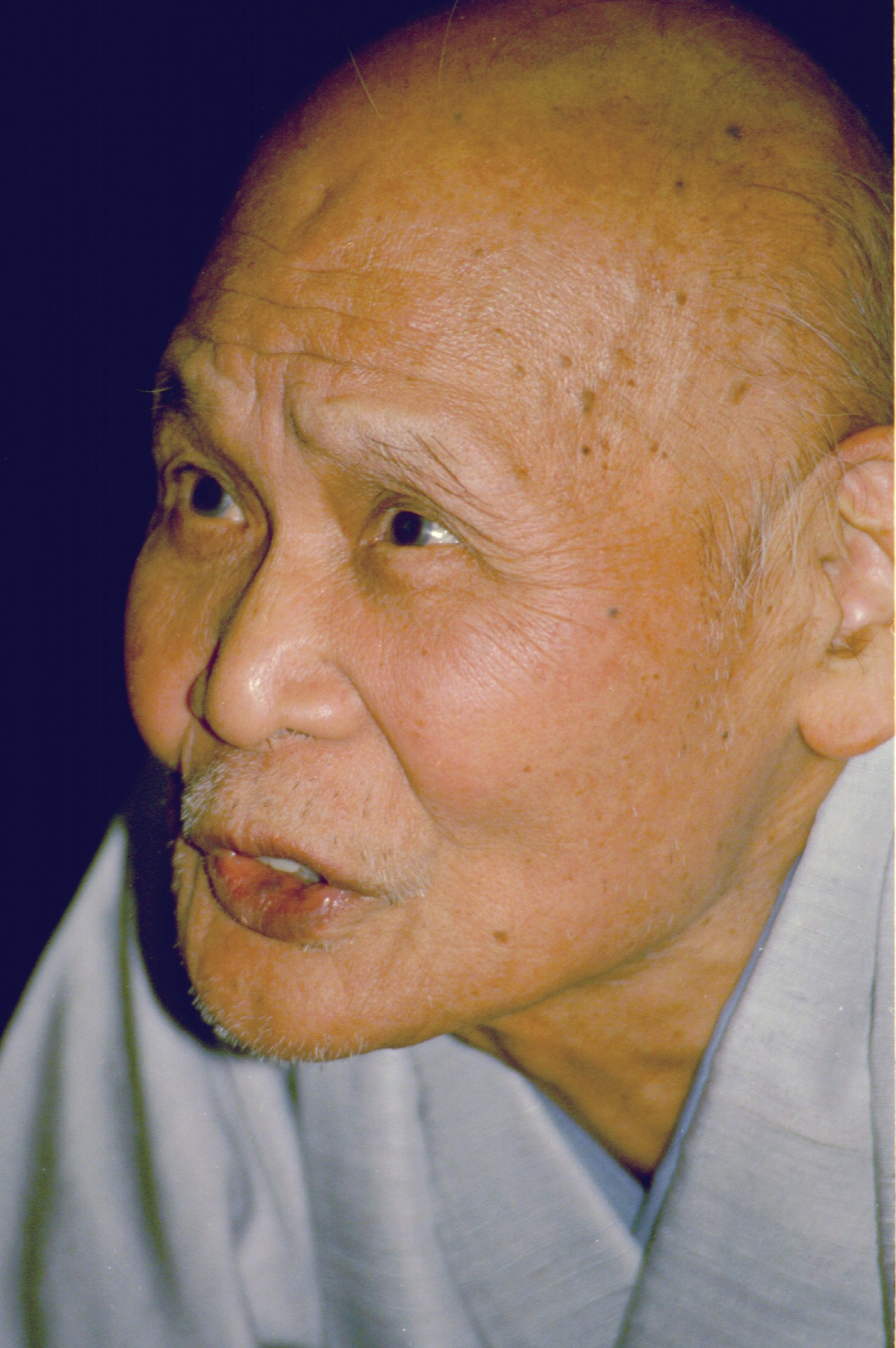
This is the second installment of an interview with Noriaki Inoue Sensei, Founder of Shin’ei Taido. Inoue Sensei, who is at present 85 years old, is the nephew of Morihei Ueshiba Sensei. Inoue Sensei was deeply influenced by Reverend Onisaburo Deguchi of the Omoto religion and Shin’ei Taido represents the distillation of his martial and spiritual study spanning more than 70 years. This is the second part of a four-part interview with Noriaki Inoue. Read the first part here and third part here.
Is your sword style influenced by the Yagyu Shinkage-ryu or Goto-ha Yagyu-ryu schools?
No, my sword style has nothing to do with those schools. My art is not at all what we call aikido today or any traditional martial art. I really don’t know anything, but I have been studying since I was a child. I was taught what the reality of affinity embodied in the study of universal affinity should be for the first time by Onisaburo Deguchi. This was something I didn’t understand from my studies. The reality of universal affinity is in movement. It should never stop. If the reality of the universe stops, everything will die. Thus, things should be created while this movement persists. This is what I learned from Onisaburo Deguchi Sensei. The virtuous power which springs from the reality of the study of affinity… Man should cultivate courage which is created by this virtuous power. If you succeed in cultivating courage, it will participate in a myriad of ways in the reality of creation. Without this courage, no expert can create anything of complexity. That was the beginning point of my studies. And so I have grown old. I still don’t understand. I think you cannot understand the talk of someone who doesn’t understand what he is studying himself. (Laughter)
I imagine there is no one left who knows about the old days. Most of them who knew about those times have already passed away. I am already 85 years old. I have arrived at where I now stand after beginning this study when I was 13.
Would you describe the occasion when you first had contact with Sokaku Takeda Sensei?
When I met Takeda Sensei and he told me to practice with him I refused to do so saying I didn’t like his type of training. Takeda Sensei really wanted to teach me. My father and Ueshiba’s father talked things over back in Tanabe and built a dojo for him. Because Morihei said he wanted to study the art in Shirataki, my father and Ueshiba’s father built a dojo and Takeda Sensei was invited to teach. I think at that time my uncle was already over 30. Ueshiba’s father (Yoroku) was a great person and also very strong. I don’t think anyone, not even sumo wrestlers, were stronger than him. He too was fond of the martial arts and this was why he understood Morihei’s strong desire to study the art and agreed to help him. Although I don’t know how much, they sent money to Takeda Sensei every month. Our fathers certainly gave what Sensei needed for the rest of his life and sent him cash every month. My father also thought that it would be nice to have a budo man from our family. Ueshiba’s father did it out of affection towards his child. There was no problem with money since my father owned a lot of real estate and also was actively engaged in business in Tokyo. I suppose the amount of money they sent was insignificant for them. They had that kind of relationship with Takeda Sensei. However, I don’t know what sort of agreement there was between Morihei Ueshiba and Takeda Sensei. So I can’t say anything about it. But I know it caused my uncle problems. I don’t know why he had to feel diffident towards Takeda Sensei after having given him all those things including a house, dojo and land.
This was why I refused Takeda Sensei when he came to Ayabe and told me to practice with him. I said I didn’t want to practice with him but that I would practice with my uncle. Takeda Sensei’s movements were completely different. He would teach calling out the names of techniques with a “kajo” on the end of them. From my point of view there is no such thing as such and such a “kajo.” The reality of flow is constant. Many things are created through this reality of flow. Therefore, I dearly refused Takeda Sensei. Although he insisted, I didn’t have to sign my name in the student enrollment book since I didn’t practice. However, I think it was in 1931, I’m not sure, that he came to Tokyo unexpectedly. My uncle was not in the best of health at that time and so I took ukemi all the time for Takeda Sensei. Since he told me to invite guests, I had to send for various prominent people so he could demonstrate techniques before them. I took ukemi for him and he thus told me to sign my name in the enrollment books since he said he taught me. I answered in the following way: “No. I wasn’t taught by you. I took ukemi for you. You are the one who should sign your name.” (Laughter) But Ueshiba said to me: “Since Takeda Sensei has told you to, you should sign.” So I unwillingly signed my name then. If I remember correctly we practiced for one week.
The reality of universal affinity is in movement. It should never stop. If the reality of the universe stops, everything will die. Thus, things should be created while this movement persists. This is what I learned from Onisaburo Deguchi Sensei. The virtuous power which springs from the reality of the study of affinity.
Sensei, if this took place in 1931 your name is indeed recorded with your seal in the Daito-ryu enrollment book.
Of course it is. He wouldn’t move unless I signed. You see, he couldn’t have charged me if I didn’t sign. 10 Yen was a large amount in those days.
Was Admiral Takeshita present for that seminar?
Yes. They all were. But I am sure he didn’t sign his name because he didn’t practice.
That’s right. I’m sure his name doesn’t appear.
People in those days wanted to observe how I took ukemi for Takeda Sensei rather than his techniques themselves. His techniques were really rough. He would throw me to the mat by reversing my hand. Since I immediately stood up after being thrown with a smile on my face, he would grow increasingly more irritated. (Laughter) He again came to me. I entered before he reached me. In other words, I was in an irimi position. So he was unable to throw me. On the contrary, I was in a position to throw him but I couldn’t since he was an old man. What Takeda Sensei did then was to take a “gyaku” or reverse position when he entered. But I had studied gyaku techniques since I was a boy. If I strike you like this you will fall. I learned this from my grandfather when I was small.
Sensei, would you give us your views on teaching Shin’ei Taido?
I practice daily praying to the kami (deities) that nothing will go wrong. It is more enjoyable to spend time every day praying to the kami. I am practicing daily in earnest. One error might result in you loosing your life. One error can injure your partner. If you injure your partner in practice, that is the reality of defeat. You are the lowest kind of human being. This is the true spirit of Japanese martial arts. True Japanese budo is a double-edged sword. With a double-edged sword you cut yourself but let others live. When you hear the term “double-edged sword” you probably think that it is your opponent who is to be cut, but it is not. When you draw your sword to cut your opponent in an instant, you see if he cowers or not or if he is going to attack. This is the affinity which originated in the old days of Japan. With this you can say for the first time that the attitude of the Japanese is correct.
When I met Takeda Sensei and he told me to practice with him I refused to do so saying I didn’t like his type of training. Takeda Sensei really wanted to teach me. My father and Ueshiba’s father talked things over back in Tanabe and built a dojo for him. Because Morihei said he wanted to study the art in Shirataki, my father and Ueshiba’s father built a dojo and Takeda Sensei was invited to teach. I think at that time my uncle was already over 30. Ueshiba’s father (Yoroku) was a great person and also very strong. I don’t think anyone, not even sumo wrestlers, were stronger than him. He too was fond of the martial arts and this was why he understood Morihei’s strong desire to study the art and agreed to help him.
Dirt never remains on the bodies of those who practice in our dojo. It flies off with the sweat. And no one has been injured in our dojo. If you practice in such a way that there are injuries it is better to stop practicing all together. A baby is flexible by nature. We have to return to the state of an infant. This is what human beings should be. There are people who don’t easily recover when injured. That kind of a person doesn’t break into a true sweat. We should sweat so that it pours out from the bottom of our beings. The easiest time to learn these things is in the rainy season. When we practice during the rainy season our bodies become clammy, don’t they? And it becomes difficult to eliminate sweat. We hold a special practice at that time. We start out during the rain and finish during the hottest part of the summer. Then, when fall comes, training is refreshing. The same is true of rice. The best rice is available in the fall. It tastes really good, doesn’t it? Then winter comes again. A rice plant thrusts itself into the air in the winter. In winter practice, even a little movement makes you feel warm. People say that they tend to suffer broken bones in winter practice but actually there is no easier training than during the winter. Practice differs according to the four seasons. If it is always the same it is not true training. We are also different depending on the season, aren’t we? If you wore the same kind of clothes in the hot and cold seasons it would be terrible, wouldn’t it? (Laughter) So practice differs according to the season in all countries of the world. No practice is the same. Ten people have ten different ways of practicing. My practice might look the same when viewed by a third person but it is completely different. You cannot teach what is taught in elementary school to a kindergarten student. You cannot teach an elementary student in the same way you do a junior high school student. Through regular practice you begin to acquire true flexibility in your entire body. When you gain this flexibility, then you can begin to use a sword or a stick for the first time. If your body is not flexible enough you will break your bones when using a sword or stick. If I strike such a person with a sword or stick he will be knocked down instantly. This is a simple principle I have developed over the years. It has nothing to do with strength or weakness. What is strongest is the reality of the affinity of the universe. You see, if this ki stops the result will be terrible. We call this force “the reality of ki” rather than “aiki.” We study it through the reality of “iki.”
Would you talk about the name change from Daito-ryu aiki Jujutsu to Aiki Budo?
It was Onisaburo Deguchi Sensei who gave me the name “Aiki Budo.” He said that “Daito-ryu Jujutsu” was not the right name for the art. He called Ueshiba Sensei and told him to stop calling it “Daito-ryu Jujutsu” and suggested that he should call it “aiki” instead. Ueshiba Sensei, in the beginning, was very hesitant to use the name “aiki” but later agreed. Later, I began to call the art “Aiki Budo.” Until then it was called “Kobu Budo.” Although Ueshiba Sensei said that “aiki is love,” that is absurd. It is not that small. “A” is the voice of heaven. “liii” is ki. “Aaa” and “iki” are continuously in movement.
Since I had a sort of a father-child relationship with Ueshiba Sensei, I spoke clearly to him. I explained to him why we had to call the art “Aiki Budo” and suggested that he stop calling it “Kobu Budo.” I said that if he continued calling it Kobu Budo, the art would certainly be destroyed sometime in the future and at that time he would return to the name “aiki.” As I expected, the name became aiki after we lost the war. Ueshiba visited me at my home and said: “Looking at the way things have turned out the name ‘Kobu’ is not appropriate so I have decided to use the name ‘aiki.’ The art is now called ‘aikido.’” I replied in the following manner: “Oh, I see. You aren’t adding the name “Budo” as well?“ At that time I was teaching my art as “Aiki Budo.”
Was the name “Aiki Budo” used consistently during the Budo Sen’yokai (Society for the Promotion of Martial Arts) period?
Let me think. No, it was not used then. It was called “Kobu Budo.” It was not called Aiki Budo. The Budo Sen’yokai was established in 1931 or 1932, I believe. I think it was 1932 that I began to travel around the country to teach. So I imagine Ueshiba Sensei taught the art as “Kobu Budo.” In other words, the term “Kobu Budo” was used in the context of the Budo Sen’yokai. This was why problems occurred.
My uncle was not in the best of health at that time and so I took ukemi all the time for Takeda Sensei. Since he told me to invite guests, I had to send for various prominent people so he could demonstrate techniques before them. I took ukemi for him and he thus told me to sign my name in the enrollment books since he said he taught me. I answered in the following way: “No. I wasn’t taught by you. I took ukemi for you. You are the one who should sign your name.” (Laughter) But Ueshiba said to me: “Since Takeda Sensei has told you to, you should sign.” So I unwillingly signed my name then. If I remember correctly we practiced for one week.
Was the center of the Budo Sen’yokai in those days located in the town of Takeda?
We initially taught in Ten’onkyo in Kameoka. I was teaching then but as you know those practicing the martial arts are all the mischievous type! (Laughter) I couldn’t put them in place every time I went there. So I talked to Reverend Deguchi about the problem. He said: “Inoue, why don’t you get rid of them by sending them to Takeda?” To tell the truth they were all kicked out of Kameoka! (Laughter) They say the reason was because a dojo was built in Takeda but that’s not true. They were sent to Takeda because they were so selfish. I didn’t spend much time in Takeda. I was mostly in Kameoka. There was a dojo in Kameoka too. I sent one of my students to Takeda first, I think around 1932.
He is still living in Himeji. He built a house in Takeda for me but I was mostly in Kameoka. With Kameoka as the base I went around the Kyoto and Osaka area to teach. I was the one who opened dojo in Osaka and Kyoto. If any of the students from that time are still living I’m sure they will think of such a small man as me as a kami. (Laughter) It’s true!
It was Onisaburo Deguchi Sensei who gave me the name “Aiki Budo.” He said that “Daito-ryu Jujutsu” was not the right name for the art. He called Ueshiba Sensei and told him to stop calling it “Daito-ryu Jujutsu” and suggested that he should call it “aiki” instead. Ueshiba Sensei, in the beginning, was very hesitant to use the name “aiki” but later agreed. Later, I began to call the art “Aiki Budo.” Until then it was called “Kobu Budo.” Although Ueshiba Sensei said that “aiki is love,” that is absurd. It is not that small. “A” is the voice of heaven. “liii” is ki. “Aaa” and “iki” are continuously in movement.
In Osaka at that time there was a Mr. Tsutomu Yukawa…
Yukawa was killed. At that time he hadn’t come to Osaka yet. He was still in Tokyo. I went to Osaka first and the foundation was gradually built. Then the Osaka Metropolitan Police Office requested that someone come to teach them and that’s the reason Yukawa was called. He was a 6th or 7th dan of Kodokan Judo. He was large but weak. When I was asked to fight with him I said all right but that I would use a pistol. When he heard that he backed down. What could he do under those circumstances? I told him that if I were to take out a gun, he would have to come to attack me with his whole body before I shot him. If he did that I wouldn’t be able to kill him. If you kill someone you will be killed.
A film has survived in which Ueshiba Sensei, Mr. Yukawa and Mr. Yonekawa appear. It was produced by the Asahi Newspaper Company.
Oh, the Asahi Newspaper Company… I know it. Mr. Takuma Hisa of the Asahi Newspaper. I know him. I didn’t go there. Mr. Hisa came to get me by car but I refused to go saying that I disliked the newspaper. There was a man named Mitsujiro Ishii at the company who later became a minister and he liked me very much. He was much larger than me and had a 6th dan in Judo if I remember correctly. He used to come to practice when we had a dojo in Sengakuji. One day I found him deep in thought. When I asked him what he was thinking about he replied: “I was wondering why I can’t throw a small man like you, Sensei! (Laughter) Normally it is easy to throw someone small. But if I try to lift you, you feel heavy. I wonder why.” I said that it was not I who was heavy but rather him. He didn’t understand what I meant. As I told you earlier, a stone weighing several thousand pounds is extremely heavy, isn’t it? But it is easy to manipulate it from above while from below it is heavy. I was stuck firmly to the ground. I was sitting in the earth. You can push me down from my head but otherwise it is impossible to move me. He didn’t understand that. I thought then that great people may know about the mechanics they learn at school but they don’t know much about the reality of the mechanics of the universe. Mr. Ishii was very fond of me and made arrangements for beginning practice at the Asahi Newspaper Company in Osaka. However, I didn’t go there. I taught the first practice there but stopped going afterward. The members liked drinking and eating after practice but I hated that. I preferred to take a bath and then sit in seiza quietly and eat something light. By doing this I could develop a powerful virtue all through my body. This is something I have been studying since childhood. So they had to call Ueshiba Sensei instead of me. I think he stayed in Osaka for quite a long time. His wife was called down too. I was practicing in a different part of Osaka at that time. I was taken care of by a lumber dealer who built a big house and a dojo for me. I once took Admiral Takeshita there too. If people from those days were still alive it would be interesting. There was a big dojo in Sumitomo also.
Yes, there was. Mr. Sakuma was there. He passed away about three years ago.
He did? Sakuma was my first student. All of my students are dying even though they are younger than me. Most of the main students I taught have already passed away. That’s why I don’t talk much about myself. If I say something it sounds like I’m lying or bragging. So I don’t talk about myself even to my present students. There are some people present today who are hearing these things for the first time. I don’t like to talk about myself because I’m not great. I just happened to be born earlier than them and have started down the Path earlier. It is thanks to Onisaburo Deguchi Sensei that I can now move around like this. I’m not the one who is great. So the reason I asked you to visit me this time is that I wanted to talk to you tonight while our leading members are gathered together and tell you to give up writing about me since my art is not aikido at all and therefore talking to me would be of no use for you. This is what I intended to tell you. However, if you insist on writing about me, I cannot do anything about it. But it won’t be of any use to you! (Laughter)
This is the second part of a four-part interview with Noriaki Inoue. Read the first part here and third part here.





Add comment