
 Josh Gold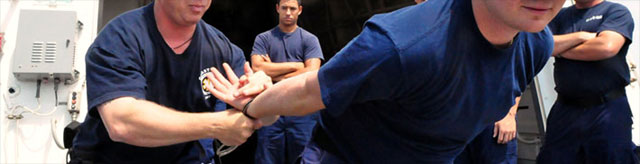
“It turns out that the “flow” of Aikido can be VERY EASILY adapted
to law enforcement as long as you train like you mean it.”
“But I do stuff different on the street than in the dojo.”
How many of us who live or work in environments that are physically threatening say that when we do something in the dojo, dojang, kwoon, etc. that it is not the same as in the streets? How many of us try a technique and our practice partner does something to counter it that’s “not Aiki?” Do we know how to react?
The quote above was said to me only a short time ago by a fellow budoka who happens to be a highly skilled police officer in the Central Florida area. I am very much aware as a former police officer and police trainer what his training was, and confident that he has learned well. Unfortunately, he has echoed a statement that I know as a professional trainer can be deadly. The NUMBER ONE RULE of almost any life and death situation is that good or bad, you ALWAYS fall back on your training. This has been demonstrated many times “on the street” and unfortunately, not every “good guy” has survived to tell the tale.
Aikido is unique among the “martial arts,” as it is an “art of peace.” Instead of trying to maximize damage or even “just restrain,” the aikidoka tries to help his “partner” achieve peace, or as said by the Aikikai, unify the body and spirit. Law enforcement officers and security personnel who have the authority and/or mandate to restrain individuals often take Aikido as an alternative to more “rough and tumble” arts in order to reduce personal and departmental liability and increase the likelihood that they will survive an encounter without resorting to lethal force. Aikido techniques however, even if done properly, may not take into account things like firearms (not the suspect/offender, but rather the officer’s sidearm), side handle/straight/collapsible batons, chem protectants (MACE, OC, etc.) and so on. Conversely, combining traditional Aikido techniques with modern “police techniques” may not work either, since most traditional and even more modern police techniques go against the “flow” or “spirit” of Aikido. As an example, the recent encounter I had with my police officer friend on the mat started out with me doing a combination throat and firearm grab (he is a right-handed officer, so my left hand went for his sidearm and my right hand went for the throat). He immediately went into an aiki technique, then changed up midstream and went into a protective lock where his sidearm was (for security purposes, I am leaving a description of the technique itself). Though he temporarily kept security on his “firearm” he’d forgotten that I was still at his throat and I “reminded” him by choking him, making him forget his gun hand.
Now I know what many of you are thinking… it’s only the dojo. Unfortunately, what he and many readers tend to forget is that if you are practicing Aikido, it’s for harmony and if you practice defensive tactics it’s for police work street defense*. Now before I have a revolt among the police aikidoka reading this, let’s think about something I said earlier: “the NUMBER ONE RULE of almost any life and death situation is that good or bad, you ALWAYS fall back on your training.” If you are a police officer who does Aikido, you have an AMAZING arsenal of locks and redirections you can use that are also very traditional. If you forget to think about weapon safety (or your instructor doesn’t know and accommodate your unique needs), you can end up being the best dead “aiki-cop” on the beat.
Now that I’ve thrown some cold water on you, let me offer some hope—lest you think that as a cop (or legally-armed civilian, military member, etc.) that all is lost. It turns out that the “flow” of Aikido can be VERY EASILY adapted to law enforcement (as many police Aikido instructors can attest to) as long as you train like you mean it. That means that at least for a while, there is a distinct possibility that the “art of peace” will have to become the “art of self preservation” (or isn’t that the same thing?). As an example, the next time you are tempted to handle an overhead strike with shomenuchi iriminage, try blending into a wrist technique then (if authorized with arrest powers) a handcuffing technique. Why not turn that combo gun throat grab into jujigarame or a comparable technique then go into handcuffing? In other words, work with your training, so when “it” happens, you’re better prepared. Also, you don’t have to “give up” on Aikido as being valuable in police work.
Keep in mind that these are only suggestions and if you are in law enforcement, you need to talk to both your police tactics instructor and your Aikido instructor for advice. If one or both aren’t receptive, don’t be afraid to do your own research, keeping in mind that you are responsible for knowing department guidelines and will be held liable for non approved techniques. It’s a shame to worry about the “legality” of self defense but for a police officer, it’s a fact of life.
“Train it like you mean it,” is a quote from Bob Elder, 5th Dan Toyama Ryu (and most likely many other instructors). That’s a good motto for men and women who put themselves on the line and who need to train hard. When it comes to combining law enforcement tactics and Aikido, the student/officer must train in the dojo, all respect to the beauty and harmony of Aikido, as Ueshiba O-Sensei, Takeda Sokaku and all the others who have had to know how to “protect oneself,” not just perform “joyful dancing” did.
Stay safe!
Note
I know many will disagree with this statement—even I disagree depending on my mood. The fact is however, that though one could argue that “living Aikido” would allow you to diffuse a dangerous situation before it becomes one, we are rarely able to maintain that state of calm in the presence of a gun or knife in the hands of a deranged individual. That (hopefully) comes with time, more training and positive introspection.
About the author
Mr. Estrella is a technologist, trainer and lecturer, specializing in technology issues within Native American tribes and organizations. He is also a lifelong student of the martial arts and is currently a student of Toyama Ryu Iaido, Nakamura Ryu Battodo, Icho Ryu and Daito Ryu. In addition, he a certified police officer, defensive tactics instructor and former Chief Investigator for a tribal police department. He has written for Aikido Journal and other martial arts publications and can be contacted at: [email protected]





Good afternoon.
My name is Vjeran Ivančević, I was 50 years, a martial art I practice for 35 years.
Aikikai Aikido studying for ten years and in the last 5 years I have 1-Kyu here in Croatia there is an alliance Aikido is at such a level that I would not want to comment but I would like to take the road which is mapped out and practically demonstrated Shoji Nishio. I have my own club, practicing Karate-do, and Aikikai Aikido techniques.
What is the time to join, or to enter into some sort of association that fosters Nishio Aikido? OSS
Train like you mean it. Yup. In a “real situation” you won’t often get much past the first or second move of a technique. Multiple person freestyle is about as close as we get on the mat. But people won’t fall down. Falling away from a strike isn’t taught in street fighting. You’ll either hit ’em (protect your hands), or they’ll duck, block or stumble away. Your atemi will have gained you time and space. It also gives “uke” something to think about. You may or may not find it appropriate to follow up with a controlling technique. Seems pretty obvious, but avoid sitting pins if you’re going to pin. The exception is if you want to “cuff ’em up”. In that case, please give some attention to the old timers who pin one arm, then pick up the offside arm and control both.
My “ahha” moment in applied aikido came with kaitennage. There are a bunch of atemi. It’s a “combination”. As such it is also in a way an answer to one of those pesky “what if” questions (what if your hit doesn’t stop ’em? what if they keep their hold and continue attacking?…). That also means that as interesting and aesthetically attractive as it is, it is limited to that question, or something closely related. Ikkyo, irimi nage and kokyu ho and nage answer a wider variety of “what if” questions… assuming you train like you mean it.
Pardon my coming at this from a different direction – or planet. I believe it was Shirata sensei who said, “He who studies Aikido will never have a fight.” The purpose of (at least some versions of) Aikido is “to become the kind of person to whom and in whose vicinity violence never happens”. Yes, things are different with a police officer but only in terms of frequency of potential incidents. Fall back on your training? I too came from a “hard arts” background as well as time with the Provost Corps (Military police) and in the few incidents in my life have managed to “baptize” the old, instinctual and often deadly techniques. A blow to the throat can easily become irimi nage; a dropped right arm to protect my sidearm can easily become a kansetsu waza. I would suggest that we practice primarily to change ourselves. When that is done then all reactions can become Aikido. And, yes, that does not happen with a year or two of weekly practice it takes time and hard work – but it is worth it!
in truth, Aikido teaches the circle of life, spinning planets do no harm to each other and are in harmony with the rest of the universe, in this way Aikido is the same and because there is no strength or strain in Aikido, Aiki practioners become one with the universal love of God for His creation, Ueshiba Sensei understood this and it is where the concept of ‘not having to fight’ comes from.
I liked your article. I think I understand what you wrote. If your aikido training is not true on the mat, it will never work on the street. I have seen and trained with many people who attest to be master of aikido, but train in a co-operative choreographed dance on the mat. This will most certainly not work out on the street. Looks pretty, and very much like dancing, but it is not aikido as I know it. Yet this type of co-operative and mutual “blending” has become so prevalent throughout the world. It only works if the attacker already knows the choreography beforehand. Many times I have found higher ranked aikido turning their backs on me expecting me to run around them to grab their wrist. Suicidal at best. I would prefer to just hit them on the back of the head, or choke them out. Where have all the real aikidoka gone???
At least at the introduction of rear attacks I like to show how to get to one from the front or side. It can start as a shomen-tsuki, transition to gyaku-te tori, then using the leverage that gives go for the other hand or strangle. You could equally slide your striking hand to nage’s shoulder and transition to ushiro ryo kata dori. Maybe later in the class that introduction can be abbreviated… or not. Whatever, make the “final” position as uke firm, controlling and as hard to counter as practical given everyone’s skill level. I think it was in my 3rd kyu test where the call was for a rear attack, but, to everyone’s amusement, I made it difficult for my uke to get to my rear. That’s where the controlling aspect of grabs can help.
Oh. If as uke you spin nage too vigorously beware of a kick to the rear from his unengaged side. That might not be common in most aikido schools, but it is an excellent way to achieve an early advantage. I don’t usually prefer it myself. I’m not flexible enough and the kick usually affects my balance too much. If the kick doesn’t connect, uke has yet more control. A back knuckle punch usually serves me better. These things are tedious to explain in detail. Play with ’em.