
 Josh Gold
Aiki News #99 (1994)
“Foreigners are at no particular disadvantage in grasping the “essence” of
aikido, even though they may have no knowledge of the Japanese language.”
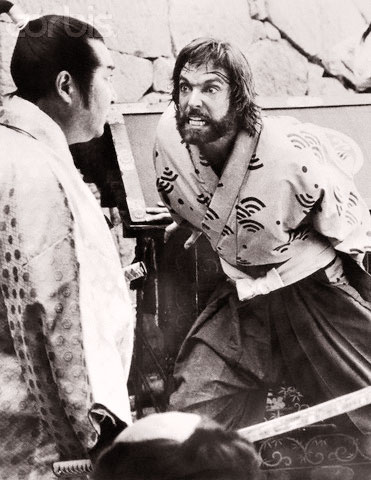
in the 1980s tv move “Shogun!
The other day I received an anonymous letter that was critical of the grading practices of certain Japanese shihan teaching abroad. The writer lamented that the shihan in question had chosen favorites among their foreign students for rapid promotion while overlooking other more deserving senior students. The overlooked foreign teachers “need the recognition of rank” states the writer, because their competitors in other martial arts have higher ranks that they use “to sell their art to prospective students.”
First of all, I would advise people who agree with this viewpoint not to worry so much about high dan rankings as a prerequisite for succeeding as a martial arts instructor. Prospective students will be much more impressed by skilled and articulate instructors operating clean, professional facilities than by those who merely claim high ranks to attract students or who bill themselves as “Oriental experts.”
But my main purpose here is really to bring up the subject of a mentality prevalent abroad concerning Oriental martial arts instructors. For want of a better term, I will call it a “gaijin” — the Japanese term for foreigner — complex. I think this is clearly a factor in the mind of the letter-writer, who though critical of the Japanese teachers, still seeks their recognition. This mindset clings to the idea that Japanese, and Orientals in general, possess some sort of innate affinity for martial arts which enables them to achieve superior skill levels compared to Westerners. Naturally coupled with this way of thinking is the assumption that Oriental teachers have a deep understanding of the esoteric aspects of their arts to which foreigners may only aspire with great difficulty.
In the case of aikido, it was of course Japanese instructors who were the major forces in the popularization of the art in the West starting in the 1950s through the 70s. It goes without saying that, in addition to their superior technical abilities, the early Japanese shihan were the most qualified to articulate the spiritual side of the art since they had trained directly under the Founder, Morihei Ueshiba. Those of us practicing back in the 1960s, I think, automatically assumed that the few Japanese we encountered — even when they held the same rank as we did — were more highly skilled. I suspect that this attitude became ingrained in our minds and that we unconsciously passed it along in turn to our juniors.
Today, the situation has changed considerably. As I have pointed out in an earlier editorial, Japan is now third in terms of numbers of aikido practitioners worldwide, mainly due to the small number of full-time, professional dojos teaching the art in this country. Not surprisingly, there are many more skilled foreign teachers abroad now than in Japan because these individuals spend many hours a day on the mat and derive their livelihoods from teaching. Their Japanese counterparts are usually salaried workers who practice once or twice weekly as a hobby. Their level of commitment is far less, except for the most senior shihan who have been active for decades.
Although I confess I have not done a numerical comparison, I am also convinced that the number of books being published on aikido in English, for example, far exceeds the number appearing in Japanese. Moreover, we have seen further evidence of an acceleration of the growth of aikido abroad compared to Japan in our publishing business; the number of readers in Western countries has grown to nearly three times the figure for Japan. This trend shows no sign of abating and, though Japan will always remain the spiritual center of aikido, its most vigorous forward steps into mainstream culture are being taken in Western countries.
Going back to the letter I mentioned earlier, if those holding these views toward the Japanese shihan are truly dissatisfied with the status quo, my advice to them would be to consider declaring their independence from the organization that they feel has neglected them. The days when one was forced to seek out a Japanese teacher to obtain quality aikido instruction are now long past. There are many non-Japanese instructors who have attained high levels. In many instances, foreign teachers are better equipped to convey the message of aikido due to their strong professional and academic backgrounds, not to mention the fact that they are teaching in their mother tongue.
Also, on a philosophical plane, many foreign aikido adherents have “got” the Founder’s message about aikido as a vehicle for achieving the peaceful resolution of conflict. O-Sensei’s views form an integral part of their teaching and this emphasis is one of the unique points of aikido that sets it apart from other martial arts. In fact, I find much more interest in Morihei Ueshiba’s ethical doctrine among foreigners than among the Japanese. Remember that, despite the fact that aikido is of Japanese origin, the Founder’s views were expressed in a colorful, metaphorical language, peppered with specialized religious terminology that was completely incomprehensible to modern-day Japanese. Many of the Japanese shihan we have interviewed over the years have plainly stated that they were unable to understand his “lectures,” and were anxious for him to finish talking so they could resume training. I have had similar experiences when posing questions about the Founder’s religious beliefs. Most of the interviewees respond only in vague terms about such esoteric subjects, or frankly admit they were unable to follow the Founder’s speech.
The upshot of this is that, in one fundamental sense, foreigners are at no particular disadvantage in grasping the “essence” of aikido, even though they may have no knowledge of the Japanese language. The secrets of aikido reveal themselves to serious practitioners through the practice of the techniques themselves. I think aikido is really about developing a centered awareness within oneself and extending this presence powerfully in one’s immediate environment. This can be achieved by practitioners of any nationality and is not dependent on membership in a given organization or study under a Japanese shihan.
Stanley Pranin, editor-in-chief and publisher of Aiki News, which he established in 1974 in an attempt to provide accurate information for English-speaking aikido practitioners. He began his aikido training in 1962 in Lomita, California, and is now 5th dan. Since 1977 Pranin has lived, trained, and worked in Japan. He publishes a separate Japanese edition of Aiki News/ as well as a variety of aikido-related books. He is the author of The Aiki News Encyclopedia of Aikido, editor of Aikido Masters, and co-author of The Aiki News Dojo Finder.






I am in agreement with you as a Birankai USA student I have watched the level of our American Shihjan and Shidoin rise consistantly for about the last ten or so years. What I can say is that Chiba Sensei has raised the bar quite high . I have also met very high level American instructors from the USAF as well as insturctors from Japan. The levels are very similar these days. Just my personal opinion.
Let me start this by stating that I am new to Aikido and my opinion is based on my limited teachings and understandings so my response may be a bit naive. One of the things that attracted me to Aikido was the “no competition” aspect. You are either a white belt or you are not. We are all equals. To my understanding, this is one of the things the founder stressed in his teachings.
Aikido is not an easy path especially for those like me who are goal centric. Always striving for the next level, the next seal of approval. It took me several years to realize that aikido is about improving myself and improvements don’t always need to be another belt. It’s the little wins that make me happy now. The right placement of my hand doing Ikkyo, the good Ukemi I take, the partner I flow with naturally in a dance. These are the things we need to remember as we practice Aikdo. Sometimes, you simply need to recognize yourself first and then the rest will follow.
Perhaps the writer of the original letter forgot some of these things. An instructor with a passion for his craft, will attract the students. Personally, I would rather be taught by a person with passion then a person rapidly promoted through the ranks. I wish the writer well and hope he finds what he is searching for.
Stan,
Re: Gaijin Complex
What a great and insightful article. Even in the 70’s, Mr. Sugano, when students would asked him to sponsor them so they could get a visa to live in Japan, “to train better aikido” (thereby in my view insulting his superlative and dedicated standard of instruction) would respond cooly, “What for? The standard is higher here,” thereby in riposte praising our dedication to the art.
Of course we were incredulous, all being smitten with the glamour of distant old Japan that we mostly got from the movies and books. When they asked him why, he simply replied, “Japanese are busy trying to become westerners and more interested in Armani suits and the stock market. They’ve lost interest in the old ways. Whereas you guys are all trying to become samurai and striving to that goal very well…”
And so the natural outcome appears to be bearing fruit.
Good reading.
Thanks,
Nev
If someone continues to practice a martial art, whether or not it’s Aikido or any other martial art, after many years, they would rarely remain for the rank and status. Maybe a few, but not many. There comes a point where you realize what is truly important for you, what truly matters to you. Despite my sincere respect for ranking system, it’s not ultimate judge of mastery. I have known many martial arts practitioners who are deeply humble in their belief that they still need to continue learning in their own practice. They wake up each day and step on the mat looking forward to discovery of that tiny little tweak of the wrist that makes technique a bit better today than it was yesterday.
Ranking system at best is designed for teacher’s use and evaluation and use in practice for better organization of learning a skill. That said, I do believe in honorary ranking as opportunity to show respect for the specific individuals who made tremendous contribution to the art.
Stan thank you for another fine article. I agree one just needs to look at the testing standards in Japan and compare them to standards else where. G. O Connor, R.Stickles, C. Tessier Sensei’s just to name a few. The list goes on.
As a American Japanese I began my Aikido in 1970 under Sadao Yoshioka 8th Dan. and T. Ishida 8th Dan. To me Aikido was training under my teachers practicing 6-days a week and supporting myself in the process. I was influenced by the many Shihan that visited Hawaii back in those early years. Doshu & Waka K. Tohei, Osawa, Masuda, Tamura, to name a few. But after my teacher Sadao Yoshioka passed away, my vision of Aikido changed I had to look at myself. All those years and now my teacher was gone. I felt like a “Ronin” I would attend many seminars where visiting instructor from Japan would teach at the Aikido of Honolulu. I was fortunate to have all these high ranking instructors teach in Hawaii. O Sensei said Hawaii is a stepping stone for Aikido outside of Japan. a path to spread aikido all over the world. I’m still walking that path and the essence of my Aikido experience is one of many in the world today.
With the hundreds of thousand practitioners through the world today, the art of Aikido is still one of many Japanese martial Arts that is still flourishing today. Remember don’t forget your Basic training. It’s like a circle of life, a beginning and no end.
Mr. Pranin, do you still agree with everything you wrote then or would you write it differently today?
Patrick Augé
Since 19 years have elapsed, I surely would have written some different things today. My perspectives in the article come from having lived about 18 consecutive years in Japan. That would be the major difference.