
 Josh Gold
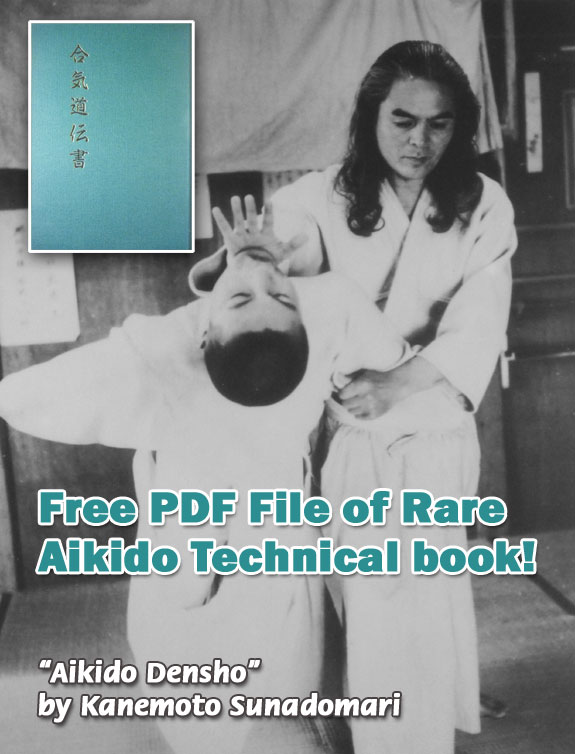 We are pleased to announce the archiving of an almost totally unknown training manual compiled by Kanemoto Sunadomari, Morihei Ueshiba’s biographer. Kanemoto Sunadomari was from a family of devout Omoto believers and was the elder brother of Kanshu and Fukiko Sunadomari. He began his training in an earlier form of aikido in 1928 after observing a demonstration by Aikido Founder Morihei Ueshiba in Ayabe.
Kanemoto maintained a long relationship with Morihei that lasted until the end of the latter’s life. In 1969, he published the first biography of Morihei Ueshiba O-Sensei after having conducted research for many years and gathering documents with the assistance of his siblings. Kisshomaru Ueshiba cites passages from Sunadomari’s book in his later biography of his father published in 1977.
Given the time frame of Kanemoto’s study under Morihei Ueshiba, the techniques covered in this manual reflect an early stage in the development of Morihei’s art. As such, this technical volume warrants a thorough study along with such documents as the Noma Dojo photos series and the 1938 training manual “Budo.” Quite a number of the techniques covered in this book are no longer practiced in mainstream aikido, but will be familiar to students of Iwama Aikido curriculum.
We invite members of the Aikido Journal readership to download this 80-page training manual in PDF form to peruse its contents. From there, we would be interested in hearing your feedback concerning the book’s content. We offer this manual free to all readers through Friday, December 16, at which it will become part of our permanent archives.
Download the pdf file of Kanemoto Sunadomari’s “Aikido Densho” by right clicking on the link below:
pdf/kanemoto-sunadomari-aikido-densho.pdf,link
Access: Free through December 16
Download size: 5.8 mb






Hi Stan,
Very interesting.
What was the year of publication ?
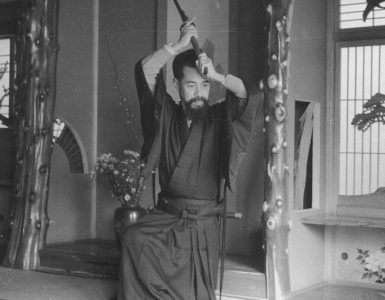
The date of publication is given as May 1993. I don’t know if this is a reprint of an earlier book or not. I never met the author as my association with members of the Sunadomari family began after his death. Kanemoto Sunadomari does appear to be quite young in these photos. It may be that there were shot earlier but never published. I’m sure I heard the story, but I don’t remember it. I believe his son may be still active. Given some time, I can probably find out more about it.
What a remarkable document. One sees techniques similar to those of the Noma dojo photos. It is interesting, even in the still photography, that one can observe Sunadomari lacking the power and integration of Ueshiba. Also, note that many of the techniques we are now familiar with are unnamed (tenchinage, kokyunage for example – and others, such as “aikinage” are attached to other techniques.
Finally, one intriguing question arises. This looks like a reprint, published in Heisei 5. It is entitled Aikido Densho. But this is also the title in the text as well. When was this book originally published. Sunadomari appears quite young. If this was originally published in the 1930’s, for example, it would be an earlier use of the term aikido than all have previously thought.
I’m pretty sure these photos were taken in the postwar era, but Kanemoto Sunadomari began his study as a teenager in 1928, or so I am told.
This is fantastic Stan. When was it published?
The techniques illustrated could have come straight out of the curriculum as Shirata taught it. The first technique is very telling. The only things he doesn’t show are the stomp to the groin and the full pin. Very exciting!
Thanks for sharing, very interesting!
What a precious document! I think, without doubt it clearly depicts techniques of prewar aikibudo as seen in Noma dojo series, no doubt. However the obstacles for deeper study of the techniques as reference to original prewar Ueshibas art is, not enough photos for each technique, and somewhat not precise execution of waza (truly, there is no match seen anywhere of precision, vigour and deep mastery of the art as in Noma dojo with Ueshiba Morihei demonstrating himself !), and maybe Japanese language. The other very valuable document of this sort would be the Soden of Takuma Hisa (especially volumes from 1 to 6), i very hope to see it and study one day. Thank you, Stan, very much for sharing this one with us. I believe there are many who really enjoy documents like this.
Nice manual with atemi…a rarity in today’s Aikido world… Thanks Stan!
Once again, Pranin Sensei, you are making a great contribution to Aikido history.
Thanks for sharing…!!!
Thanks, Sensei Stan, clearly resembles the techniques seen in the book Budo ! such rich hard to find documents of Aikido truly coming from a chronicler who knows the art and where it came from.
Ouaooh! THANK YOU so much.
Fascinating book and photos that worth to look carefully! As you said, many similarities with Iwama techniques in numbers of points. (p. 77, for example, just to take one)
BTW, does someone know the name of the grabbing p.74 ?
(ushiro ryo karatedori, then hands are pushed up)
SAITO Sensei shown quite the same grabbing, but with thumbs up, little finger down:
ftp://ftp2.aikido-france.net/aikidofr/video/aikido-iwama-ushiro-saisies.mpg
Thank you!
Yes, thank you very much Mr. Pranin.
This is very special, again as all your research and publication is. Since years I’m an avid reader of yourarticles, and of course, of many articles of all the other authors on your web-portal.
Really great. Thank you again.
Guido from Germany
Another wonderful gift. Thank you, Pranin Sensei!
I will be very interested to read this.
Thanks so much.
Hello Stan.
Thank you for sharing this precious gem, of history, lost knowledge and skills.