
 Josh Gold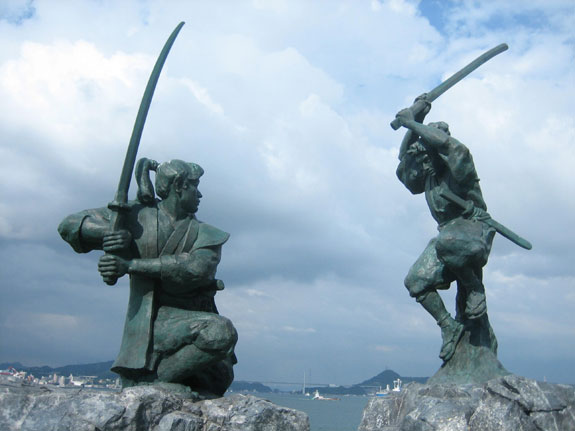
From Aiki News #95 (Spring/Summer 1993)
This essay has been edited with the help of Fumiaki Shishida of the Japan Aikido Association from tapes made during Aiki News interviews with Kenji Tomiki Shihan in 1979. Tomiki describes the evolution of the martial arts and stresses the historical inevitability of competition to keep these arts alive. He also emphasizes the need to look at budo from a broad educational perspective so that its essential value will be preserved and can be spread throughout the world.
From live blade to kata
The Japanese fought with real swords up until the beginning of the Edo era. Those who are known as the founders of various schools of swordsmanship, such as Musashi Miyamoto, Sekishusai Yagyu, and Tajimamori Yagyu, grew strong and cultivated their abilities by using their skills to kill.
The famous duel on Ganryu Island between Musashi and Kojiro Sasaki is one example. Kojiro was, despite his youth, one of the best swordsmen of the western region of Japan, while Musashi, though a middle-aged man, was known to be the best in the eastern region. People were curious about which of the two was strongest, and so the duel on the island was set up.
This contest was similar to a modern sports match. Two excellent men challenged each other for the right to be known as champion. However, they used real swords and unfortunately young Kojiro was killed. Musashi, on the other hand, survived and became famous. Survivors such as Musashi became the masters of various schools of swordsmanship. It is not possible to know one’s true martial ability without fighting. During the peaceful days of the Tokugawa Shogunate, the government issued an official notice prohibiting such violent killings. Thus, swordsmen began to practice kata [forms] exclusively.
When you train in kata you must release your strength at the very last moment. It is permissible for the swords of the opponents to knock against each other, but one must stop just short of killing his adversary. Thus, it is necessary to practice the basic movements for a long time before beginning to train in the actual kata. One must be able to stop the sword no matter where it is. It is dangerous to attempt to practice the kata before having learned the basic movements. Once the basics are learned, the teacher will then instruct the student to strike at him.
Kata practice used to be conducted like this. Suppose you were a student [in the early Edo period] and I were your teacher. [When executing a kata], you would have to stop your wooden sword at precisely the right place when you came to strike at me. If you didn’t move sharply you would get cut. I would tell you to repeat the movement or to move forward in short, you would practice until you were drenched with sweat. Then I might tell you to strike my kote [wrist]. If you became confused by this instruction this would be a sign you were not yet good enough. You would have to practice hard until you were able to match swords without any mental agitation. At that point you could be regarded as having mastered the kata. The teacher would then invite you to strike him anywhere since you would have mastered all of the kata over long years of practice. He would then advise you to test your sword skills. In Japanese, this is known as kokoromiai, to test one’s ability. People would do this with either wooden or real swords, since protective gear had not yet been invented.
Kendo becomes a sport
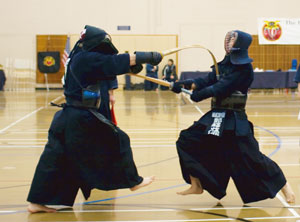 Shinai kendo, or sports kendo, came into being in the middle of the Edo era. This was during the Shotoku era [1711-1716], over 260 years ago. Shinai [bamboo swords] were used because the wars were over and it was a time of peace. Since the mid-Edo era, however, people often waylaid passersby to test their sword skills in actual situations. As we see on historical dramas on television, they would waylay samurai, taking advantage of darkness. If they were not lucky, they were killed. The use of the shinai did not mean that participating in contests was wrong, but that teachers wanted to keep their students from injury or even death. [Note: after the middle of the Edo period, contests which resulted in injuries or death were prohibited. The samurai began to practice only kata. When they could no longer train for matches they had no way of testing their true abilities nor could they experience the essence of technical principles. As a result, their skills degenerated. In order to correct this, shinai kendo, or midare geiko [freestyle practice] in jujutsu, were developed. This is the beginning of competition in the martial arts (from Budoron, a collection of Kenji Tomiki’s essays, published by Taishu-kan, p. 21-22)].
At that time swordsmen only practiced kata and were forbidden to kill since human life was considered important. I think this is a characteristic of Japanese martial arts. Kendo’s ultimate secret is found in not killing. Religion of whatever variety teaches the value of human life. When an educated person of common sense has become skilled, or in other words, has attained mastery of the innermost secrets of swordsmanship, he comes to believe it is better not to kill others. Even though the techniques allow one to instantly kill an opponent, the swordsman concludes that it is better not to do so. We can find this recorded in the transmission scrolls of some classical martial arts schools. For example, mutodori [no-sword technique] is one of the secrets noted in the transmission scroll of Yagyu Shinkage-ryu.
Peacetime iaijutsu and the seated techniques of jujutsu
In Japanese swordsmanship a person can completely defend himself using only a sword. Ushiwakamaru immediately blocked Benkei’s strike with his naginata [see editorial, p. 5]. A skillful swordsman can use either a short sword or a long sword. He can, wielding a jutte or iron stick, control an opponent attacking from any direction. This is kendo. The principle of kendo is to defend yourself using a sword wherever or however an opponent comes to attack.
Iai [sword-drawing] was developed during peacetime. Warriors were clad completely in armor during the era of Hachima Taro Yoshiie [1039-1106], or in the Kamakura period [1185-1333] or the War of Kawanakajima [1555-1561]. In those days, as we read in the old war stories, warriors would grapple, jostle and pin down their opponents in order to finish them off with a stab. Sometimes captured warriors were held as hostages, and the fight ended when a samurai was subdued. Samurai did not necessarily use swords for the entire duration of a fight. Beginning in 1543 when the Portuguese brought matchlocks to Tanegashima Island, the methods of war changed. Nobunaga Oda, an outstanding warlord, formed a matchlock brigade, and had half of all of his troops use them in the battles of Koehazama and Nagashino. The opposition’s armor was useless against the firearms. After that time warriors began to wear less armor.
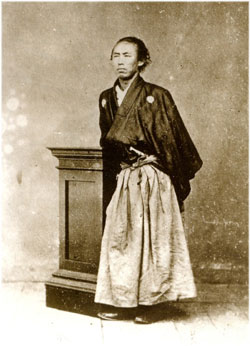
When peace came the samurai no longer wore protective equipment. For example, Ryoma Sakamoto [1835-1867, important political figure of the Meiji Restoration] was killed at an inn while drinking tea, by an assassin charging at full speed down the corridor. What could he have done to defend himself? If he had had a sword, he could have cut the assassin’s leg before the assassin could slash at him. That is iaijutsu. Iai was developed long after peace had been established.
On the battlefield, iai was hardly necessary. During the Edo period, people who practiced jujutsu emphasized seated techniques. From the historical point of view we can say that goshinjutsu, or the art of self-defense, is protecting oneself against any attack at any time, and from any direction. There is no Japanese martial art which does not include an element of self-defense.
Battlefield martial arts and defensive martial arts
Japanese martial arts can be divided into two categories, battlefield martial arts and those used primarily for self-defense. The first were used during wars over political or ideological differences between provinces, while the latter were used to cope with violence and as legitimate civil self-defense. Although one should not try to kill an attacker even in self-defense, there are situations in which it is necessary to do so to save one’s own life. This is the purpose of defensive arts.
Self-defense as safety education
There are no prearranged situations in the martial arts. You must be able to defend yourself from any attack. In Japan, swimming was also considered to be a martial art, as it was a necessary skill for samurai during wartime. In peacetime, people die by drowning. When typhoons or tidal waves occur, or in a shipwreck, swimming is very important and could save one’s life. Thus, it is now taught as a part of safety education. Another example is sports, which are now a part of the educational curriculum. Participation in sports sharpens children’s senses, and this can be useful in preventing, for example, traffic accidents. Many victims are the aged or youngsters, whose legs and hips are weak. Practicing sports is, in a sense, an art of self-defense. You can die by falling from a rooftop if you are hit in the wrong place. You can slip and incur a concussion. Thus, ukemi [falling] can also be seen as part of the art of self-defense. We must view physical exercise in this broad way; aikido and judo also include these aspects.
Dislike of violence, but not of people
Moreover, the best part of practicing martial arts is that you learn good manners. This is also a form of self-defense. For example, if you were to hear someone dashing down a corridor intent on killing you, you could freely avoid the attack the moment the assailant entered the room. On the other hand, if it turned out to be an acquaintance, you would politely ask him to come in. The movements of Japanese etiquette and the basic postures of martial arts such as kendo, judo, and aikido correspond, and this was noted in the Edo period by Sogyo Yamaga in his Bukyo Shogaku [A Buddhist Primer] and in the Bukyo Zensho Koroku [Compendium of Buddhist Studies] by Shoin Yoshida. Etiquette is preparedness. It is the way you show your respect for another person. Budo holds at its core respect for the character and humanity of every individual. So if you have truly understood budo, you will naturally not dislike a person, but rather his violent conduct. For example, there are some Chinese-style documents which were transmitted in the Yoshin martial tradition, which was the basis of Tenshin Shinyo-ryu jujutsu. “It is a secret technique of this school and it may kill an opponent who is wielding a sword or a spear. Therefore, not winning means death. This jujutsu will kill the opponent’s bad spirit but not his innocent body.”
People used to consider such deep philosophical points. Truly excellent martial artists are not proud of their strength and are not haughty. Martial arts are not that simple. Most people consider the sword to be a weapon and try hard to kill the enemy once they become soldiers. True leaders are not like that. Therein lies the difference between violence and martial arts. It is a part of traditional Japanese culture. This philosophy is a universal one and we should drive out violence by disseminating such ideas throughout the world. It is important for the just man to attempt to confront violence while cultivating his own mind.
Martial arts and faith
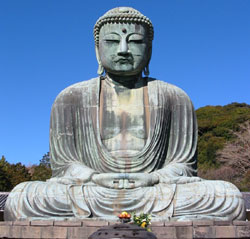
The reason Shakyamuni Buddha founded Buddhism was that all men’s lives end in death. He himself was born a prince. He suffered no material inconveniences and he had a family. He led a fulfilled life until the age of twenty-nine, when he suddenly realized that he had to solve at any cost the problem of death. He had been a precocious child. When he was four or five, his father took him to a field where a farmer was working. An insect emerged from the earth and when he rushed towards it, it scurried quickly away. According to his autobiography, Buddha pondered the fact that creatures kill one another. He believed in the survival of the fittest, as now espoused by the theory of evolution.
As a prince he had never suffered.
Once when he was out in the town, however, he saw the aged, the sick, beggars, and death. These are things which human beings cannot avoid; all of humanity is subject to these four afflictions and unless one can transcend them, one cannot lead a whole and peaceful life. These thoughts led to the foundation of his teachings, which formed the very basis of Buddhism. From that standpoint, Buddhism is interesting.
In any event, death awaits all human beings. Martial arts are designed to cope with any kind of dangerous attack, with situations in which you are directly facing death. How can you confront your thoughts about death? Most people are terror-stricken. In order to overcome this fear you need to not be afraid of the idea. Then you will ultimately have faith.
Deepening of skills- Starting point of competition
Competition in grappling is not the same as track and field, or swimming competition, because you need an opponent. I believe that we can never become accomplished in our training unless we can find a way to defeat an opponent who moves and resists at will. I have many friends who are kendo and judo experts. I believe that we must find a way to train so that we can have competition in aikido. Otherwise we will never be able to convince experts of other martial arts [of the efficacy of aikido]. I think that the content of aikido is superior to that of judo, both in terms of health and technique. If we can develop a safe way to have competition, I think our technical understanding will become deeper. I’m afraid that this idea is not completely approved of by those at the Aikikai. I think this is unfortunate.
Nothing will change if I am the only one to insist on this approach. I hope my ideas can be demonstrated by young people who will continue the search and make improvements on what I have studied. If my ideas are right, they will spread naturally and contribute to the betterment of aikido as a whole. My thinking is that I don’t want to do anything which causes confusion in the aikido world.
The foundation of martial arts’ kata
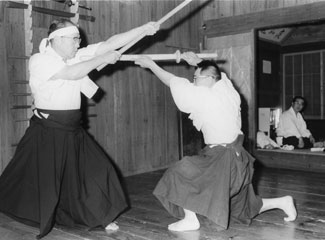
If you were to do judo without clothes, it would look like sumo. I mention this idea because I would like judo practitioners to recognize the error of their ways. What happens if you meet a naked opponent? You would be better off using joint and arm techniques as we do in aikido. In earlier times in jujutsu the techniques which comprise present-day aikido and judo were mixed together within a system, but they are now classified separately just as iaijutsu and kenjutsu have come to be separate. For example, ninjutsu consists of arts similar to gymnastics, rock climbing, and grappling for escaping. What we now must aim at is to discover how we can allow people to practice the old techniques safely. In the absence of actual fighting and real blood, we must study the deeds of the great martial artists of the past, with the help of modern scientific knowledge. Then I think we will come to the conclusion that competition is necessary. However, even competition can include only portions of the old technical repertoire since it is constricted by rules, and the remainder of the curriculum should be learned through kata training. The kata invented in times past are superb. They are not dangerous, even when you use a real sword. Therefore, we must not forget to practice kata, which preserve the basic framework and structure of the techniques.
For example, looking at the architecture of different cultures by way of example, Japanese traditional architecture uses different types of framework and structures compared to its Western counterparts. In Western fencing, unlike in kendo, shields are held in the free hand for defense. Instead, in Japanese swordsmanship we must defend ourselves only with a sword. At the same time, we attack with this sword. Thus, fencing and kendo too are different insofar as concerns their basic forms. For example, ex-wrestlers like Geesink [Anton, winner of a gold medal in judo at the 1964 Olympics] or Ruska [Wilhelm, Geesink’s student, gold medalist, 1972 Olympics] who wore judogi and did judo following its rules beat Japanese judoka. They shook the basic structure of judo, which has come to the point where it cannot ignore their innovations. If an opponent kicks or punches at you, you cannot maintain your posture. It is necessary to study techniques to cope with boxers, karate practitioners, and wrestlers. The structure of judo has become too much like wrestling, and the competitors’ postures are no longer upright. We must always remember to continue to reflect and study further.
Degeneration of kata
If martial artists train only in kata, however, their movements will become like those of the samurai in fighting scenes on television. Even when a main character allows his back to face his opponent, he will not be attacked. People who concentrate only on kata practice tend to lose their alertness. If they were attacked seriously, they would have to block or deflect the opponent’s sword sideways. In a fake situation the opponent does not try to thrust his sword right at you. Thus, people become complacent if they do not have serious contests. One should not practice a martial art in such a lenient fashion.
For example, pro-wrestling shows are the same as stage plays. The wrestlers can impress their audiences with their grand builds, but what they do is fake. There is no resistance on the part of the wrestler who is thrown to the ground. Then the other opponent waits around to be thrown in return. They just follow a specific plan for the match. Although they do not do any of the techniques seriously, amateurs can’t recognize this. Budo will, like pro-wrestling, end up being merely demonstration if we become too complacent and practice only kata. This actually happened during the Edo period, and the effects were later corrected through the invention of shinai. I believe that training in both kata and randori competition is essential.
To be continued
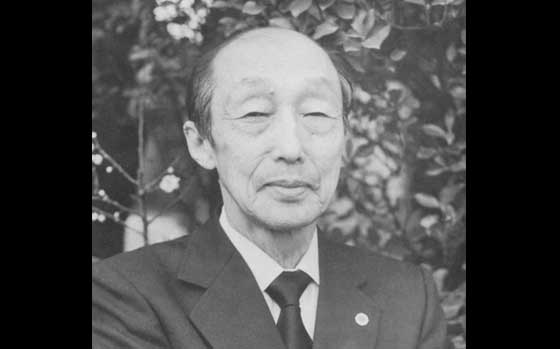 Kenji Tomiki was born in Kakunodate, Akita Prefecture on March 15, 1900. He was the founder of the Japan Aikido Association (JAA), known in the West as Tomiki Aikido.
Tomiki joined the judo club while a student at the preparatory school of Waseda University. He also attended the Kodokan where he was greatly influenced by the educational ideas of Jigoro Kano, founder of judo. He first encountered Morihei Ueshiba Sensei about 1925, and continued training under the founder of aikido at regular intervals until relocating to Manchuria. In 1936, Tomiki became a lecturer at Daido Institute in Manchuria and in the spring of 1938 he transferred to Kenkoku University to teach aiki budo, which had been newly added to the curriculum there. After the war in 1949 he started teaching at Waseda University in Tokyo and became a judo shihan in 1951. He established the Waseda Aikido Club in 1958. During this period, he made great efforts to devise a competitive form of aikido patterned after the judo principles of Jigoro Kano. Tomiki died December 25,1979 in Ogikubo, Tokyo.





There’s a mistake concerning Sakamoto Ryoma’s death. When he was attacked by members of a shogunal police corps in the night of november 15 1867, he was ill.He had a sword, but too far from him, lost time grabbing it, and just tempted to block an attack with the sword’s scabbard. Nakaoka Shintaro, who was with him, was mortally wounded too. His sword was far from him. He would have said friends, before dying the day after:”Not have my sword at hand was a mistake.Be sure not to do the same”.
Usually, Sakamoto Ryoma carried just one sword, because he had a 22. caliber Smith & Wesson revolver
he had been offered. It had helped him ounce, but he had forgotten it in the village he was born that he visited some time before.
Yours Jean-Claude Meot
Great article, but I wanted to point out a little inconsistency in data:
“People were curious about which of the two was strongest, and so the duel on the island was set up. This contest was similar to a modern sports match. Two excellent men challenged each other for the right to be known as champion. However, they used real swords and unfortunately young Kojiro was killed.”
Not quite accurate. Musashi was actively challenging swordsmen all around Japan, and challenged Kojiro, as he was one of the last skilled fighters around. It’s not that it was “set up from the outside”, so to speak, but rather that Musashi sought him out.
Also, Musashi actually used a wooden (or was it bamboo? Can’t quite remember!) sword, not a “real sword”, and quite brutally pummelled Kojiro to death.
This is correct. I used to throw around my Aikido partners with judo techniques I learnt 15 years ago, in an informal randori after our training. They just didn’t know how to react or defend themselves in such a situation.