
 Josh Gold
The term kiai is sometimes talked about in conjunction with aikido training and refers to a “combative shout” used to disrupt or neutralize the attack of an opponent. The use of this powerful vocalization technique corresponds to the exhalation of breath and concentrates the body and spirit of nage at a specific point. The end result of a well-executed kiai is a disruption of uke’s ki flow and a dissipation of his attack. Often uke’s movement will be frozen for a brief instant thus presenting nage with an excellent opportunity to apply a technique.
O-Sensei frequently used kiai as a tool to set up and control his uke. He used it particularly often when demonstrating with the sword. Ironically, the Founder’s use of this technique is so effective that his uke’s attacks often appear half-hearted because they have been interrupted by his well-timed kiai.
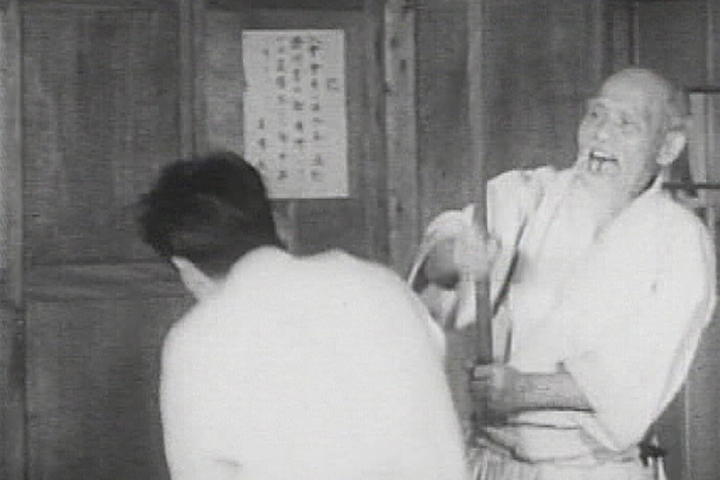
The Founder can be seen applying atemi or “preemptive strikes” right up until the end of his life. But today, atemi have fallen into disuse in aikido. I believe this is due to a misunderstanding of its purpose. Atemi is an action used to preempt uke’s aggressive intent through a distractionary manuever in the form of a strike. The use of atemi is not for the purpose of hitting or “softening up” uke prior to performing a technique. Its role is similar to that of the kiai in that it disrupts uke’s concentration.
Beyond “Sensen no Sen”
A traditional explanation of strategies in a Japanese martial arts context often involves a discussion of three levels of combat initiative: “go no sen,” “sen no sen,” and “sensen no sen.” These strategies are defined as follows: “Go no sen,” meaning “late attack” involves a defensive or counter movement in response to an attack; “sen no sen,” a defensive initiative launched simultaneously with the attack of the opponent; and “sensen no sen,” an initiative launched in anticipation of an attack where the opponent is fully committed to his attack and thus psychologically beyond the point of no return. The latter strategy is generally considered to be the highest level in the classical martial arts scenario.
The Founder’s concept of aiki strategy goes far beyond the dimension of psycho-physical confrontation. In an interview conducted in 1957, he expresses the concept in these words:
“It is not a question of either ‘sensen no sen’ or ‘sen no sen.’ If I were to try to verbalize it I would say that you control your opponent without trying to control him. That is, the state of continuous victory. There isn’t any question of winning over or losing to an opponent. In this sense, there is no opponent in aikido. Even if you have an opponent, he becomes a part of you, a partner you control only.”
The key concept here is that what would normally be construed as a physical confrontation with a would-be attacker is reframed as a harmonious interaction. Uke’s fighting impulse has been overcome and enveloped with love. In other words, the goal is to live one’s whole life on a different plane of consciousness in harmony with one’s surroundings and the people one meets. Seen in these terms, aikido becomes a metaphor for living in peace while possessing the skills necessary to neutralize and win over a violent opponent.
This is a high-level ideal that is attainable only through long years of training to develop a heightened sensitivity to people and happenings in one’s surroundings. It further involves developing a set of spontaneous skills consisting of physio-psychological responses suited to any conceivable kind of human interaction. The Founder described this state as “Takemusu Aiki”—the highest level of aikido where one is capable of spontaneously executing perfect techniques in response to any circumstance.
Ame no Ukihashi
The Founder saw the world from a Shinto viewpoint and was especially influenced by the Omoto religious sect. One of the expressions he used frequently in reference to his role as the creator of aikido was “Ame no Ukihashi.” This means literally the “Floating Bridge of Heaven.” It is the bridge that connects Heaven and Earth. Therefore, standing on Ame no Ukihashi means standing between Heaven and Earth. In the Kojiki, the ancient Japanese chronicle, it is recorded that two deities stood on this bridge and started their first work of creating countries (islands).
This Ame no Ukihashi—the link between Heaven and Earth—was located wherever O-Sensei might be at a given point in time executing works on behalf of the kami or deities to bring about a harmonious, peaceful world. In other words, this is the mission of aikido. O-Sensei’s elaborate jo kata consisting of up-and-down and spiraling movements that he would perform at demonstrations symbolized this link with divine energy emanating from the heavenly sphere.
Up and down, to and fro
The Founder was adept at dictating the terms of a would-be attacker’s movement. Among the ways he would achieve this end was to execute various body manuevers with exquisite timing just before an attack. Using up and down, side-to-side, and slipping movements, he was able to make it virtually impossible for an attacker to launch an aggressive movement from a stable posture. Uke’s mental composure would be disturbed through such leading movements to the point he lost any will to attack.
Sometimes the Founder would raise his arms high up or even leap into the air as he approached his partner leaving the latter virtually helpless as he tried in vain to muster an attack.
Leading and redirecting
The Founder made frequent use of arm extensions and circular hand movements as a prelude to physical contact with his uke. Such leads served the same effect as the body shifting movements described above. The attacker’s attention would be drawn to the Founder’s hand and arm motions and any impulse on his part to attack was preempted. These leads when carried to completion would result in spiral and up-and-down movements that would be a prelude to a throwing technique or joint manipulation and pin.
Another typical manuever used by the Founder involved a set-up and reversal of direction. This would take the form of a body movement or subtle body shift from one side to the other prior to entering. His taisabaki would force uke to commit to a movement in one direction thus allowing O-Sensei to enter from the side as uke proceeded forward locked along the initial attack line already abandoned by the Founder.
Aikido and the sword
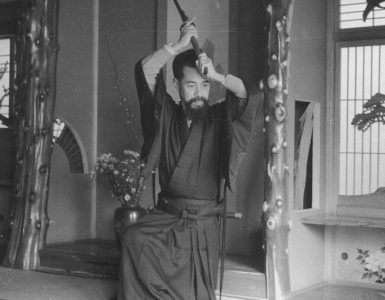
The Founder showed a great interest in the sword throughout his martial arts career. He even received a Yagyu Shinkage-ryu sword certification from Sokaku Takeda in 1922 although the exact content of his sword training under Sokaku is not known. Later in 1937, he officially joined the Kashima Shinto-ryu classical school which had an influence on his experimentation with the sword especially during the Iwama years from 1942 to about 1960.
O-Sensei made no attempt to codify or develop sword kata to be used formally in aikido training. The sword was for the Founder an extension of divine power to be used only for life-giving purposes. His sword work—and the same can be said of his jo—was merely a different tool for the expression of aiki movement based on the same universal principles as taijutsu techniques.
In that the sword is an extension of the body, certain uses and principles of movement are more clearly understood in comparison to empty-handed techniques. Often the Founder would illustrate a movement or principle both with and without the sword during training in order to clarify their interrelationship.
In this light, comparisons of O-Sensei’s swordwork with classical sword schools are completely beside the point as his intention was not to impart battlefield techniques but to show how divine energy channels through the human body, the space around it, and all throughout the Universe.
Kihaku
“Kihaku,” usually translated as “spirit” or “vigor,” is a term that can be used to describe the overall energy level or focus evident in the Founder’s aikido. There was an “electric” or “charged” quality in his movements that was so palpable it could be picked up even by an observer. All of the characteristics of O-Sensei’s aikido that we have alluded to above taken together can be summed up as kihaku. It is a dynamic intensity born of total focus in attunement with one’s surroundings.
The Founder’s art was truly magical. Even by watching the old films that preserve his movements one is captivated by his commanding presence, joyful ebullience, and complete mastery of energy and space. Such a level of expertise could only be attained by one who has reached a state that many would hasten to call “enlightenment.” In any event, he without doubt transcended normal human consciousness and entered into a state of elevated alertness and sensitivity. This state of oneness is a goal that should stand as a shining example for aikidoka everywhere who are touched by his timeless message. Why should we settle for anything less in our own training?
—————————–
BEST VIDEO RESOURCE OF AIKIDO FOUNDER MORIHEI UESHIBA AVAILABLE…





Stanley,
I may have said this before but I find this posting to be, simply stated, the finest single contribution you have made in your quest not only to write the first accurate and disinterested Aikido history but also to explicate O-Sensei’s techniques. I treasure this posting. Many, many thanks!
Pax,
Douglas+
Douglas,
I really appreciate your feedback.
Stanley
Hi Stanley Sensei,
I am careful not to miss your daily editions. I am practicing Aikido now and it is obvious to say that your postings and newsletter helps me to understand more about this beautiful martial art! Thank you.
Thank you very much for the kind words!