
 Josh Gold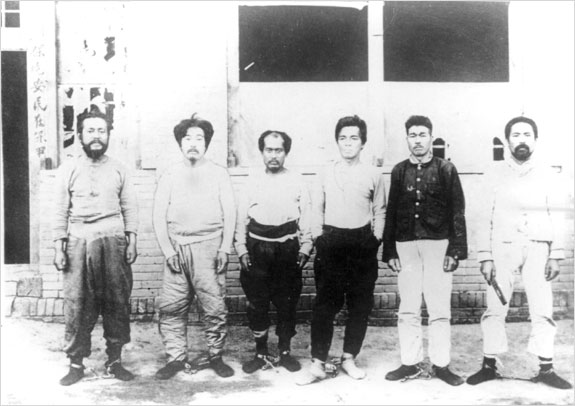
“Had this transpired, Morihei would likely have been imprisoned and tortured along with other leading church figures, and aikido would never have seen the light of day.”
This is a famous photo taken in 1924 in Tongliao (Payintala), Manchuria. Morihei appears with Onisaburo Deguchi and other members of their party in a Chinese prison, all in foot shackles. Morihei is third from the left with Onisaburo on his right. The story goes that the Chinese marched the Japanese prisoners outside of their cell and lined them up against the wall. All feared that there were about to be executed, and Onisaburo even had the presence of mind to compose the following poems:
Even if my body is exposed
on the plains of Mongolia
I will still keep the dignity of a Japanese
Farewell!
I will ascend to Heaven and protect
not only Japan but the whole world
Far away from Japan
I will now join the gods
in the sky of Mongolia
But it turned out that the party had their picture taken instead!
The events leading up to Morihei’s near-death experience are very complex and difficult to sort out. The cover story for the journey of Onisaburo’s party to Mongolia via Manchuria was that he was on a divine mission to set up a utopian colony in this region that would be a safe haven for members of all religions living in harmony and mutual respect. Ever one to seek the limelight, Onisaburo arranged to be photographed as the party made its way forward, and several remarkable images remain including several in which Morihei appear. Behind this facade lay the maneuverings of rival Chinese armies and militia, the Kwantung Army, Japanese spies, secret societies, Russian interests, in short, a political and military ferment.
Onisaburo had numerous connections with Japanese ultranationalists, including such notorious historical figures as Mitsuru Toyoma and Ryohei Uchida. It appears that certain Japanese military and covert interests found Onisaburo to be of use as a religious figure to divert attention away from the military’s plans to bring the region under Japanese control. Both sides were using each others’ power and influence to further their respective goals.
Following the last-minute rescue of Onisaburo and company from the jaws of death through the intervention of a Japanese consular official, the shaken party was returned to Japan in July amid a media uproar. Onisaburo’s escape from Japan and journey towards Mongolia had been reported in Japanese newspapers, and their safe return after such a close-shave with death was big news. Onisaburo, who had slipped out of Japan while still on bail following the First Omoto Incident in 1921, was returned to jail for several months. Morihei resumed his life in Ayabe, and it seems his brush with death had deeply transformed him in a spiritual sense. He would soon venture out to teach in other locations, including Tokyo, at the urging of Admiral Isamu Takeshita.
His experience on the continent did not deter Onisaburo from forging ahead with his grandiose plans after his release from prison. The Omoto quickly regrouped and resumed its growth, in the process constantly pushing the envelope in a repressed society. The sect’s explosive growth, voluminous publishing activities, and extreme rhetoric frequently raised the ire of government authorities.
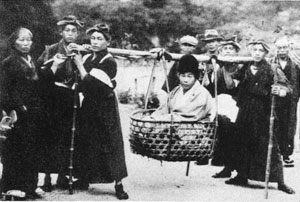
Onisaburo even had the temerity to create several suspicious auxiliary organizations in the futherance of its aims. Some of these like the Budo Senyokai–whose president was none other than Morihei Ueshiba!–had paramilitary functions and wore uniforms. Onisaburo was revered as a kami by the Omoto faithful and sometimes carried about in a basket palanquin by his private army of uniformed church members.
As it later turned out, Onisaburo’s contacts and alliances with right-wing elements were not sufficient to overcome the powerful opposition the sect had fomented in Japan. Events came to a head in December of 1935 when the sect was again attacked and crushed by the Japanese government. Its leaders, including Onisaburo and his wife, were arrested, tried and imprisoned. On this occasion, too, Morihei faced a perilous situation where plans called for him to be arrested along with other top Omoto figures. Had this transpired, he would likely have been imprisoned and tortured along with other leading church figures, and aikido would never have seen the light of day.
After the second persecution of 1935, Omoto fell into a state of disarray and was relentlessly criticized in the media, Morihei was forced to sever ties to the religion. Contrary to what has sometimes been written, Morihei did indeed reestablish contact with the Omoto after the war, and was received by Onisaburo Deguchi shortly before the latter’s death. Morihei practiced the religion openly and made periodic trips to Ayabe and Kameoka, sites of the sect’s headquarters. He also enjoyed close associations with members of other religious persuasions.
Morihei Ueshiba’s life was filled with adventure, danger and intrigue due to his successful career as a martial artist, and vast network of associations with members of the top echelons of Japan’s militarist society. Morihei was a man of his times, and an observer and participant in the events leading to Japan’s humiliating war defeat. He saw first hand the destructive effects of the unbridaled use of force on a societal and personal level. This, in turn, caused him to deeply reflect and reach a new understanding of the true purpose of martial arts–one embracing the concept of respect of life and reconciliation. The result is Morihei’s aikido, of which we are all beneficiaries.
—————————–






Add comment