
 Josh Gold
“Aikido techniques generally will not work well against
a strong opponent unless he has first been unbalanced.”
From Aiki News #87 (Winter/Spring 1991)
In my last editorial I touched upon the subject of what I regard as poor training habits prevalent in many aikido dojos both in Japan and abroad. I pointed out that the execution of techniques against slow, weak attacks had disastrous consequences on their effectiveness and the quality of practice in general. I consider this subject to be of extreme importance and have some additional thoughts to express.
To review a bit, let us remind ourselves of the origin of aikido techniques and the historical rationale of their predecessor arts. As is well-known to readers of Aiki News, aikido inherited its techniques primarily from Daito-ryu Aikijujutsu. Many techniques were eliminated from Daito-ryu by Morihei Ueshiba as too dangerous or complicated, and of those retained, most were simplified. This process of modification and simplification accelerated after World War II mainly due to the influence of Doshu Kisshomaru Ueshiba, Koichi Tohei Sensei and other leading students of the founder. What remain today are a few score techniques including joint-locks (kansetsuwaza) and throws (nagewaza). The traditional approach to aikido of Morihiro Saito, which still retains hundreds of techniques and an elaborate weapons system, is the exception.
Daito-ryu techniques themselves, like the curricula of other classical jujutsu and weapons schools, came into being as a process of gradual refinement based on the actual combat experience of the Japanese military caste. In a military context, unarmed techniques were designed for soldiers who were deprived of their weapons or unable to use them. Hence the existence of unarmed versus unarmed techniques and unarmed techniques versus weapons.
As late as the beginning of the 20th century, the Japanese fighting systems did not include karate-like punching and kicking techniques. Karate originated in China and took root first in Okinawa before being transplanted to the rest of Japan due in large measure to the efforts of Gichin Funakoshi. Jujutsu and judo were taken beyond the shores of Japan prior to World War II but were not widely practiced. However, after the end of the global conflict and the occupation of Japan by the U.S. Military, many servicemen joined judo and karate schools which subsequently led to the large-scale export of these arts to America and later Europe. Karate eventually achieved a greater degree of popularity in the west than did judo and has been glamorized in film and by the mass media to the extent that it and its Chinese cousin, kung-fu, have become the stereotypes of oriental fighting arts.
How does this relate to aikido practitioners? Since judo and aikido have common roots in traditional Japanese martial art forms there does not seem to be too much concern among practitioners of aikido about the effectiveness of their techniques against judo. Karate techniques are, however, a different story. Many aikidoka doubt that their skills would hold up against a well-trained karate practitioner. I think there is good cause for concern due to the lack of emphasis on strong attacks in aikido practice. Many exponents of aikido even at the black belt level would, I think, find themselves overwhelmed by the powerful, linear attacks of a skilled karateka. I don’t think it would be too farfetched to state that aikidoka would only be able to defend against the sorts of attack they practice in the dojo. Hence we might safely assume that practitioners could hold their own against lapel and hand grabs, round-house or frontal strikes of the yokomenuchi and shomenuchi variety, delivered with the intensity which is customary in the dojo where they practice.
By comparison, how would judoka fare against karate exponents? A judoka would probably be vulnerable to a rapid series of punches and kicks delivered by an opponent, but would immediately gain the advantage if the combative distance were to close or the fight were to end up on the ground. Unlike their aikido counterparts, judoka, although engaged in a sport, regularly confront opponents who resist in practice and competition. Both arts clearly have their strong and weak points. Of course, the above analysis is based purely on abstractions. In reality, martial artists are often trained in more than one discipline so the issue is not a simple one.
The Importance Of Atemi
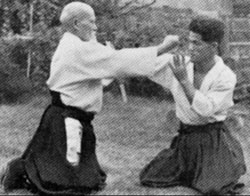
One of the problems with aikidoka is, as I see it, that they lack familiarity with offensive forms. The weak attacks used in aikido dojos simply are not realistic and do not prepare practitioners for the speed and power of real attacks. Moreover, in Daito-ryu and aikido as it was practiced during its early years, atemi played an important role in the execution of techniques. Not surprisingly, the founder can often be seen executing atemi in his earlier films. Aikido techniques generally will not work well against a strong opponent unless he has first been unbalanced. One of the main functions of the atemi is to neutralize the opponent’s attack and destroy his balance. Aikido techniques which do not include judiciously applied atemi are, in my opinion, largely ineffectual. I suspect that the virtual disappearance of atemi is due to the fact that the early teachers of aikido either did not learn them from the founder or continued the process of simplification of aikido techniques which resulted in their gradual elimination. Another contributing factor is, I believe, that atemi, which are strikes to vital points, are considered by some to be contrary to the ideals of aikido in that they are intended to inflict damage.
Such a belief demonstrates, in my opinion, a lack of understanding of the roots of aikido and its evolution. A strong argument could certainly be developed for aikido as the most humane of the martial arts. However, the nature and mechanics of aikido techniques contain the potential for inflicting great pain and damage. This essential fact cannot be altered without a dramatic departure from the original teachings of the founder. The important thing then is for all of us to keep in touch with reality when practicing aikido. That is, we must keep in mind such obvious things as the mechanics of the human body and the physics of aikido techniques. We must find out what works, how and why it works, and what doesn’t work. We must realize that any attack we may encounter will be by a resisting opponent whose purpose will be to thwart our every effort and consider what this implies for our daily practice if we truly wish to have at our disposal an effective response to violence. What is unique about aikido is the handling and execution of these powerful techniques by enlightened individuals guided by ethical principles which proscribe the use of excessive force.





Lucidity plus. Simple, correct and to the point. Deployment must be effective in real emergency situations. The compassionate side of Aikido is resides, for the greater part in the skills to mitigate violence thereby thwarting the need to engage, that arises from a depth of understanding of the consequences of deployment; and having the practical skills to do so if required. This comes from honest daily training without bias of any kind, rather an attitude of research and discovery.
Great article!
I think many aikidoka would rather believe they will be ok in a real fight. The reality is that they would probably freeze in fear, run, or attempt to defend, and be overwhelmed. It is far better to pressure test your skills in the dojo than in the street. A nice cosy dojo, training with ‘friends’, who attack slow and weak is not a real test.
A good knowledge of atemi strikes to pressure points is an essential ingredient in an aikidoka’s toolbox. But, like techniques, they have to be thoroughly trained to be of any use. Approximately 3,500 correct repetitions will help create a body memory, where they are more likely to be available under the extreme stress of a violent attack.
If we don’t wish to train in this way, it is better to be realistic about our aikido skills… than find out the hard way.
Spot on and well said. Atemi is so often lacking in the teaching I’ve observed in so many dojos. Amdur sensei has written about this topic, and the reality is aikido will not work without taking an attacker’s center.
I’ve heard many recite the quote “Aikido is 90% atemi” but I seldom see them practice it. One need not be grabbed to execute the techniques if Aikidokas would simply train differently. I have always thought this was a limitation that practitioners are placing upon themselves. My 30 plus years of karate gives me a completely different view of Aikido. It can certainly be effective against Karate. I have amazed karatekas for years now using Aiki principles and adapted techniques BUT one must train accordingly to be able to apply them.
This article was written in 1991 and it is still true today. I have the chance to travel and to visit and practice in a lot of dojos and I alway note that the attacks are so weak, kind and indulgent that it is not possible to improve one’s techniques. As sensei Patrick Augé was always saying at the time I was one of its students: “It is important to offer a sincere attack…, giving a good attack will permit to apply a good technique”.
Today in our dojos, proud and faithful to our heritage, we emphasize a lot on that topic and it is good to read that it is also a concern for others.
Bien que cet article ait été écrit en 1991, il est toujours d’actualité aujourd’hui. J’ai la chance de voyager souvent et aussi de visiter et de pratiquer dans plusieurs dojos, et chaque fois je constate à quel point les attaques sont souvent sans puissance, sans intention et très complaisante. Cette façon d’attaquer ne permet pas d’améliorer une technique. Comme le disait si souvent sensei Patrick Augé lorsque j’étais un de ses étudiants: “il est important d’être sincère dans ses attaques…. une bonne attaque permettra au partenaire d’appliquer une bonne technique”.
Alors aujourd’hui dans nos dojos, fiers et fidèle à notre héritage, nous mettons l’accent sur l’importance des attaques sincères et précises, et c’est rassurant de lire que d’autres y portent attention également.
I second the arguments and would like to share with you the following guide lines I try to follow in my training and lectures. And this doesn’t necessarily lead to fights. You can still develop a so-called soft but efficient and effective Aikido.
thomas
1. You have to learn how to attack before you learn Aikido.
2. You must be willing to hit uke (by an atemi) to unbalance uke without hitting him really.
3. The typical grasp is not the real attack. The other hand of uke delivers it.
4. Don’t be anxious as nage to accept a blow delivered by uke.
Stan was WAY ahead of his time with this one! But it’s not just atemi, but actual resistive grappling.
Seems that the aiki community is starting to discover that perhaps Takeda’s and Ueshiba’s sumo practice *may* have had something to do with their effectiveness and power – especially against students who did not have the same background in grappling or use of atemi.
It is the very reason judoka, BJJ, and MMA folks do so well against aikidoka and classical jujutsuka without a grappling base: the latter took out the “engine.”
That being said I have had success with a number of classical techniques on both the training mats against grapplers including BJJ black belts, and against criminals in the streets. The primary elements in that are proper technical drilling, and consistent honing against progressive levels of antagonistic striking and grappling opponents.
Stan – I appreciate your continued willingness to question your art and practice: a rare thing indeed.
Kit,
Your kind words are much appreciated!
Stan
This article is right about the weak attacks used in most Aikido dojo’s.
I practice Aikibudo by Alain Floquet myself, which is more like the pre-war style of contemporay Aikido, and my Sensei also tells me about training with Aikidoka sometimes; it’s obvious that many times their attacks are very poor.
We need to look back at the old training methods and refine current ones. I know a sensei who once took a self defence class offered at a local college. Ridiculous. As Kit said, ahead of your time.
I recently saw a video of a 3rd kyu test of one of the most highly regarded organizations in aikido, all of the uke just floated their attacks slow and soft. Randori against 3 persons was a disaster, the student was unable to take even one uke to the ground with a throw and they came in slow and sloppy. When it was over, everyone clapped and praised the candidate and the sensei–a 5th dan–promoted the student. No doubt this student believes he is capable of defending himself against a real attack. Aikido is no longer a martial art in many dojo, it’s just a workout. Senseis focus more in dojo etiquette (no shoes on mat, fold your hakama right) than on proper technique.
I have seen students argue against martial competence by bragging that they are on a spiritual path – their lack of competance is a sign of spiritual growth to them! “They would respond Aikido is not about winning” while clearly in their mind not believing they would lose.
I do see some students who are too obsessed with being “real.” In the dojo, that usually means someone who is trying to do a bad impersonation of a boxer doing light jabs or doing “point contact” karate stuff that yes, is difficult to train against because the actual intention to hit goes right out the window.
The balance is the important part. So, I will have students who are so focused on the atemi that getting off the line, taking the balance, applying the lock correctly, staying receptive, exercising control of uke – it all goes right out the window. The strike is separate from the technique, not a part of it like I think it should be.
I see this with hiji-kime, atemi and even nage waza or osae waza. The simplified versions are something I see as a core technique that can be embellished once it can be performed effectively. One handed techniques are learned as a platform that lets you strike at the same time – and if you can’t control with the one hand, you can rescue yourself by striking, but when you have control and have gotten safe using one hand your strike is much more dangerous.
This essay is really reflective, Stan! I NEVER underestimate the importance of atemi in Aikido, however, one critical thing to remember about atemi (which I learned from my sensei) is: use atemi wisely and necessarily. Therefore, he taught us for not to become too dependent on atemi.
BTW, I strongly believe that it’s always OK to use atemi in street-fights, however, in the dojo, it will be better if we always try to effectively execute techniques without atemi. Learning to atemi is easy, but to execute a powerful technique without atemi is definitely harder. But, that’s training: powerful skills always resulted from the hard-way of training…
I’ve just started Aikido over the last few months, though in my youth I held a black belt in Shorinji-ryu and competed at the regional level for Karate in the Junior Olympic system in sparring (back when we still wore just light gloves and mouth guards). I admire Aikido’s philosophy, but also its effectiveness. My instructors in Aikido certainly don’t pull punches with atemi, though at this point in the game I’m much more focused on my footwork and my center. Still, we’re always taught about the opportunity for a strike to change the situation and also to offer credible threats as uke. It was one of the reasons that I decided to train at this dojo. I also walk away from every class with the minimum bruising–no one is out to hurt anyone, just train with integrity.
I was wondering if people had tried delivering atemi as a slap? I find that it’s certainly distracting, not normally damaging, and brings that slight edge of adrenaline to the situation. Obviously, it’s no use slapping a pinned uke all day, but as I found out when I tried to slip in a few dirty tricks during practice, it certainly brought me up short. That, and my sensei’s tendency to drop the occasional elbow in with a throw.
Anyway, I see this idea tossed around a lot, and I wonder if the worry about applying atemi couldn’t be mitigated by applying a slightly less foreign action than the straight punch to the teeth. Thanks for your thoughts and comments, and tolerating questions from a rank amateur.