
 Josh Gold
 Aiki News #92 (Summer 1992)
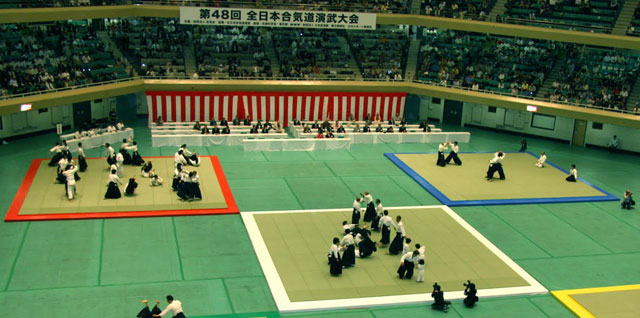
The scene is the annual All-Japan Aikido Demonstration held at the Budokan one fine spring day several years ago. A high-ranking shihan commits a slight error of timing during his performance and fails to unbalance or even touch his uke. The uke, obviously at a loss at what to do, looks to the left and then the right, and after an interminably long one or two seconds, falls down.
All of us have witnessed similar incidents at one time or another. Clearly, in aikido there is an unspoken agreement between tori and uke to the effect that the latter will execute a controlled attack, not offer any significant resistance, and take the fall regardless of whether he is thrown. This is especially true for demonstrations, but the situation is common in dojo practice as well.
What is it we are trying to show by our demonstrations? Is our purpose merely to display the beauty and softness of aikido movements? Is it our intention to exhibit a spirit of cooperation with a martial veneer? Idealistic, abstract words such as “harmony,” “peace,” “love,” and similar terms are often used glibly in connection with aikido. However, the meaning of such labels can be misleading since they are often used in everyday conversation in association with notions such as meekness, passivity, or lack of action in the face of violence. The founder used these lofty concepts in a particular spiritual context and the element of martial strength was always implicit in his vision of budo. We do a disservice to Morihei Ueshiba if we turn our public demonstrations into “dance displays.”
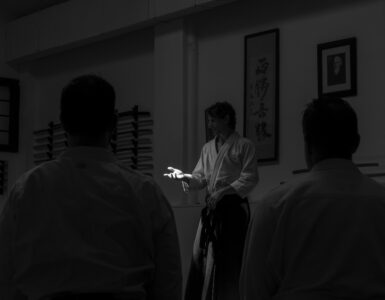
I am reminded of a famous episode involving the founder recounted by Gozo Shioda Sensei of Yoshinkan Aikido. O-Sensei was asked to give a special demonstration around 1941 at the Imperial Saineikan Dojo in the presence of the imperial family but initially refused the invitation saying he couldn’t “show a lie.” By “showing a lie,” he was referring to the fact that real martial techniques are so devastating to the attacker they cannot be shown for demonstration purposes. He finally consented to “show the lie” and in that demonstration his uke, Tsutomu Yukawa, failed to attack strongly enough out of deference to Ueshiba Sensei’s weakened physical condition (he was then suffering from jaundice), and ended up getting his collar bone broken.
Aikido has a poor reputation in many martial arts circles for its lack of effectiveness due to the obvious collusion which takes place between tori and uke. I personally don’t find anything objectionable about a gentleman’s agreement in training, particularly if there is a great difference in skill level between the two partners. Obviously, it would be inappropriate for a senior student or teacher to violently attack a beginner or stubbornly refuse to fall when a technique is applied on him. Nevertheless, within the parameters of safe practice, the uke can still attack sincerely with a mind toward gradually increasing the intensity according to tori’s ability. Tori, for his part, should strive to insure that his initial movement succeeds in unbalancing the attacker. If this is accomplished, then the remainder of the technique will proceed smoothly without any undue force being required.
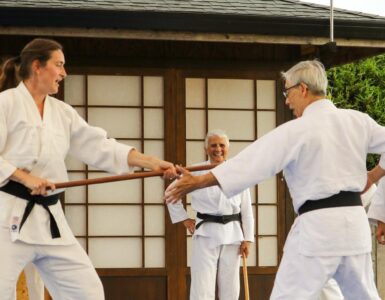
O-Sensei was asked to give a special demonstration in the presence of the imperial family, but initially refused saying he couldn’t ‘show a lie’…
Returning to the subject of demonstrations, when top shihan demonstrate in front of hundreds of people and their uke take beautiful, controlled falls, such performances may have artistic merit, but to the trained eye of any knowledgeable martial artist, these displays border on the farcical. If the uke is in perfect control of his body when thrown by tori, then tori has failed to unbalance him. This is an inexcusable situation for a serious budoka. If we think of it carefully, a well-executed technique does not allow for a “beautiful” fall. An off-balanced uke can at best salvage his situation by protecting his body when he falls.
One method I discovered many years ago to evaluate the skill level of an aikidoka is to closely watch his or her uke. Usually one is caught up in the movements of tori and fails to pay much attention to uke. This is particularly true during demonstrations which tend to be of a spectacular nature. One would be amazed at how many of the top instructors fail to even unbalance their uke. I’m sure in most cases they are quite capable of doing so, however, a difficulty arises when aikidoka viewing such performances conclude that this is the proper way to execute techniques. They then proceed to imitate what they see in their own training, and the result is a gradual deterioration of technical skills. Outside observers, on the other hand, who are not impressed with such displays walk away believing that aikido is worthless as a martial art. Choreographed performances devoid of all martial spirit are best suited to the dance floor and have no place in the founder’s aikido.
Nevertheless, within the parameters of safe practice, the uke can still attack sincerely with a mind toward gradually increasing the intensity according to tori’s ability.
In conclusion, I would like to urge each and everyone of you to think deeply about your commitment to aikido. If your main purpose in training has little to do with learning self-defense or the budo spirit and revolves around the friendships and family atmosphere which naturally arise from dojo interaction, then, by all means, continue as you are. You would be foolish to rock the boat! But, if on the other hand, your involvement in aikido stems from your fascination with the wonderful concept of aikido as formulated by the founder, Morihei Ueshiba, then is it not time to reexamine how you spend your time in practice? Discuss your ideas and doubts with your teacher and fellow students. Gradually increase the level of intensity of your training. Does your initial movement succeed in unbalancing your partner? You would be amazed at how easy the rest of the technique goes when this is accomplished. Do your skills include the ability to execute atemi? Do your pins truly immobilize your partner and preclude all chance of escape? Are you alert upon completion of each technique to a possible attack from another direction? Basically, what I am talking about is practicing aikido with full concentration as opposed to treating training as a casual “social outing.” The ability to focus your energies which gradually develops as a result of serious aikido training is a powerful skill which will serve you in good stead in all aspects of your life. We invite you to continue sending us your letters and speaking your mind!


 Antonio Aloia



According to Mochizuki Sensei, Ueshiba Sensei changed his techniques for demonstrations and whenever he was filmed. This was confirmed to me by senior members of the Yoseikan who said that what he was doing when visiting the Yoseikan dojo was also different.
Patrick Augé
THANK YOU for speaking the obvious that usually goes unmentioned: There is real ‘harm’ in our ‘harmony,’ and we need to be aware and make our students aware that the level of harm is a result of mutual collusion (or lack of it) between the uke and nage.
Dear mr. Pranin. Is that allways possible to trully unballance a person that is much stronger, well trained and urge to resist?
I doubt.
Morihei Ueshiba could do it!
Hello Stan, I think that a lot of what people do is done by wrote, meaning they don’t really study how to effect the body and strive to understand the various ways that the body works. I think also that few are really studying where their power zone is, where the off balance points of uke are and striving to understand some of the psychological aspects of how to control the attacker’s mind and body at a reflexive level. Perhaps the word here is kuzushi in various forms.
A friend gave me a book about Tai Chi that had a section in it about the various forms of power, about 20 or so. I need to go look at that again. The point here is that in our techniques most of those forms of power are used or hidden.
When you start to put all these things together you start to get some wonderful results. Something that I often tell the beginners now is, “The best executions of techniques are like nothing! Things become nearly effortless! ”
It still requires a lot of precision and practice. In one of the interviews of Hitohiro Saito, he says, “If you are off the path by as little as a centimeter the technique might not work.” This is often a true statement.
I keep practicing.
Tom Huffman
Gainesville, FL.
Absolutely agree!
Thank you. Well said.
Absolutely right Mr Pranin, I am always telling new students not to fall over because that is what they see and think is expected of them when their partner applies a technique. They should only fall when their balance is gone and they have no option but to fall. Gravity makes this happen, along with a bit of assistance from Tori. Once they are falling it is up to them to control how they impact on the mat. We do spend time however teaching beginners how to fall safely so when they have to do it they will be able to look after themselves.
JSL.
Yes, it will but at a slightly higher price.
I express my respect and gratitude for this article and let us remember the will of the founder – learn Aikido as Budo!
Cease to do so out of aikido dance, yoga and fittness!