
 Josh Gold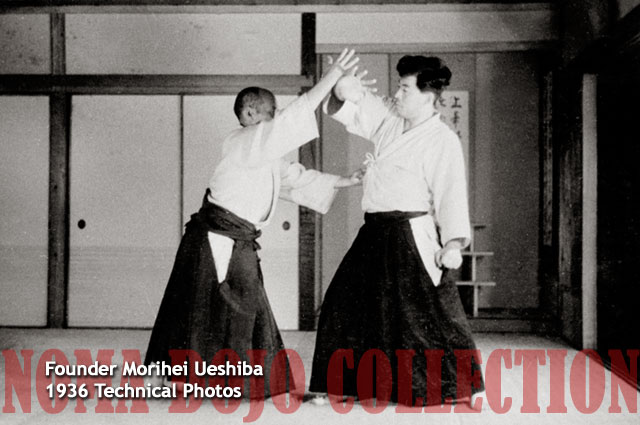
“The control, positioning, perfect balance, attention to detail, and many other subtleties revealed in the Noma Dojo photos reflect a deep mastery of Daito-ryu.”
In 1936, an historic event took place that provides a clear snapshot of the techniques of Aikido Founder Morihei Ueshiba at this stage of his career. The Founder, together with his devoted uchideshi Shigemi Yonekawa, were photographed performing hundreds of Aiki Budo techniques, running the gamut from basic to advanced. The Noma photos are full of complex joint-locks and pins and retain many of the characteristics of Daito-ryu aikijujutsu techniques. These images capture the Morihei Ueshiba during a transition phase on his path toward the development of modern aikido.
Those who have described Morihei’s study of Daito-ryu aikijujutsu as brief and superficial are left with the task of explaining how he could have such a profound knowledge of Daito-ryu techniques. The control, positioning, perfect balance, attention to detail, and many other subtleties revealed in the Noma Dojo photos reflect a deep mastery of Daito-ryu.
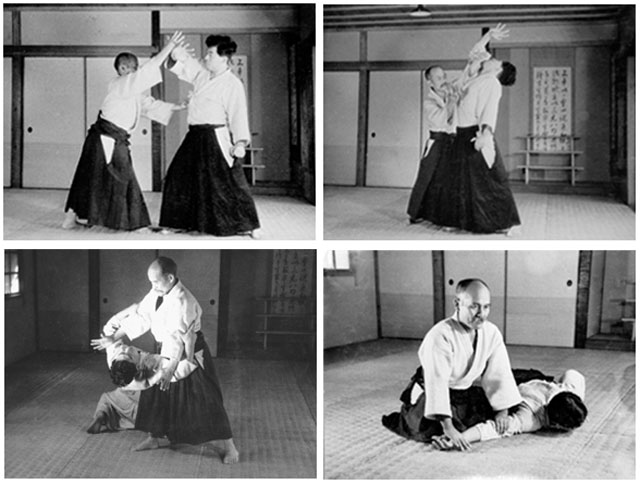
There are over 1,000 surviving Noma Dojo photos comprising two separate collections that were united in the late 1980s. Aikido Journal will publish the entire series over time. This is a major project in which we would like to interview the entire aikido community. We will maintain an ongoing dialog on how to prepare, organize, and disseminate this collection to insure its survival intact for coming generations of aikido practitioners.
As we publish each photo, we would like to request that readers submit any technical or other comments they might have to provide context for the image and facilitate efforts to reconstruct this wonderful technical legacy!
Please submit your comments below!
_______________________________________
The Morihei Ueshiba Founder’s Course is O-Sensei’s video legacy starting in 1935 and covering a span of 34 years until just before his passing in 1969. Besides the more than 30 films of the Founder, the course includes three rare audio interviews of O-Sensei with complete subtitles. These are wonderfully intimate conversations with the Founder that convey his bright personality, playfulness and sincerity. In addition, the course includes a series of video documentaries by Stanley Pranin on the life of the Founder and the spread of his art worldwide.
Click here to discover the secrets of the highest
level of aikido to accelerate your progress!



I think this collection is of extraordinary importance, and been way too long out of reach, if we want to disseminate strong aikido, maintaining its roots as budo, we must show aikido community this element of aikido by making Noma Dojo pictures available. And seems there is no faster way to achieve this than working together, helping Mister Pranin. I definetly would like to participate somehow. I have will, energy and some free time. All we neednow is Mr. Pranin’s direction. Marius
I fully agree with Marius’ suggestion. I need some help in a couple of areas:
1 – Help with restoring many of the photos. This can be done in Photoshop or other image editor
2 – I need to have some help with ideas for creating an interface to allow fast, retrieval of these photos for study and comparative purposes.
Please make suggestions below.
Hello Stanley,
I’m a fairly new member, and have only just seen this post. Judging by the post’s original date, I’m sure that the photos’ restoration has been addressed already. However, if the project is still ongoing, I can gladly help with photo cleanup.
I’ve been trying to reconstruct this old stuff. Some I’ve incorporated into my work. I like the daito ryu pins for shihonage and jujinage. Some is interesting just for opening the mind. There are a number of old pins which involve picking up the offside hand which would be useful for applying handcuffs. There are a few which are just inherently harmful. There is one for go-kyo which involves kneeling on uke’s pinned hand. It works, but there’s no way you can apply it without hurting the hand you’ve put your knee on. Something to think about in general is that aikido techniques tend to leave thrown partners behind to concentrate on any remaining. It’s specifically adapted for multiple person situations which O Sensei demonstrated on a number of occasions for which we have films. Pins are inherently focused on the individual pinned unless you’ve mastered the art of stacking ukes.