
 Josh Gold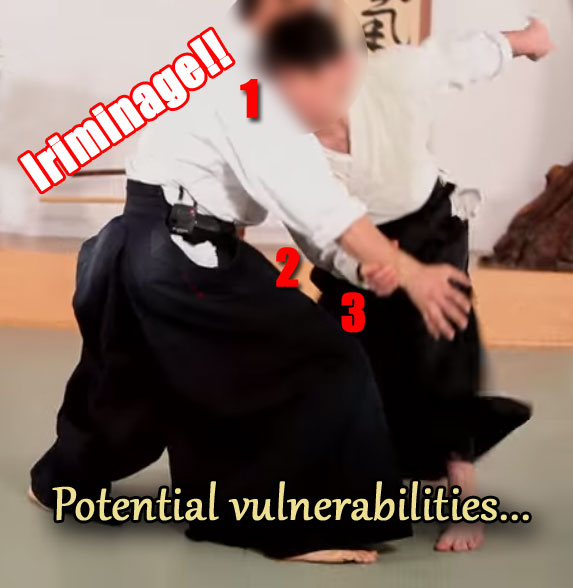
“We can do a great deal to self-diagnose our techniques and
work toward honing our skills to higher and higher levels.”
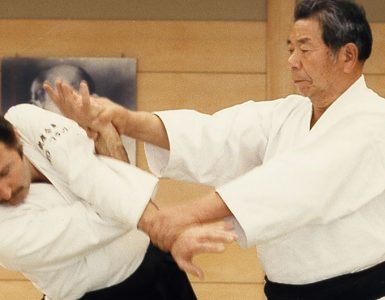
Here is a random screenshot retrieved from an online video that exposes several potential vulnerabilities when executing aikido’s iriminage. Although we are looking at a single image, this manner of throwing in iriminage is quite common, especially in mainstream aikido.
When done this way, the setup for the technique involves nage bringing uke downward using centrifugal force and pressure on the neck. After uke has reached the bottom of his downward movement, the logic is he will “rebound” upward in an attempt to save himself. Finally, nage reverses his motion and swings his right arm through as he steps forward to complete the throw. Uke is thrown in a “high fall”. The entire effect is very spectacular and can be seen widely in demonstrations.
Limiting ourselves to this still image — a moment frozen in time — let us analyze some potential difficulties in approaching iriminage this way. Let’s look at the numbered regions of the image first.
1 – Here, uke’s head rests against nage’s right shoulder and upper arm. Uke is partially unbalanced but very close to nage. Uke also has hold of nage’s right arm with his right hand. As you can see, uke is attempting to support himself using nage’s body as a prop. This close contact of uke with nage’s body creates a major weakness that may be exploited.
2 – Though perhaps not obvious, uke’s right elbow is very near nage’s groin and upper thigh. If uke still has partial control — and I would suggest that he does — he might use his elbow supported by his right-handed grip to attack these vital spots of nage.
3 – In a like manner, uke’s right hand can be used to attack nage’s knee. In fact, given the multiple points of contact between uke and nage’s body, uke might collapse his entire structure against nage’s body and execute a counter-throw. This is a very real danger when the iriminage throw is executed in this manner.
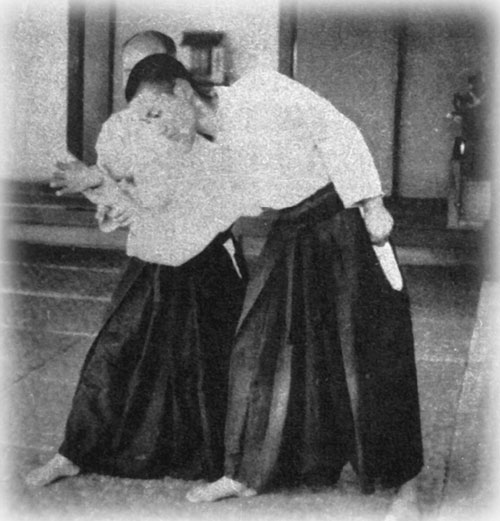
different and does not reveal the vulnerabilities mentioned in this analysis.
An untrained person would not and could not respond as uke does in these iriminage demonstrations due to the high-level of skills involved. The mere fact that uke can respond in a high fall indicates that he has a certain measure of control over his body.
My purpose here is not to criticize any particular person or method but to suggest that we should submit every technique we practice to close analysis. Is uke being fully unbalanced? Does uke have the possibility of responding with a counter-attack at any stage of the technique? Is the technique prolonged unnecessarily affording opportunities for exploitation? These are questions that we should ask constantly. By doing so, we can do a great deal to self-diagnose our techniques and work toward honing our skills to higher and higher levels.
___________________________________________
Stanley Pranin offers you solutions to problems
that are holding back your progress in Aikido!


 Antonio Aloia




The way it is described and due to the lack of kuzushi, nage can be countered with an osotogari or an ipponseoinage for example. If tehodoki had been taught, the result would be quite different.
Patrick Augé
How can Tori be countered with osoto gari and ippon seoi nage in this type of situation? As far as the picture goes:
1. Uke is not supported by Tori’s body or his arm. Tori puts his arm under ukes neck in order to sway his head in the direction of the throw.
2. and 3. Neither is Uke’s hand close to Tori’s groing or can Uke go for Tori’s knee because in this situation if Uke lets go of Tori’s hand Tori can throw uke more easily. In fact if Uke does try to grab Tori’s knee he could end up with a broken neck because he would not be capable of performing ukemi because he would be countering the movement of his head which would be under the sway of Tori’s arm, especially at high speed.
The problem in this picture is the position of Uke’s body. Uke’s hips are completely turned towards Tori’s body, in this situation Uke can simply barge into Tori and knock him down, eventually causing much more damage. If Uke is too long in this position he can even use his left arm to punch Tori, that is why Tori’s body should be always aligned with Uke’s body in the direction of Uke’s body, before the throw.
Could you elaborate on that, pelase, Auge sensei?
I was trained in Iwama style, and as far as I can tell (without looking at myself from the outside) I perform iriminage in that style. Nonetheless, I do use the head grip (as I was taught) rather than the collar grip, on the principle that uke may not always have a collar. (If uke does not have a head I think I would need a wooden stake or exorcism rather than aikido.)
Now I am wondering how vulnerable I am.
You are right on all three points. Big dangers. But, beginners must start somewhere. I see the people in the picture are not beginners but even Shodan level may not be aware of these weaknesses you point out. Most aikido, after all, is kata training and doesn’t look into such things. I could also add a few more counters. Uke’s left foot is in a good position to lunge straight into tori: thus, a shoulder strike is possible to the solar plexus. He could follow up with a nice headbutt, as tori’s grip gets weaker with the unbalance caused by the strike. Finally, a floating rib strike. I feel that a strike to the ribs is one of the most problematic areas in the standard slow-motion irimi-nage such as is practiced in the Aiki-kai. Yes, I can throw the guy but I don’t really like getting my ribs broken, if I can help it.. To be honest, I have had all the above, including what you described, happen to me, so I have learned to work around these problems. It would have been much easier if they were pointed out to me from the beginning of my training but they were things I had to learn on my own from weird and wonderful ukes..!
In our dojo iriminage has been discussed in depth during ‘aiki-lab’ sessions.
Is iriminage a true technique or simply an exercise?
As an exercise it teaches sensing uke’s body position in real time and adjusting to it with staggered timing. When done perfectly it follows Aikido principles of twisting the body and taking balance as well as the principle of entering to attain success.
As an exercise it is a tool to understanding subtle principles of Aikido and thus meets the demands of being the ‘Crown Jewel’ of Aikido as someone once called it (Stan Pranin?).
Iriminage whether traditional (Iwama/Aikikai) or modified (Tohei/Nishio) shares a common element– uke’s head being ‘welded’ to nage’s shoulder thus creating a velocity differential between the head and feet. This velocity differential precludes uke from engaging in kaeshi waza because uke is so confused they can not execute atemi or counter techniques–theoretically.
Some of our female Aikidoka have consistently pointed out that when Uke’s head is ‘welded’ it presses upon their breasts creating immediate discomfort and possibly long-term health consequences. Therefore they modify the ideal to achieve success. This is another example of iriminage as exercise rather than technique.
For iriminage to work as a technique uke must be fairly inexperienced and ‘loose.’ Nage must be very experienced and have perfect timing. These two factors make iriminage a very ‘iffy’ option in real world ‘on-the-streets’ situations.
Iriminage presents Aikidoka of all levels with a puzzle–how to integrate timing, balance taking, body twisting with inherent vulnerabilities to deliver a truly effective technique that doesn’t hammer uke yet works in the real world. This is why iriminage is sometimes called the ‘crown jewel’ of aikido. It is a lifetime … or more… endeavor which a small few have truly mastered.
[…] en el tema, nos gustaría traeros otro artículo del mismo autor, en el que explora las potenciales debilidades de irimi nage, relacionándolas precisamente con las diferentes formas en que puede ser ejecutada. Una opinión […]