
 Josh Gold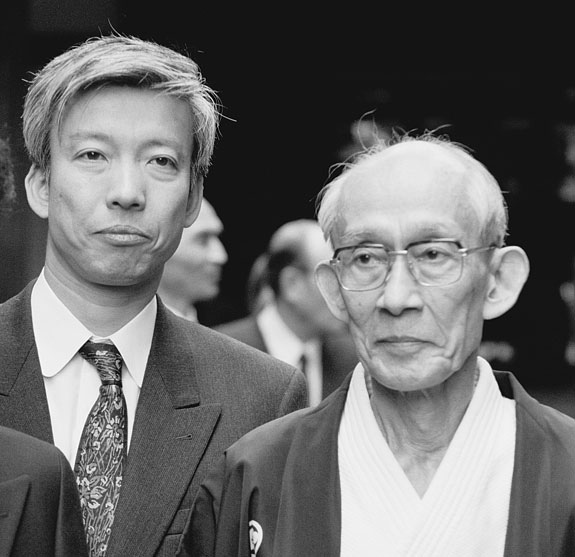
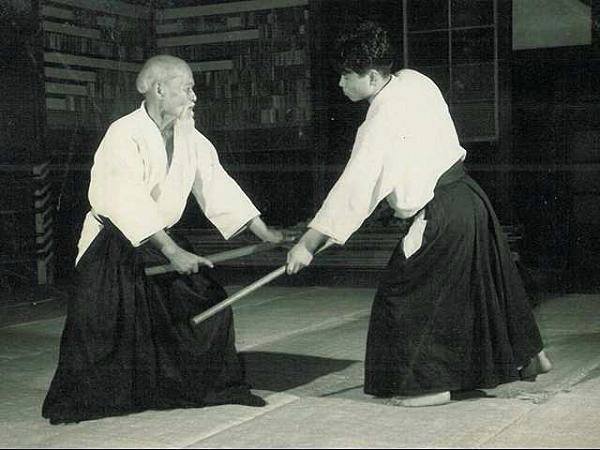
the Second Doshu, at the Aiki Taisai in Iwama, c. 1990
In answer to a question regarding the role played by Aikido Founder Morihei Ueshiba in postwar aikido, Shizuo Imaizumi Sensei of New York City made the following comment:
“As Kisshomaru Ueshiba Sensei handled all daily matters both inside and outside the dojo, the role of O-Sensei seemed to me to be that of the symbol or spiritual figure of the Aikikai. He did whatever he wanted. His only concern was the future of aikido under the Ueshiba family as he was the kind of man who would follow the old ways. O-Sensei would often refer to the art as “Ueshiba-ke-no-aikido,” that is, “Ueshiba family aikido.” In the same way that the Shinkage-ryu or Itto-ryu sword schools belonged to the Yagyu and Ono family, O-Sensei believed that aikido should belong to the Ueshiba family as he himself was its founder. So O-Sensei believed that the Hombu Dojo should be controlled by the Ueshiba family. I think that Kisshomaru Ueshiba Sensei, as the founder’s son, and O-Sensei’s grandson Moriteru Ueshiba have firm control over the daily matters of the Aikikai in accordance with the wishes of the founder.”
Quoted from Aikido Journal #114, 1998, p. 10.

Imaizumi Sensei first entered the Aikikai in 1959 and, several years, later in 1964, became an instructor and close follower of Koichi Tohei. He continued in this capacity through 1974.
Many years ago, I heard a comment very similar to that of Imaizumi Sensei from Mariye Takahashi who was a student at the Aikikai in the early 1960s. She, too, referred to aikido as “Ueshiba family property.”
What, in concrete terms, does it mean to aikido practitioners today if we regard the art as the property of the Ueshiba family?
First of all, I think it would be safe to say that Morihei Ueshiba’s statements imply that it was his intention that aikido continue to develop according to his vision. It further implies that he trusted his son Kisshomaru–aikido’s Second Doshu–to carry on in his stead. By extension, the Aikikai Hombu Dojo may be regarded as the physical “home” of aikido, and the administrative and technical center of the art.
If Morihei’s vision was to be understood as the basis of aikido as it continued to evolve as a martial art, then we must try to clearly understand what the art entails. For example, was aikido conceived as a martial art? The Japanese term is “budo,” that is, a martial way or path. If one were to poll today’s practitioners, what percentage would perceive the art in this light? Such practices as atemi (strike) and kiai (combative shout) are frowned upon in some schools.
In a technical sense, what does it mean to say that aikido is a martial art? Does it mean that its techniques may be useful in defending oneself, or intervening in the defense of others? I don’t think it is unreasonable to think in this manner. If there is a body of aikido techniques that allow these martial skills to be learned and applied, if necessary, what are they? Who will determine what the technical curriculum of aikido is? Should this body of techniques evolve over time? Should it not be the Ueshiba family as the successors and protectors of Morihei O-Sensei’s vision who determine this?
What about the ethical dimension of aikido? Morihei was very much involved in the Omoto religion and influenced by its co-founder Onisaburo Deguchi. Moreover, he had a wide circle of friends and acquaintances from religious circles with whom he interacted all of his life. This was mostly within a Shinto context, and thus Morihei and his associates had a particular world view the was aligned with Shinto, the Kojiki, and a particular set of myths and metaphors expressed using a specialized vocabulary. This world is not easily understood by modern Japanese, and much less so by foreigners. How then should we attempt to inform ourselves as to the true intent of his philosophy and apply it to our practice of aikido?
First of all, I think it would be safe to say that Morihei Ueshiba’s statements imply that it was his intention that aikido continue to develop according to his vision. It further implies that he trusted his son Kisshomaru–aikido’s Second Doshu–to carry on in his stead. By extension, the Aikikai Hombu Dojo may be regarded as the physical “home” of aikido, and the administrative and technical center of the art.
As is natural in a movement that has attracted several million practitioners in the postwar era, many divisions and schisms have occurred in aikido. Some of the groups and organizations that have formed along the way look to someone other than Morihei Ueshiba as their starting point. In the case of the Aikikai in Tokyo, obviously Morihei Ueshiba as the founder is the point of departure of the art.
As a historian, my research has suggested that although Morihei Ueshiba is universally recognized as aikido’s creator, the specifics of his life and art are poorly understood by most students, even advanced practitioners. Also, in the intervening years following Morihei’s passing in 1969, there has been a gradual shift in emphasis within the Aikikai toward the viewpoint of Doshu Kisshomaru Ueshiba.
The following translation is an excerpt from an article of the Aikido Shimbun, the official newsletter of Hombu Dojo. The article titled “To the spirit of the past Doshu” was written by Moriteru Ueshiba Dojo-cho for the January 20, 1999 edition:
“The techniques and way of Aikido that the founder O-Sensei left us, were not always easily understood by everyone. Doshu, my father, changed these so they would be easily understood, and he gave all of his life to spread this. For that reason he left behind many books that he had written. I grew up watching Doshu return from keiko to study and write for long hours and even with my child’s eyes I could see the importance of this work.”
Retrieved from martialartsplanet.com
Inevitably, there will be those who would prefer aikido to be something closer to the original vision of the Founder. That quite obviously has been the stance of Aikido Journal since its inception. The main thrust of our efforts has always been to act as a medium for the propagation of his life and art, lest his true message be obscured and he as a person relegated to a vague symbol of aikido’s distant past.


 Antonio Aloia




A fine article with lots of interesting points.
I do remember my teacher’s wishes were to have the Ueshiba family learn the Founders aikido again. He had several ideas to lead this to a fine conclusion, but none were put in action for many reasons, all understandable and very valid.
What martial arts have not had the same development as Aikido?
Isn’t it safe to say that most martial arts – inside and outside Japan – have always had teachers that split from the main house to form different schools? This is not unusual at all. The new practitioners just need to search a bit more in order to find out which school/way of teaching/teacher is really in tune with their personalities or objectives. If I would learn karate, for example, it would be Goju Ryu. I like the teachers, the techniques, the teachings and the tradition associated with this school. However, there are many schools of Goju Ryu. I would have to search well. It is a lot of work. The same happens with Aikido now. I do not see it as a problem.
I consider myself extremely lucky that I started to do O’Sensei aikido from the beginning. But I have no antagonism against other schools. I would not do what they do – that is sure. But O’Sensei’s Aikido is far too big and as such I do have to spend a lot of time studying it (this includes reading Aikido Journal Articles too!).
Our present Master keeps on studying profoundly not only the Founder’s techniques but also the Founder’s martial logic. He is a religious man, meditates and does misogi thus being closer to the Founder’s real practice than any other teacher I know, with the advantage that he also practices his waza. This is fabulous. The Founder is unusually present in our school in everything we study and do.
Nice article.
I was so fortunate to start my Aikido life at Sunset Cliffs, in Ocean Beach, CA. while I was in the Navy. Wes Leavens, Bernice Tom, and Satoshi Takamori were the instructors and all had practiced in Japan with Saito Sensei. I learned that Saito Sensei felt it was his duty to O’Sensei to transmit the art exactly as O’Sensei had taught it.
I feel certain Saito Sensei fulfilled this duty. I got the Navy to station me in Japan so I could train with the masters who trained directly with O’Sensei. This also opened to me avenues to train with some other masters as well. While at Atusugi, Naval Air Facility, I trained with Hitohiro Saito at a middle school a few stops south from Shinjuku area of Tokyo. On my second tour of duty, I shifted from Atsugi, straight south from Tokyo, to the USS Independence out of Yokosuka, Japan, perhaps 45 or so miles southeast of Tokyo. The closest Iwama Style classes to the Yokosuka area were in Misaki Guchi, right at the tip of the Miura Peninsula, farther southeast from Yokosuka. These classes were taught by Ryugi Inagaki-Sawa (He was adopted by his wife’s father and took the Sawa family name). He was teaching exactly the same as Saito Sensei. When I started Sawa Sensei told me he had been promoted to nidan by O’Sensei when he was 13.
When I was retiring from the Navy, I told this group that I would teach Iwama Style in Florida and they corrected me. They said, “No. No. Not Iwama Ryu. It’s O’Sensei Ryu, O’Sensei Ryu”. My goal had been to get as close to O’Sensei as I could. This confirmed that what is referred to as the Iwama Style is really what O’Sensei was teaching. During my practices with Nishio Sensei and the Iwama Style, I attended many seminars. The students from the Hombu Aikikai who came to these seminars were not nearly as skilled as the Nishio Sensei and Saito Sensei students. I found the Hombu Dojo, but declined to practice there because I felt why should I train with people who had limited skills. I turned around and left and never went back.
O-Sensei’s own style changed and evolved over the decades too. His style in his younger days were very hard, while his style in his golden years were much softer and “no touch”. There were even minor changes to his style within the post-war era.
So which of his styles are we referring to?
Aikido was sent forth from Japan many decades ago. Since then, a couple of generations of teachers have devoted their lives to this art. I think it is not a viable idea that this art is the property of a family in Japan, who have little or direct knowledge of what we are doing, or care particularly, and actually had no exposure to training with the Aikido Founder himself. If “Aikido” is deemed the property of the Ueshiba family, I think we should simply change the name of what we are doing and keep going developing the art. Morihei Ueshiba created this art. He is the reference point for many of us. I do not see any inherent technical advantage someone has because he is related to the Founder. Basically, the Aikikai is run by a man who trained with a teacher(s) who trained directly under the Aikido Founder. Well, there are a number of us out here who were also trained by teachers who were uchi deshi of the Founder. I see no reason why we need to defer to the family or the organization in Japan. If there were some sense in Japan that we were in a partnership in developing this art, then I’d be fine associating with the Aikikai. The relationship with the Ueshiba family is, however, very important to my teacher, Mitsugi Saotome Sensei. Whatever relationship I have with the Aikikai is entirely through him and will remain so as long as he is alive.
The wonderful thing about aikido worldwide is that we have a full range of schools that teach the founder’s techniques from the hard and martial beginning, to the soft flowing end. If we could squeeze the top teachers of each school/variation into one man/woman, we would have a fair representation of the founder back on earth. Dare I say it, but in such a case we might even have a superior martial artist than the founder. I believe that would please him greatly and furthermore validates aikido in the world today. It highlights why we should be inclusive and respectful of differing opinions and approaches to training. Right attitude and right effort are the basis to aikido and to life itself. Individually we are limited and flawed. United we are a force for change on earth.
Can’t be said any better than that, Ken! Thanks
Mochizuki Minoru Sensei also said that Aikidô was the property of the Ueshiba family. For that reason he was opposed to calling his system “Mochizuki Aikidô” and chose to name it “Yôseikan Budô” instead. However we still use the term “Aikidô” in its generic sense.
What do we do when it becomes obvious that the heirs deviated from the Path established by the founder and refused to acknowledge it? Look the other way or keep following the Path?
Patrick Augé
During my time studying with Kisshomaru and Moriteru Ueshiba in the 1970s, I found them both very honorable and humble men. When I moved to Iwama, they frequently visited and seemed to appreciate Saito Sensei’s efforts as caretaker of both O’Sensei’s dojo, and his traditional practice.
It has always puzzled me to observe how the Aiki Kai Foundation essentially erased Iwama and Saito from aikido history, just as it erased to valuable contributions of Koichi Tohei. How can the roots of a discipline, which are its foundation, be so foolishly discarded? Perhaps it is related to the immense size of the Aikikai organization, which, like most huge corporate entities and churches, become more corrupt the bigger they get, until finally it exists only for power and profit.
No wonder O’Sensei chose to stay secluded in Iwama most of the time, training with just a few students, for the last several decades of his life. He knew – small is beautiful !
Pranin Sensei: it would seem that a literal reading of your various expositions from the past of O Sensei’s life, work and teachings uncovers many deviations from the emphasis or even from the dogma and “history” of official Aikikai Aikido as held by Hombu Dojo. What has been the official position, if any, of Hombu Dojo? Have they, in effect, simply ignored you (or rather, your publications), as though your misguided ravings in the English www do not impact upon their Japanese language readership? This could lead eventually to some awkward situations, I would think. Or is their response more nuanced than that?
Please forgive me if the awkward question appears rudely directed; that was not my intent. As a student, I merely want to more precisely understand what the situation actually is.
Thank you for your perceptive comments. In my experience, the Aikikai does little publicly about activities in the aikido world that they may disagree with. This is even more the case if such things happen abroad and outside of the Japanese language. On the other hand, they have historically been active behind the scenes to deal with such matters if they occur in Japan.
It means nepotism rules in the aikikai. Hardly anyone of seniority in aikido would argue that the 2nd Doshu was the most skilled aikido instructor (whether you are talking ability to perform or to teach) at the time of the founder’s passing (or any time since.) Yet he was given the leadership role, almost solely due to the fact he was the son of the founder. The practice continues obviously within the aikikai. The leadership of the aikikai, headed by the Ueshiba family after the passing of O-Sensei, have taken to rewriting history and even editing photos to glorify their contribution and version of events and reduce or erase those contributions of instructors who were far more skilled and capable in aikido. It’s disgusting and wouldn’t be tolerated by most modern people. Somehow just the fact of studying a traditional art from a foreign culture has kept most of us non-Japanese quiet and reserved about a situation that few of us would welcome if it came from within our respective cultures. As for Japanese, they have their own ways of dealing with it whether or not they agree with the situation as it is. It is hard to fathom by outsiders, even those of us who have lived some time in Japan. It is far easier and more profitable for an individual, however, to find a competent instructor that teaches valid aikido principles than it is to change the political situation at hombu dojo.