
 Josh Gold
“Modern aikido has tended to neglect such
techniques which have true martial application”
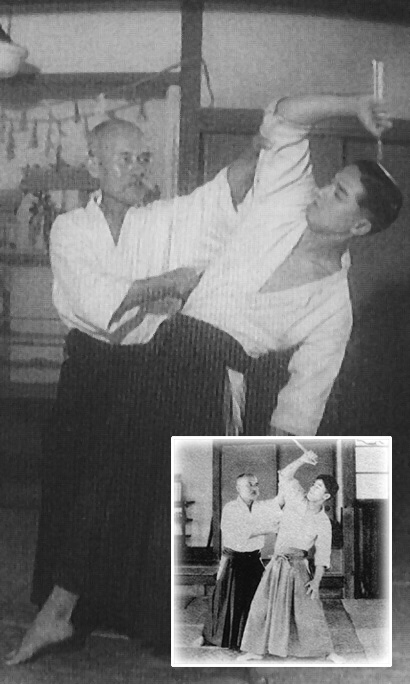 The other day on Facebook, some kind soul posted a very rare photo of Morihei Ueshiba taken c. 1940. If you happen to have information about the origin of this image, please contact me.
In this photo, you see Morihei Ueshiba inside his Kobukan Dojo executing a technique with Gozo Shioda as his uke. In this obviously posed photo against a fan attack from shomenuchi, Morihei has entered to Shioda’s flank, executing atemi to the latter’s ribs, and attacked a pressure point under uke’s elbow. This movement is a classic defense against a knife attack.
This was the way this technique was executed in the prewar era continuing through the Founder’s Iwama years in the late 1940s and 50s.
Taking a close look at this photo, I thought I saw something familiar. I went through my collection of photos from Morihei’s 1938 “Budo” book and found a virtually identical photo — also with Gozo Shioda as uke! That is the photo inset here. In this earlier photo, Shioda is attacking with a knife. Other than that detail, the two images are almost the same.
Modern aikido has tended to neglect such techniques which have true martial application in favor of the lighter, more flowing movements that were emphasized during the period of aikido’s popularization in the 1950s and 60s, especially within the Aikikai system. Nonetheless, with a little digging through the materials on Aikido Journal, you will find articles, photos, and videos that revive these wonderful techniques of an earlier era. They are certainly worthy of serious study.
_______________________________________
Click here to discover the secrets of the highest
level of aikido to accelerate your progress!
The Morihei Ueshiba Founder’s Course is O-Sensei’s video legacy starting in 1935 and covering a span of 34 years until just before his passing in 1969. Besides the more than 30 films of the Founder, the course includes three rare audio interviews of O-Sensei with complete subtitles. These are wonderfully intimate conversations with the Founder that convey his bright personality, playfulness and sincerity. In addition, the course includes a series of video documentaries by Stanley Pranin on the life of the Founder and the spread of his art worldwide.





Very interesting photo. It looks just like an entry from the Daito Ryu video with Kondo Sensei.
If you try this, look for the “magic spot”, the junction between the tricep and deltoid muscles to place your tegatana. In my experience there is something particularly effective about pressure at that point in many techniques.
As for fan, there is an excellently choreographed fan v. sword sequence in Watanabe’s “47 Loyal Ronin”. We don’t carry fans here, but consider using your hand for similar atemi.
Shodokan Aikido’s Aigamaeate, Jodan with a slight variation in the target for the strike. I believe politics played a role in this vanishing from the Aikikai syllabus, as well as losing the war. We pretend Tomiki never existed, the same for Tohei Sensei much later.
The first time I saw this photograph I was struck by the obvious use of atemi to specific striking points. I believe the grip on the arm has the thumb exerting pressure on the H2 pressure point (an elbow control point), and the strike is probably to GB25, which is a kidney alarm point. There are other possibilities for both but I think they’re the most likely. I’ve never doubted that O Sensei, Takeda, et al would have had a good knowledge of Kyusho-Jitsu/Dim Mak vital points and have wondered if this aspect of their art has ever been written about — what and where they learned it, etc.
I am now training in Yoshinkan Aikido and one of the reasons I chose this style of Aikido was for some of its more obvious martial application. I am loving training and am very grateful Gozo Shioda preserved the prewar Aikido he learnt from O`Sensei.
Will you have further articles on aikido & pressure points ?