
 Josh Gold
The inconspicuous village of Iwama situated in a farming area of Ibaragi Prefecture seems an unlikely candidate for the birthplace of aikido. Yet today the website of the Iwama Town Office proudly claims aikido as one of the community’s main attractions and remarks that foreigners who have come from abroad to learn the art can frequently be seen on town streets. Iwama is located between Tsuchiura and Mito on the Joban line—the railroad connecting Ueno with Sendai—and today has a population of only 16,750. 70 years ago when the initial events linking aikido with Iwama occurred it was a farming village of only a few thousand.
Perhaps not surprisingly, Morihei Ueshiba’s involvement with the Omoto religion provided the nexus for his connection with Iwama. In 1932, an association for the promotion of martial arts called the Budo Senyokai was established under the auspices of the Omoto religion. This organization was created on the initiative of Onisaburo Deguchi who had set up a series of other auxiliary groups to appeal to different segments of Japanese society. This approach worked well and, by the early 1930s, the Omoto sect had more than a million adherents from a wide range of economic and social levels.
Morihei had been a member of the inner circle of the Omoto sect since the early 1920s. He was somewhat of a “poster boy” for the Omoto as Onisaburo was fond of welcoming talented people from different walks of life into the religion with an eye toward their potential for promotional purposes. Ueshiba was regarded as a consummate martial artist—even serving at one time as Onisaburo’s bodyguard—and an important asset to the Omoto sect that was so often courting the displeasure of government authorities.
The Budo Senyokai created a network of martial arts study groups that held class sessions in conjunction with the Omoto chapters operating throughout the country. Although in theory a number of martial arts were included in the curriculum, the main focus was on Morihei’s aikijujutsu as is evidenced by the fact that he was the association’s first chairman and most of the training involved Ueshiba’s aikijujutsu. The creation of the Budo Senyokai provided Morihei with a ready-made All-Japan network of affiliated groups thus enabling him to build a student base much more rapidly than before.
The Omoto chapter in Iwama was among those that started aikijujutsu training sessions. The person in charge of training there was a man named Yoshikatsu Fujisawa. Fujisawa had undergone a brief training stint in the town of Takeda in Hyogo Prefecture where the Budo Senyokai conducted intensive practice seminars. The training in Iwama was conducted in the home of the town postmaster, Mitsunosuke Akazawa, father of Zenzaburo, the latter one of Ueshiba’s prewar uchideshi.
One person who participated in the Budo Senyokai training in Iwama was a young man named Shigemi Yonekawa who happened to be a relative of the Akazawas. Yonekawa soon became an enthusiastic pupil of aikijujutsu and entered Ueshiba’s Kobukan Dojo as an uchideshi later in 1932. In an interview in conducted in 1979, Yonekawa describes his introduction to aikijujutsu:
“… I was asked if I might not be interested in participating in a martial arts seminar [in Iwama] and so I decided to attend. Before attending this seminar, I had had some experience taking breakfalls in judo. So I helped out at the seminar under the mistaken impression that it would be a lot of fun. I practiced for four or five days but was totally out of my element. The teacher handled me with great ease and I was so impressed by the uniqueness, subtlety, and depth of this art that I knew I wanted to learn it.
When I talked to Mr. Fujisawa he told me to come with him and be his assistant. We traveled around Ibaragi Prefecture and when we arrived in Tokyo he introduced me to Ueshiba Sensei. I was told that the fastest way to learn the art would be to become an uchideshi. Then I requested Mr. Akazawa’s help and he asked Ueshiba Sensei’s permission on my behalf. That’s how I joined as an uchideshi.”
The founder became quite ill toward the end of 1942 with an intestinal ailment and this may have affected the actual timing of his withdrawal to Iwama. The contrast with his hectic life in Tokyo was dramatic as rural Iwama had only a few thousand residents. As Ueshiba recovered from his illness, he began to devote his time to farming, training and meditation. His few aikido students consisted mainly of local youths and members of families of Omoto believers who still had to keep a low profile after the crushing blow dealt the religion in 1935. Freed for the first time in many years from heavy teaching duties, the founder could at last pursue his personal training and ascetic activities without distraction. He made the Iwama dojo and the surrounding fields into a training laboratory. There Morihei experimented with endless variations of techniques while continuously making refinements, and further expanding his awareness and ability to perceive his opponent’s intent.
Morihei would rise before sunset each morning to pray and chant. This ritual was part of his misogi training and one of his ways of connecting with the divine world. The founder never imposed his religious beliefs on students. However, as a personal matter, aikido represented for Morihei a bridge between Heaven and Earth and a tool to be used for driving evil from the world and achieving harmony among peoples.
End of World War II
The war effort progressively sapped the strength of the highly-militarized Japanese economy. With shortages of many basic goods and dangerous living conditions, many fled to the safety of rural areas to avoid the devastation occurring in Japan’s larger cities. With the surrender of Japan in August 1945, the economy lay in shambles and the Ueshibas in Iwama had to go to great lengths to make ends meet as did virtually the entire Japanese population. The overriding concern on most people’s minds all over the nation was procuring enough food to eat.
Although Ueshiba had taught tens of thousands of students prior to the war, the aftermath of the conflict left him severed from all but a handful of his former disciples. The practice of martial arts had been prohibted by the General Headquarters of the Allied Forces (GHQ), but this edict was unevenly enforced even in urban areas and was of little consequnece in the countryside of Ibaragi Prefecture. During the early postwar period, Morihei called his country residence the “Aiki En” to de-emphasize his martial arts training activities in deference to the GHQ ban.
As Japanese soldiers were gradually repatriated after the war, a number of Ueshiba’s former students came to visit and train with their teacher at his Iwama retreat. Among the well-known figures from the Kobukan era who joined in training with the few locals at the dojo were Gozo Shioda, Koichi Tohei, and Minoru Mochizuki. Also, Morihei’s son Kisshomaru often practiced in Iwama, and a young Tadashi Abe who later spread aikido in France was an uchideshi during this period.
As Ueshiba was ensconced in Iwama training with a small coterie of disciples and there was virtually no activity at the old Kobukan Dojo in Tokyo in the late 1940s, Iwama became the official headquarters of the Zaidan Hojin Aikikai when the foundation was set up in 1948. It would remain so until headquarters status was returned to Tokyo about 1956 by which time activity at the Shinjuku Dojo had fully revived.
Morihiro Saito enrolls in the Iwama Dojo
In 1946, a skinny lad of 18 named Morihiro Saito summoned up the courage to seek out Ueshiba at the Iwama Dojo. To the local youth, the aikido founder seemed like a mysterious recluse with strange physical powers. Saito was born in a nearby village in 1928 and became fond of martial arts at an early age. He had dabbled in judo, kendo, and karate before meeting Ueshiba. Saito described his initial encounter with the founder in these words:
“It was during the hot season and I arrived in the morning. O-Sensei was doing his morning training. Minoru Mochizuki directed me to where O-Sensei was practicing with several students. Then I entered what is today the six-tatami room of the dojo. While I was sitting there, O-Sensei and Tadashi Abe came in. As O-Sensei sat down Abe immediately placed a cusion down for him. He really moved fast to help O-Sensei. Sensei stared at me and asked, “Why do you want to learn aikido?” When I replied that I’d like to learn if he would teach me, he asked, “Do you know what aikido is?” There was no way I could have know what aikido was. Then Sensei added, “I’ll teach you how to seve society and people with this martial art.”
I didn’t have the least idea that a martial art could serve society and people. I just wanted to become strong!”
Saito soon became a staple of the dojo and progressed quickly. As a result, he was allowed to participate in early morning sessions normally reserved for uchideshi. His job with Japan Railways proved a stroke of good fortune as far as his aikido training was concerned. Saito’s work schedule of twenty-four hours on and twenty-four off left him free to spend a great deal of time with the founder. Other students did not have this sort of flexibility in their work schedules. The widespread poverty of Japan in these years made it increasingly difficult for them to continue practicing aikido. If they spent time training or helping Ueshiba with farm chores, it was time away from their own work and families. One by one, students were compelled by circumstances to abandon aikido training until only a handful continued to attend morning practice.
Seeing Saito’s devotion toward training, Ueshiba gradually began to rely on him more and more in his personal life. Much of the time Saito spent with Ueshiba involved helping the founder with farming and work chores. In the end, only Saito was left to serve the founder on a regular basis. Out of gratitude for his assistance, Ueshiba presented Saito a parcel of land on his own property on which to build a house. Even after his marriage, Saito’s passion for training continued unabated. In fact his young bride began to serve the Ueshibas too, and personally looked after Ueshiba’s elderly wife, Hatsu.
Hiroshi Isoyama
There is one other young man who joined the Iwama Dojo shortly after the war who would go on to prominence in the aikido world. A native of Iwama, Hiroshi Isoyama joined the Ueshiba dojo at the age of 12 in 1949. He trained regularly in the Ueshiba dojo for nine years, first in the children’s class and then with the adults. In a recent interview, Isoyama recalled the rigors of training in the early days before the Iwama dojo had tatami mats. He appears in many of the old photos from the 1950s as a thin lad often together with Morihiro Saito.
Isoyama left Iwama in 1958 when joined the Air Self-Defense Force. Throughout his long military career, Isoyama taught thousands of students in the Japanese armed forces as well as American personnel stationed at military bases in Japan. He has attained the rank of 8th dan and is currently a technical councillor for the International Aikido Federation. Since retiring in Iwama, Isoyama travels frequently within Japan and abroad to instruct.
Birth of modern aikido
The founder’s teaching methods in during Iwama period were very different from his approach during the prewar years. Earlier in his teaching career, Morihei’s custom was to merely show techniques a few times while offering little explanation. This was the traditional method of martial arts instruction where students had to do their best to “steal” their teachers’ techniques.
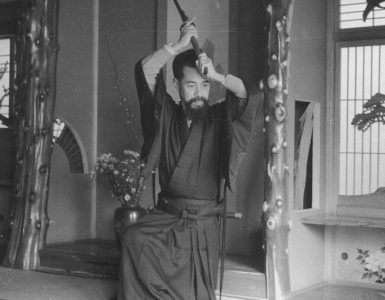
During the late 1940s and early 1950s, Ueshiba engaged in extensive private training during the day. Morihiro Saito served as his training partner most of the time. The founder was especially absorbed in the study of the aiki ken and jo. One of the main influences on his study of the ken was the Kashima Shinto-ryu sword school. In 1937, Ueshiba even formally joined the Kashima school along with Zenzaburo Akazawa. Instructors from this ryuha paid weekly visits to the Kobukan Dojo where they taught the Kashima curriculum over a one to two-year period.
Although he did not personally participate, Ueshiba would regularly observe the sessions that consisted primarily of weapons training. The large number of weapons techniques contained in Ueshiba’s 1938 training manual Budo provides further evidence that the aikido founder had an abiding interest in this subject starting around the mid-1930s.
The postwar Iwama years were extremely important to the development of modern aikido. Ueshiba began to systemize his techniques into related groupings and cover the same techniques over and over again in practice. He would moreover teach techniques starting with the basics and progressing to advance levels. The founder stressed that every little detail must be correct in the performance of a technique. It was also around this time that he started using the term “takemusu aiki.” This concept represents the highest level of aikido where one becomes capable of executing spontaneous techniques perfectly suited to the nature of the attack. In fact, it can be argued that the birth of the modern form of aikido coincided with the emergence of the concept of takemusu aiki during the Iwama period.
In 1970, the year following the founder’s demise, a new tradition had its beginning in Iwama. Every year on April 29—a national holiday formerly celebrating the birthday of the late Emperor Hirohito—a service commemorating the passing of Morihei Ueshiba is held in front of the Aiki Shrine. This service is hosted by the Aikikai Hombu Dojo and organized by Morihiro Saito and the Iwama Dojo. The ceremony inside the Aiki Shrine is conducted by Omoto priests dressed in their traditional sky blue and white garb. The “Aiki Taisai” has grown in size over the years and this year’s event was attended by some 900 people. Practitioners from all over Japan and foreign students from abroad come to pay their respects and witness the Omoto service remembering Morihei Ueshiba.
Iwama was indeed a special place for Morihei Ueshiba. It served as a refuge during the stressful times of World War II and provided the perfect setting for years of intensive training and introspection. The oft alluded to concept of “takemusu aiki” was a product of Ueshiba’s training during the Iwama years. So it was with his focus on weapons practice as an integral part of the aikido curriculum. Certainly, the argument can be made that since Morihei Ueshiba was continuously refining his aikido he was at his peak at the end of his life. Yet many who knew and trained with the founder in his late 60s and 70s point to the Iwama period as his prime. From all accounts, Morihei’s physical vigor, technical precision, and spiritual awareness during these years were truly amazing. This view added to the fact that the founder set up Iwama as his private training and spiritual retreat make a convincing case for considering Iwama as the birthplace of aikido.
Concluding remarks
I first visited Iwama in July 1969 together with William Witt who would soon become the first foreign uchideshi at the Iwama Dojo. I had trained with Morihiro Saito Sensei at his Sunday class at the Aikikai Hombu Dojo the summer following the founder’s passing and was curious to visit Iwama. It was not until the summer of 1977 that I was able to arrange my life such that I could return to live and train in Iwama. I spent a total of 4 ½ years practicing at the Iwama Dojo before relocating to Tokyo. Over the years I have attended the Aiki Taisai on about 15 occasions and regard it as one of aikido’s most important unifying events.
My research work has afforded me the opportunity of interviewing people such as Morihiro Saito, Zenzaburo Akazawa, Shigemi Yonekawa, Gozo Shioda, Koichi Tohei, Sadateru Arikawa and the late Doshu Kisshomaru Ueshiba over a 25-year span. All of these and numerous others have provided invaluable insights on the importance of Iwama to the development of postwar aikido.
At one point in time, the Iwama Dojo and Morihei Ueshiba’s home in Iwama were in danger of being torn down and the property sold. Fortunately for the aikido world, this sad fate has apparently been averted and these historical structures and the Aiki Shrine remain intact as a monument to the genius of Morihei Ueshiba O-Sensei.
Stanley Pranin
August 2001
Las Vegas, Nevada
—————————————————–
Watch these videos for insights into solving the
technical problems that hold back your progress!






would like to visit iwama one day.