
 Josh Gold
“He went down easily. I had only used one hand from beginning to end!”
From the start of my involvement in aikido I would find myself using physical force in an attempt to salvage techniques that were not working. I was not alone in this regard. Virtually all of my peers were doing the same thing. I don’t think any of us understood why our techniques weren’t working.
Clueless about relaxation
Our teachers endlessly repeated that we needed to learn to relax. So in our attempt to achieve this state of relaxation we would try to visualize the flow of ki in our arms and bodies. On other occasions, I can recall even trying to make my arms go completely limp. My idea was that perhaps I would get lucky and discover this elusive state of relaxation through experimentation. None of the things I tried worked.
In the end, when I found myself under pressure to complete a technique against a resisting attacker, I would revert to using physical strength. Doing this always felt wrong. I knew it was antithetical to the principles of aikido. But the fact is, I simply ran out of alternatives and didn’t know what to do.
Faking it as a teacher!
After a few years of training, I found myself in a teaching role. Here’s how I got around the problem of not being able to handle a strong opponent. Since I knew the techniques I was best at, I would look around the class to see who was there. If someone was strong and tended to resist techniques, I would simply avoid calling that person to serve as uke. I did not want to risk being embarrassed in front of everyone!
Only many years later when I began teaching privately isolated from most of my peers did I began to find a solution to this perennial problem. There were few students in our group and several of them were physically quite strong, much more so than me. I could not get around calling up everyone to take ukemi because so few people were present. Also, I was training myself along with the members during the entire class. Everyone knew if your techniques worked. There was no place to hide!
The importance of positioning
For the first time, I began to pay close attention to how I positioned myself before attempting a throw. I found that by getting well to the side of my attacker and out of his immediate reach that I had more success. I could see that uke‘s force was effectively neutralized if I could get to his blind spot. This was a major breakthrough and I began systematically setting up techniques this way.
But there was another hurdle I had to overcome. I still could not cope with the physical strength of certain members due to their powerful grips. Since I was having good success by altering my positioning strategy, I was eager to find a way to prevail against strong grabs too. Here’s how I solved this problem.
Body unification
We did a lot of katatedori techniques and I began to notice certain things. First of all, I gave up on the idea of using any physical strength at all. But I also knew from my past experimentation that I couldn’t succeed by attempting to remove all strength from my body either. What other possibility was there?
I began to visualize myself as a unified body. When someone started to grab me, I no longer felt that he was merely grabbing my hand. I began to realize that it was my entire body and mind receiving the attack. My partner would target my hand, but I was no longer reacting to his grip in isolation. Even though he was of superior strength, his only point of contact with me was my wrist.
I began to understand that if I was not resisting his grab specifically but responding with my entire body, I could assert control while executing the technique. If he was grabbing my hand, I was still able to move other parts of my body like my legs and hips. Also, I still had a free hand. I found that if I didn’t tense my arm I could use my grabbed hand more as a steering mechanism backed by my unified body. I could alter the line of attack by subtly adjusting my hand position and twisting my hips.
After a few years of training, I found myself in a teaching role. Here’s how I got around the problem of not being able to handle a strong opponent. Since I knew the techniques I was best at, I would look around the class to see who was there. If someone was strong and tended to resist techniques, I would simply avoid calling that person to serve as uke. I did not want to risk being embarrassed in front of everyone!
When I moved to my uke‘s side and he noticed that the dynamics of the technique were changing, the strength in his grab began to wane. He realized he was loosing his balance and lost his focus on grabbing. From there it was easy to destabilize him thereby nullifying his strength advantage. The key realization I had was that it was first necessary to unbalance my uke in order to use my arms effectively without tensing. Under those circumstances it was indeed possible to “relax”.
Confronting Goliath!
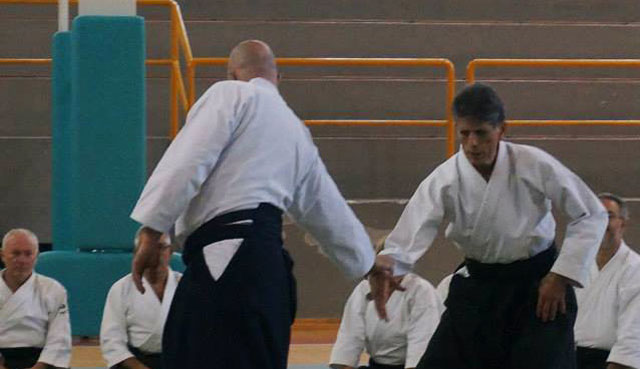
In concluding, let me tell you what happened last month. I was teaching at a seminar in Italy. There was a powerful man who was a leading instructor in his country, and he still liked to train. He is about 6 feet 2 inches and weighs around 250 pounds. In the old days, I would have been overwhelmed by someone that large.
I was demonstrating a technique from kosadori, a cross hand grab. He grabbed me, but I could tell he was not using full power. So I asked him to grab me as strongly as he could so that he would be convinced that the technique worked without requiring the use of power.
Without confronting the strength of his grip, I kept my forearm totally relaxed and stepped to his side while turning my hips. From there I was able to reverse his hand easily and his balance began to falter. I was then able to advance against his outstretched arm and lead him while lowering my hips. He went down easily. Then I realized that I had only used one hand from beginning to end!
For the first time, I began to pay close attention to how I positioned myself before attempting a throw. I found that by getting well to the side of my attacker and out of his immediate reach that I had more success. I could see that uke‘s force was effectively neutralized if I could get to his blind spot. This was a major breakthrough and I began systematically setting up techniques this way.
It dawned on me that for many years I considered such things to be impossible. It was sheer ignorance on my part. It turned out that my way of viewing things was deficient. The solution lay on a conceptual level.
I’ve done my best to describe the process I went through to make these discoveries. I do wish to state clearly the following: it is possible to consistently execute effective techniques on a larger and more powerful opponent without the use of physical strength. The whole rationale of aikido rests on these principles. This applies to you in your own training whether or not you believe it now.



Thank you Stan. I am myself on the discovery path for several years now. Your comments might have saved me at least another couple of decades.
Let’s hope so!
I fully agree with the process that you describe.
Here are some suggestions that may help:
As tori as well as uke, make your whole body like a vehicle with its transmission in drive: it’s relaxed yet ready to move immediately.
When training with grabs, (katate, ryote dori, etc), slightly move the target starting from your hips while uke is committed to his attack. It will be much easier to unbalance him at the time of contact. The same principle can be applied to strikes.
I sincerely hope that more students and teachers wake up as a result of your researches and publications.
Patrick Augé
Hi Patrick,
I am also doing exactly what you described and it works wonders. Sometime very soon I will put out a video that describes this process. I’ve tested these concepts in the last couple of years in 5 different countries. I’m convinced that this is a worthwhile direction.
Hi Stan
Thanks for a refreshingly honest article about your journey. I think that the “strength” issue is something that most male Aikidoka go through whereas the ladies seem to go down the technical route a lot sooner out of nexessity.
waremest regards M.
“Don’t focus on what you can’t move, focus on what you CAN move.”
I thought of an analogy that might be useful. Consider cornering a car or bike. There are sweeper curves. There are increasing and decreasing radius turns. There are S’s… Now, consider that when demonstrating in front of a class you want to use big, easy to see moves – sweepers. These are usually possible by staying just at the interface of uke’s strength, taking the outside of the curve. Sometimes there are difficulties. If there are, considering “changing your line”, going to a smaller radius. The hand gets closer to the hip. The hip puts the whole body behind it… and of course along a path of low resistance. I’ve been doing that for a while. I used to attract some attention, when I still visited other schools. I would look for the big, strong, difficult guys because they were more interesting, and ended up collecting a lot of apprehensive glances. I only came up with this way of explaining what I’ve been doing the other day.
Paths of low resistance are a somewhat separate topic. Consider that there is a zone in which we can be strong. Outside that zone is pretty easy to see, taking the “sweeper” on the outside. The weakness on the inside is a lot trickier, but it’s there.
Hi Stan,
Thanks for sharing your experience and all the tremendous work you’ve done so far !
I have a question or an on-going reflection. I can understand it’s important to be able to apply techniques with “strong” opponents, but on the combative aspect, isn’t it a mistake to let ourselves be grabbed so strongly? As if I let my opponent strike me before moving ? I know the comparison is a bit far fetched but please share your thoughts.
Thanks, friendly regards
Fred
Yes, it’s an interesting dilemma. My take is that you need to practice being grabbed, all the while repeating that it is best not to be grabbed. This is because we’re imperfect and can be caught unawares. If you have practiced being grabbed really strongly you can learn to react instinctively in ways that allow you to deal with such attacks. From there you can raise your technique and awareness to a higher level so that an attacker can easily dominate you from the start.
Hello you all! ^^
Sure that being grabbed by a strong blacksmith may cause trouble, especially if you wait for the the grab to be in a quite strong position.
I believe that the main thing about relaxation is to keep the ability to feel the grab precisely. I mean that tori has to preserve his knowledge of the direction of the grab, because a strong grab is never neutral in its direction. It can be downward, upward, left or right, strait or not or whatever.
The second thing I believe is that if tori waits for the attack to be complete, he’s dead (virtually or not). That means that tori must be moving in the same momentum of the attacker and not forget to make an atemi (no need to strike) after being positioned as you say Stan, to keep the attacker’s mind busy, and stop only then everything is over.
A good way to find a relax body is to practice kokyuho drills.
Keep care, have a good keiko!