
 Josh Gold
“If uke has the mindset that there is a risk of being struck,
it will mess up his ability to attack strongly and sincerely!”
 Last night Bob and I were training. The technique we were working on was munadori kotegaeshi. Bob has been studying aikido for about 15 years. He’s a strong guy and a good athlete. One of his hobbies is rock climbing so he has a strong grip and tends to tense a lot. Normally, it is fairly easy to deal with his techniques because you can predict his movements through the tension in his arms.
Well, last night midway through practice, Bob let loose with a perfect atemi, a strike to my forehead. If I had not dropped quickly backward, he would have surely clobbered me in the face.
I’m always taking about how useful atemi are in assuring that a technique will work effectively. But usually what happens is that students are tentative when executing atemi, and so their effect is dampened. What is lacking is the strong intention that nage is serious about striking and that uke must quickly react to avoid being struck. A well-executed atemi can often pave the way to performing an effective technique without the need to resort to physical power.
Another point I often mention is this: if nage is serious about striking and does so with full intent, thereafter uke will behave differently in training with this particular partner. The reason is that uke will become aware that he must respond quickly in order to escape being struck. If uke has the mindset that there is a risk of being struck, it will mess up his ability to attack strongly and sincerely if he knows his training partner is serious!
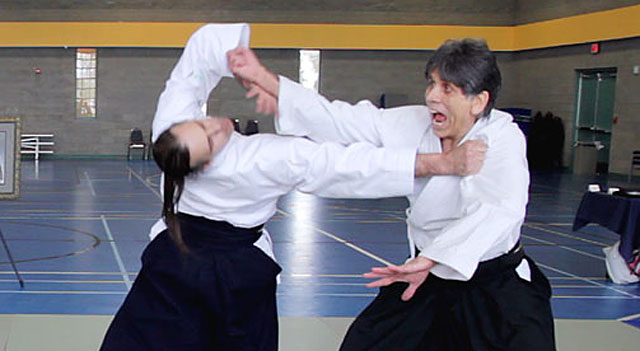
From that point on, uke will be at a great disadvantage because it will be hard to focus on executing a strong attack. This will sure carry over into the practice of other techniques and may become a permanent reaction. It is equivalent to becoming “gun-shy”.
I experienced exactly that myself and I was quite amazed at how much it affected my attacks thereafter while we were practicing this particular kotegaeshi technique.
In layman’s terms, I believe what is going on is that the brain is overwhelmed by the intensity of the stimulus — in this case, the strike to the head — and reacts instinctively to protect itself. Reflex takes over in an attempt to escape from the present danger. There is almost nothing one can do to overrule this type of automatic reflex.
Atemi strikes are a regular tool I use when practicing aikido techniques, and as an instructor I emphasize their importance constantly.
There are are some practitioners who believe that the use of atemi in aikido is inappropriate. Some dojos discourage or even prohibit the use of atemi. This reveals a poor understanding of aikido’s roots and is in direct contradiction to what Aikido Founder Morihei Ueshiba taught and demonstrated in his own art. Atemi are an essential tool in aikido and to forgo their use will in many instances compromise one’s ability to execute effective techniques.
years. The above article is one of hundreds he has written. His aikido
looks like this.




I think you are 100 % right about this important point Stan Sensei, atemi is an essential at understanding what aiki is.
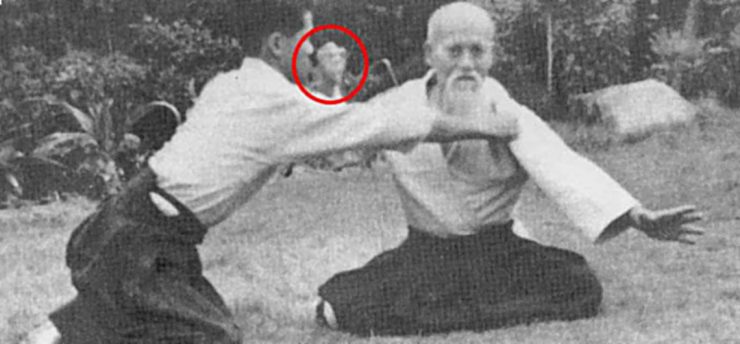
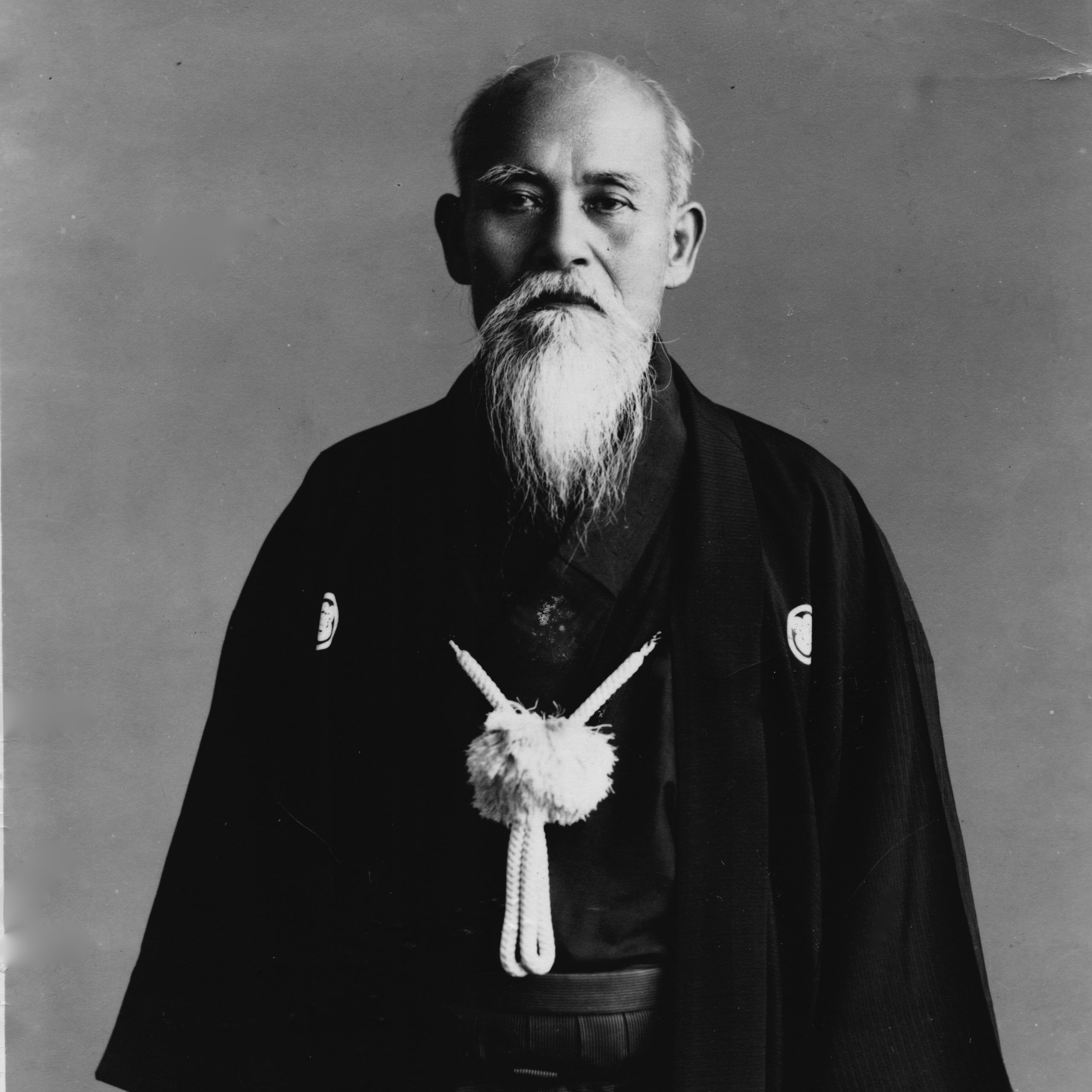
People who say otherwise do not understand what is aikido, at least in budo terms. Now, the picture of o sensei you have used I like very much, as far as i know it’s from 1951 demonstration of basic techniques in Wakayama. Through my efforts, I have managed to obtain 35 images, it really seems to be just a small part of priceless collection! That is as much as i know of it. Do you have more info of it Stan?
Thank you
I can add the name of O-Sensei’s uke to what is known about the rare technical photo series. The man’s name is Naritoki Hirano. He was a devoted student of the Founder from Tanabe after the war. I met him on one occasion in Tanabe. He was kind and gentlemanly.
Most of the photos from this collection that I have seen were published in one of John Stevens’ books on aikido in English.
I’ve been taught that “disturbing the space” is critically important. Most of the time this will be done by atemi, but sometimes I’ve had senior students and senseis make a feint with their torso, move their fist slightly towards me, or even touch me with their foot to create what I can only describe as a neurological response that makes it easy for them to get kuzushi.
This is more of a question than a comment and I’d be interested in Pranin-sensei’s and other opinions: What some call might call Aiki (as with ASU’s Kokyu Tanden Ho practice for example) often seems to blend the disturbing effect of atemi with the finishing move. Energy seems to jolt up and draw uke’s shoulders from behind (into the “ikkyo curve”) and then tugs his/her center. In suwari, hanmi handachi, and standing waza, nage tries to replicate the same feeling while moving off the line of attack and adds tai sabaki with drops the center. Not that it’s that simple! 🙂
But to Pranin-sensei’s point, I can remember earlier in my training when a technique wasn’t working right for me because uke was resisting, the instructor told me to add a punch to the face. “But remember,” he said, “it will be your turn next!” Nishio-style, Iwama-style, Yoshinkan, Tenshin, and O-Sensei’s Budo manual all emphasize atemi. I just watched O-Sensei in the first five minutes of “Morihei Ueshiba – Takemusu Aiki DVD” on YouTube (https://www.youtube.com/watch?v=l4GjJk9TkLc). It’s only 7 years after the war, The Master is 69 and in great form, and the only time that he doesn’t use atemi when he’s tossing around Tohei, Saito, and everyone else is when he offers them something to grab–the jo, a shoulder, his arms, etc.
In this YouTube video (https://www.youtube.com/watch?v=AJ4ry_eyCLc), Saotome-shihan repeatedly offers or points his hand, in effect “disturbing the space” of uke’s shomentsuki, strikes while moving ever so slightly off the line with perfect timing. Sensei alternates between ikkyo, kokyunage, and some really cool elbow and palm strikes to uke’s torso. The video finishes with Sensei illustrating the same principles with several different paired-sword katas.
Regarding the first few minutes, an argument could be made that Saotome-shihan’s arm movement is a softer substitute for an atemi (tegatana or hammerfist perhaps) to the outside of the attacking arm. But execution of such a strike might make the technique that follows (if any) very different. I would draw everyone’s attention to time marker 2:06—Sensei demonstrates first the inside punch, and next the soft throw after that, as essentially the same technique! (At least that’s my read!) But of course, we haven’t all been training since the late 1950s!! 🙂
Keeping in mind Saotome-shihan’s ability to seemingly reach out and control his uke’s attack before they even move, I ask, with genuine curiosity: Is all proper atemi “aiki”, and is all aiki “perfectly executed atemi”?
Thanks, Pranin-sensei, as always!!
I say Amen ! to your comments about atemi, Pranin Sensei. It not about violence, but unbalancing uke’s body and mind, and sharpening awareness. It also helps our sense of distance, establishing proper spacial relationship.
There also seems to be a close and important relationship between atemi and kiai. The times I have been “popped,” responding too late to an unexpected atemi were all instances where atemi was used without kiai. Likewise, the only time I can remember injuring a training partner with atemi is an occasion where I used atemi — without –an accompanying kiai. Executing powerful kiai – with atemi – seems to arouse uke’s responsiveness. This not only makes the technique more effective, but most importantly, it “wakes us up” at that critical moment to avoid injury. In this way kiai acts as a protective training device when using atemi, to avoid injuries.
But I must confess – beware that kiai can have unintended consequences: Last weekend at a large East Coast seminar I blasted out kiai – and it “kimochi o toru” – stole my partner’s balance resulting in almost no physical force needed to down him. But woe unto me I forget where I was – kiai shattered the placid aiki kai atmosphere. Everyone – almost 100 students – FROZE in shock and terror! What awful event had just occurred? Only when the teacher chuckled and reassured them everything was ok, would they return to practice. Embarrassing, yes – hilarious – absolutely…..
Great comments as always, Tom! I can just picture the looks on the faces of the participants in your recent seminar.
Thank you.
ATEMI AND AIKIDO……………..
As with most of the original students I came from a Judo background. The shihan who were teaching aikido at that time were budoka holding high grades in kendo or judo In the cases of Abe shihan 6th dan in both as was Nakazono shihan. Being judoka we would not give up our balance easily and it was emphasised that ATEMI MUST BE USED IN EVERY OMOTE TECHNIQUE and in most ura.
Today many aikido clubs do not use atemi and to be brutally frank it is because it is not needed because their “attacker” has spent more time learning how to fall rather than how to attack. There are even videos on how to fall “correctly” I “learned” how to fall by being thrown continuously and no two breakfalls were identical.
The problems that aikido faces today I feel is because many have chosen to “take that part of aikido that appeals to them” and eschewed the rest to the detriment of the art.
Aikidoka should be trained in atemi and how to receive atemi (sweep it aside) even as they themselves attack.It is the norm in Kokoro Kai club to block an atemi while attacking even beginners find this important.
ATEMI ARE NOT USED TO DISTRACT as such all atemi should be powerful and accurate the one’s usually described as “distracting” should be aimed at the head and if not blocked should strike the head. The intent is to unbalance backwards to the side in most cases so the atemi should attack a kuzushi.
POINTS ON ATEM…………
I
They must always attack a weak point.
They must always attack the kuzushi
They must be delivered on the move
They must always be accurate and powerful
I have little time for “associations” and “different schools” of aikido.Effective aikido is effective aikido. It is those who stand between the student and O Sensei’s art and say “It shall be like this”
meaning their personal preference that I feel has led to the splintering of aikido today.
Another principle not always followed is that we should NEVER ATTEMPT TO THROW SOMEONE WHO HAS NOT BEEN UNBALANCED PROPERLY FIRST
Someone who “gives” his balance or colludes in any way with the execution of the technique has NOT BEEN PROPERLY UNBALANCED FIRST.
Another principle that many are guilty of is ignoring the fact thatWE SHOULD NOT ATTEMPT TO TAKE HOLD OF SOMEONE WHO HAS NOT BEEN UNBALANCED PROPERLY FIRST.
Which brings me back to ATEMI IN A REAL SITUATION IS 90per cent OF AIKIDO (O Sensei Ueshiba)
” Every omote technique must be instigated with atemi” (Saito Shihan and many more)
Kiai strengthens the impression of atemi, maybe even their actual force. Please consider the critique of Lou Fields (Capt, USN Aviation and ex boxer), “That will maybe stun somebody, but it isn’t strong enough to do much damage.” Atemi are to disrupt your opponent’s mind, timing and maybe stance, to gain, regain, or maintain the initiative. If they aren’t actually surprising they will simply cause a defensive move, locking up, blocking up or retreat. Not to worry, though. Making the opponent stop means they have to regather, replan and reaccelerate. In that time you can be leaving, or dealing with another “customer”. Avoid the temptation to attack their defense. That has never ended well for me.