
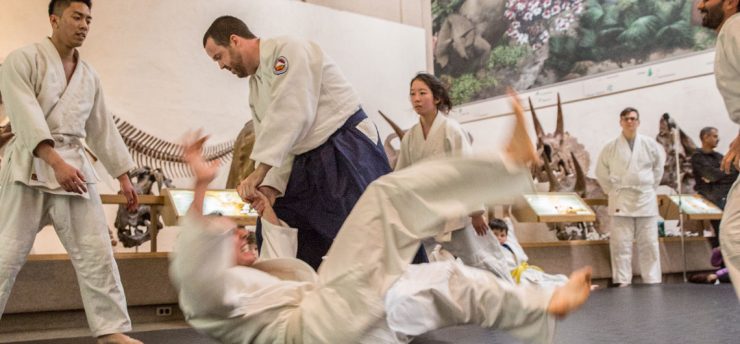
 Josh Gold
Without embellishment, here are a few highlights from aikido guests who have not returned:
“I was surprised that your class had so much… jutsu.” – Student with several months of aikido experience, looking for a new group after relocating.
“Your students are not very good uke. They do not fall at the appropriate time.” – Student with several years of experience of study with a prominent teacher.
“Thank you for the great class, I’ll bring my hakama and one of my black belts next time.” – Student who was disappointed to learn that all beginners wear a white belt, and politely declined my offer to lend a white belt.
“My other teacher said it didn’t matter if I could do ukemi on both left and right.” – Student who reported several years of aikido experience.
“I had a fantastic time! It’s great I’ll be able to earn hours toward my next ranking exam while I’m at college.” – Student who was disappointed to learn this wasn’t going to be the case.
“Can I get my picture made with you to send to Sensei back home?” – Tourist.
“I have always been curious about the Yoseikan and would like to come and train with your class.” – Person who did not disclose that he was the shihan of his own martial arts school.
Contrast that with the students who have come and stayed, or trained even a short time with the “here to learn” attitude: these students have some sort of prior exposure to a rigorous formational discipline of some type, a few from a prior martial art, others through a practice grounded in a spiritual study, others from their parenting. Perhaps some have simply experienced hardship and discovered the tools for themselves.
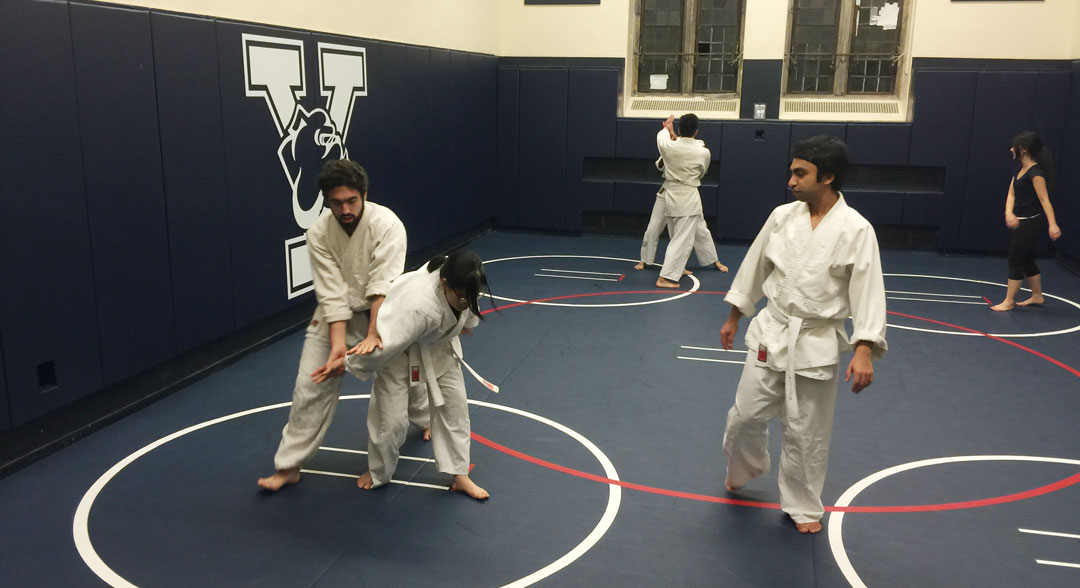
I recently asked Patrick Augé Sensei, leader of the International Yoseikan Budo Federation in North America, about interacting with aiki-visitors. His answer was the Japanese proverb, “When in the village, do as the villagers.” (Gou ni itte wa, gou ni shitagae.)
When in Rome. That’s not only a guide to behaving as a guest or as a visitor to a new dojo, it’s essential to opening oneself enough to learn. If you thought enough of it to spend time preparing, travelling, and stepping onto the mat, just give it the benefit of the doubt. If you want the exact same experience and techniques – and more importantly, the exact same status and comfort – then why leave home?
Here then are suggestions for visiting another dojo or class (not just Yale Aikido):
1. Adopt the mind of the beginner. Are you coming to the dojo to get attention and status or to study and learn?
2. Focus on your dojo and your teacher. Are you sure you should be looking for a new place to train instead of making arrangements for your solo practice and returning periodically to your home dojo?
3. Come with a non-taking posture. Aim for non-taking rather than contributing. Coming to a first practice with a goal to contribute will lead to disruptive eagerness to show your way of doing things. Hikers have a principle of leaving a campsite the same or a little better than they find it. That applies very well to the dojo.
Some dojos receive transient students often and publish a mat fee for visitors (we do not), though this is only one component of your goal to be a neutral presence. Make an effort to participate without detracting from the practice of the regular students.
4. Make the way smooth. Omiyagi can be a reassurance that you are not coming with a consumer attitude. Other mindful approaches include arranging your visit in advance instead of arriving unexpectedly, observing an entire class mindfully before asking to participate or, if you are high-level practitioner, asking your teacher for advice and a letter of introduction.
5. Remember that you represent your previous teacher. If you cite your lineage, you are your teacher’s ambassador into a larger world. This is about behavior and not technical prowess – use humility as a guide and you will consistently land in good territory.
The above article originally appears here and is published in Aikido Journal with the cooperation of the author






Good one Varley-San! Totally agree… The humble way!