
 Josh Gold
“I kept imagining what had transpired and tried to conceive of some alternative courses of action that would have spared him this beating.”
I attended an aikido seminar recently. I had a very interesting conversation with an attendee that I would like to relate to you.
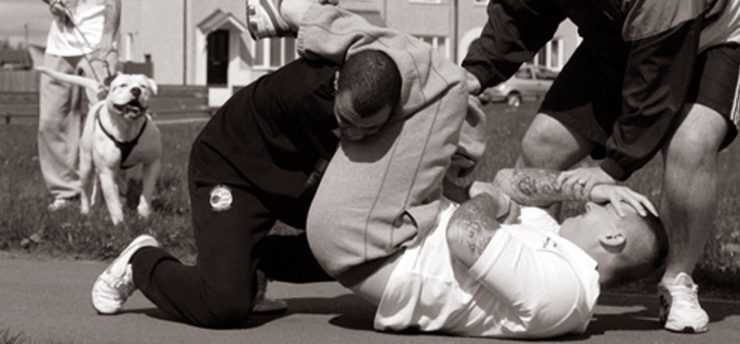
This young man, an aikido black belt, was involved in an altercation in which he was badly beaten. He fortunately emerged without any permanent damage other than a black eye and several noticeable facial lacerations. Here is what happened as far as I can recall.
The man exited a building at night to find six attackers beating up a lone man who was on the ground and bloodied. The aikidoka immediately entered the fray to help the victim and successfully dealt with a couple of the attackers. However, the entire group stopped their attack and turned their fury toward him. The victim ran away leaving our aikidoka alone to fend for himself.
The group of six proceeded to pummel and kick the aikidoka until several people saw what was going on and intervened. Obviously injured, he was taken to the emergency room of a nearby hospital where he was treated.
Forgive me if I don’t have all of the details exactly right, but that is the gist of the story. As I lay in bed that night, it took me a while before I fell asleep. I kept imagining what had transpired and tried to conceive of some alternative courses of action that would have spared him this beating. I came up with a couple of scenarios that are, of course, pure speculation. Nonetheless, it occurs to me that it might be an excellent mental exercise to go through in case one should find himself in a similar situation that required immediate action.
Ironically, I was speaking with two other long-time friends at the same event who told me about a somewhat similar incident in which a couple of aikidoka confronted a gang to “test their skills,” and one ended up seriously injured and in the hospital.
So using this channel of the Internet where we can reach a worldwide audience, I would like to open the discussion to all of you to gather your feedback, which I highly value. Here are some relevant questions:
What are some possible alternatives that the young man had in the situation in which he found himself?
Was he right to act immediately by himself without first calling for help?
Have you ever found yourself in such a situation? What did you do and what was the result of your actions?
How can we use aikido in such situations where we feel compelled to physically intervene?
Please post your comments below.


 Antonio Aloia



I’ve never been in such a situation so can only speculate. However, I think that the first thing to do is to dial 911. At least then you would know the calvary is on the way (hopefully) as you dive into the fray. Admittedly, police response time can be somewhat unpredictable. BTW, I am a reserve police officer so please don’t think I am criticizing law enforcement…I am just being realistic.
Another option open to most of us is to carry a concealed handgun. While I agree with my Sensei that a firearm isn’t appropriate for every situation, it does provide those who feel they should intervene another option. (I am not suggesting that one just starts shooting.) There are potential legal ramifications but it could help equalize the situation.
In my world travels, I have encountered several instances where I felt it necessary for me to intervene to prevent some violent injury to someone. At least once I discovered it was doing the wrong thing and the person being beat up was indeed the attacker! It taught me to assess the situation before I got involved.
I will not stand by to see someone being beaten by a group of people. If there is a 911 capability, of course use it. I did not begin study of aikido in 1958 to simply do dojo practice. I was in the USMC and as a professional warrior, (there is something to think about!), I anticipated using aikido techniques in combat.
It has served me well in both avoiding situations requiring my skills, and in using those skills to help someone in distress. Even at an advanced age, late 70’s, I will not hesitate to use whatever skills I have to assist someone if they are being preyed upon. And, I will not be gentle or use dojo sensitivity on thugs.
Call the police and wait for them.
To get involved directly against six people who may have concealed weapons themselves is foolish to say the least. If six men are attacking you or your loved one directly, then that’s a different story as you have no choice, but to intervene by yourself against six people is foolish, dangerous, and may well cost you your life.
If that’s where you’re coming from philosophically, then that is the correct response.
What drew me to Aikido was Morihei Ueshiba’s philosophy of compassion for all parties, even the attacker. Having been a Buddhist and a current follower of Hindu philosophy, I see a common thread in the east… where the idea of “self” ultimately is lost – and all are seen as family (both attacker and victim a like.)
So if one has that frame of reference, then getting involved, even to loose their life is rational.
It may seem like I’m waffling on my opinion here, but I think either way of getting involved or not, is correct – as long as you remain true to your own belief. The worst thing is to want to get involved and do nothing out of fear. Or to get involved out of ego, and end up dead. To make an action that is in harmony with one’s will seems the most appropriate to me. Whether that means getting involved or not.
Well put.
But sometimes you got to do what you’ve got to do …
That’s why I wrote:
” If six men are attacking you or your loved one directly, then that’s a different story as you have no choice”
I had a similar experience on the campus at Ohio State just after the Rodney King verdict came down. There were some small riots and groups of disgruntled African Americans walking up and down the main street next to campus where all the shops and bars are. I was going out that night to meet with some friends (probably not the best choice, but I was a young college student) and was walking past a side street when I saw a group of young black people punching and kicking a blond white girl on the ground. I ran over, grabbed the girl by the arms and hauled her out. I did not try to engage her attackers, and fortunately they did not attack or pursue us. It’s possible they did not attack me because I did not attack them, or maybe they felt some shame after seeing her crying and staggering away with me, I’ll never know. But I got the girl home safely.
This was actually before any Aikido training, but I would do exactly the same today. As others stated, it would have been stupid to try attacking the people in the group. Actually, it would be counterproductive since I couldn’t have fought her attackers and got her out at the same time. Every situation is going to be unique, and your response will vary as well. It’s difficult to say what is the “right” response, but as others said, some are probably wiser than others….
It is not a movie, it is not a dojo guys- it’s a real world danger. So don’t even think of attacking someone you don’t know and not knowing what are they capable of. Please don’t be deceived by the fact that you are training in budo. There is very little chance you will succeed in situations like this. In most cases, physical techniques are the very last thing you should rely on. Also, you can’t ignore the act of violence, we must help each other, the way we can.
So as an aikido practitioner we should utilize the strategy of aiki. Whats that? It’s about not leaving any openings in your actions that can cause additional damage to him or to yourself , first trying solving the problem mentally.
The sequence of actions could be: Seek help, if there are no people visible around, call the police and ambulance, or ask somebody to call it for you if possible,as you don’t want to loose time. Next keep your distance, make the attackers know that they are not alone, shout a loud kiai if you can, show them your mobile phone informing that the police is on their way. In most cases they should flee. You might also try to affect their conscience, yelling that the man is your friend, and you are not going anywhere, and if they will continue the man is going to die.
Really, you don’t have to play a hero in situation like this by atacking a group of people. O sensei used to use a term ”kotomuke no awase” meaning literally ”words face-to-face blending” what it means that before resorting to fighting you should try to affect the attacker’s mind, that he himself refuses to attack.
One never knows when or how he will be truly tested. We can go over this situation as much as we like but keep in mind hind-sight is always 20/20. I like to think results count and in this one a beat down was interrupted, the Calvary arrived, and everyone got to go home and reflect.
I have intervened in violent situations on many occasions over the years, most of them a long time ago. I don’t know if it’s something to do with getting older, but I don’t seem to come across these types of situations so much any more. I once came across 3 guys kicking the life out of this guy, his only crime was, he came from a neighbouring town. He was rolled up in a ball on the ground and was repeatedly getting kicked in the head, etc, I just got in between them and pushed them away as much as I could, stating that he had had enough…. Luckily enough, it worked and they left. The guy, although badly beaten, bruised and bloodied was eventually able to get up and stumble on his way. However, the one that really sticks in my mind, is when I came across this guy beating his girlfriend up. She had a bloodied nose and he was repeatedly smacking her in the face, I intervened and managed to get in between them, to stop him from smacking her, he was non violent towards me, however, imagine my surprise, when said female, punches me in the head from the rear and starts pulling my hair (It makes me laugh now). She was easy to deal with, and she ended up sitting back on the tarmac, and I made a quick exit, to leave the love birds to it. There is a lesson in there somewhere. Apparently, this may not be as uncommon as it seems! How bizarre!
Indeed, simply put, machismo it´s not only a “belief” inculcated to the males.
First of all, I would like to say to the young man that helped that victim, “Good work!” There are too many people that are frankly, cowards, and not only would not have helped, but would not have even called the police. As a former bouncer and jerk, I can tell you firsthand that when you are one against many, you appreciate any help you get, and resent anyone that could have helped you, but chose not to. I have high regard for his spirit!
Technically, it’s hard to be critical or say what he could or should have done. In the moment, your training will either save you, or fail you. That he was able to weather the storm is luck, combined with a great deal of mental forbearance, and a bit more luck. If you think that chance doesn’t have a factor in real fighting, well, I’m going to just say you’re wrong.
Weapons. Plain and simple. Train them. Learn them. Use them. In a real fight like that, you have to dominate immediately. Any weapon, or anything used as a weapon, is a great equalizer against bigger, stronger, and multiple attackers. I make all of my students train in Kali. We then look at how those techniques can be applied from an Aikido standpoint.
I have seen first hand the hypocrisy of Aikidoka that claim to train as a martial artist, but think me poor for having used Aikido a LOT in fights. Crazy, they call me. I say, eh. This is supposed to be a martial art, period. Martial arts includes the use of weapons. “Bu” literally means “holding the spear at bay” or something along those lines. Most people that train martial arts do so with the expectancy of never having to deliver the goods, under duress. They have “fun” and their classes are “safe.” I read in one of Saito Sensei’s books that “it would have been preferable to have been beaten up in a real fight than go to class at times.” Well, there is a reason for that.
Well said. Weapons, weapons, weapons, when facing larger or multiple attackers. I carry a collapseable police baton in my pocket at all times, and have received some training from LEO friends.
Real life confrontations are not a choreography between well trained Uke and Nage. When I’m on the mat, especially with brand new students, I will not practice a technique with them until they offer an honest attack. I tell them if their attack connects with me then it’s MY fault, not theirs, and that when they offer an honest attack it makes BOTH of us better Aikidoka. If they don’t know how to give an honest attack, I’ll show them or have our head Sensei show them. This way both of us can grow in the art.
Interesting article that makes you think whether this is really worth it getting involved to help someone you do not know on the street and when you end up surrounded by multiple attackers the unknown person you were rescuing flees the scene leaving you on your own. Is this really worth it? I would say no personally, as I was involved in fights in my previous years working as Doorman in night clubs and knowing Aikido, I have always felt I was lucky as you then re-think of the entire situation and keep asking questions what if so and so had a sharp object or knife or worst a gun? What if I did not move fast enough or if I was in a spot where someone hits me behind and I did not see. I could be lying on the ground and die and leave my love ones… You do end up asking if this is really worth it overall. The only reason I was involved in these kind of situation was that it was part of my job to intervene and as I am no longer involved in this kind of job (which was dangerous, I have to admit) you do have a choice: walk away and call the police or take a risk to intervene trying to assist the person in danger…
I have my reservations about getting involved in any fights and would only intervene if it was a member of my family in danger, but if someone I do not know, I would have to be honest I would simply walk away and call the police. This sounds cruel but in this situation, the man who intervened to assist the person in danger was not himself in danger to start with and made a choice and was ultimately let down by the unknown person who escaped and let him be on his own to defend against the attackers. If I was surrounded by a group of gangsters or thugs then it would be different as I would be in a different position where I cannot chose but to defend myself or to run away if possible… I hope my experience is helpful to anyone who has not yet been involved in this kind of situation and thinks after a few years of training in any Martial Arts will make him feel ‘invincible’ and would make an error in ill-intervening. Trust me, I have been in this position and now I am lucky and glad to offer a wise and good advice to anyone. Street fighting is different from training in the dojo: dojo training has rules, but street fighting has not got any. People will do anything and fight like cowards – stabbing behind you when you do expect it least.
Well said.
Taking one step back, how uniquely human for us to spend so much time and energy looking for some notion of an ‘absolute’ – what we would have done or will do or will train to do – with this moment … poof!
How much of our lives would be better spent trying to understand what keeps us from this moment?
“I have my reservations about getting involved in any fights and would only intervene if it was a member of my family in danger, but if someone I do not know, I would have to be honest I would simply walk away and call the police.”
“Aiki is not a technique to fight with or defeat an enemy. It is the way to reconcile the world and make human beings one family.” – Morihei Ueshiba
Judging from the quote above, aikidoka should even consider the attackers members of our family. I think if we would want others to help us, we should do the same.
I think it is a duty of everyone, towards a better mankind to intervene in such situations, no matter which way. Calling the police, trying to reason with the group, grabbing the victim and running looks like pretty intelligent and peaceful ways to avoid a confrontation, as it always should be. And, why not to say, if aikido is the way to reconcile the world and make humans beings one family, this would be also aikido?
But if you choose to engage in a fight, you better be very good at Jiyu-waza against this many opponents, either by always throwing them away and keep yourself safe or, in an not so good-hearted way, make it six 1X1 fights, where the opponent always become incapacitated to continue attacking.
I’m not very good at handling many opponents yet (hope I’ll be someday), so if I saw such situation where waiting for the police could be deadly for the victim, I would try to, at least, disjoint or even crack a few arms and wrists or use atemi straight to the nose. Maybe after the first or second broken arm, the group could get scared and run, because these kind of cowards doesn’t like situations where they’re not 100% sure they can win. Aikido techniques aren’t so deadly during training because we go soft or use ukemi to soften our falls. But applying correct techniques to ‘normal people’ without injuring them is on a total different level, at least to me.
It’s not a very aikido way to approach, but that’s my point of view.
Remembering, a peaceful solution is always the better way.
ps.: Sorry if there are mistakes, my English is not so good 🙂
When ever I am “out and about” I carry my trusty broken Jo cut down to walking stick size… it is a deterrent, and if needs be a fine tool to equal the odds!
When I worked as a fireman, I was told, “everybody wants to be the one to run into a burning house to save someone. If you don’t do it right, there are two people trapped in a burning house and the rest of us need to do double duty.”
Calling for help is mandatory in CPR, to buildings on fire, to a code blue in hospital. Yelling for help, dialing 911 or asking someone else to might have lessened the hero’s own injuries. Arming himself would have been justified and would have made him more effective.
Why he was fighting is something we might never know – the six could have been beating a rapist pedophile or a drug dealer they wanted out of their neighborhood. Not a justification. The six might have been armed, making his intervention dangerous. They might have been undercover police officers, making his Intervention possibly illegal. In any emergency device, assess the scene and gather information.
But, I agree with Autrelle – there’s too many people in the world who are too cowardly to save a life. We are not called to be cowards by our philosophy. At the same time, the world doesn’t need more hotheaded cowboys.
Some Aikido people would also try to avoid injuring their targets in a situation like this – a guaranteed beating.
I thought I commented on this earlier, but maybe missed it with the repainting of the screen as I paged down. We’ve all seen the movie bar fights where everybody is hitting everybody else without a clue as to why or how it started. Please avoid that. Think. Observe. Consider some infantry wisdom – “OCCOKA”, a military acronym for looking at critical points in operational areas and standing for Observation, Cover, Concealment, Obstacles, Key terrain features, and Avenues of approach. Then act.
Remember, in this case YOU are the attacker and you do NOT want to take unnecessary ukemi. First – does this look like a scum-on-scum scrum? Maybe the recipient messed up a drug deal. They can’t take him to small claims court. There will probably be words. If they’re like “You mo-fo’ing… Where’s my f***ing money?” that might be different from “Get his watch, Weasel!”
Now, if you choose to help the defaulting drug dealer, up to you. Here’s a thought. If you’re watching some informal business negotiations “The Chicago Way”, there are probably lookouts. Enter the fray and they will be behind you. Next, what resources do you have? I like pepper. Do YOU carry two? If you use it, consider also some deception, “POLICE! BREAK IT UP HANDS IN THE AIR!” before “SPRAY! DOWN!” while soaking the whole group. as best as possible. THEY don’t know if you’re a plainclothes or off-duty cop.
Might even deter the lookouts from joining in. Calling 911 and leaving the dispatcher on the line might be a thought. Pursue nobody. They just removed themselves from your multiple person problem. Consider your flanks and rear. Being “target oriented” probably killed The Red Baron. If you pile in hand to hand, your first moves will probably be kicks or strikes. Very soon you should transition to what we usually do. Please try to make that transition early.
One of my most impressive students had an experience of a three-man attack. He took out the first and was dealing with the second when the third got him on the back of the head with a bottle. Nasty scar. He said he finished by munching all three out, but… nasty scar. Bob Cornman, a contemporary at old San Francisco-Turk Street, broke up a purse snatch. He had pinned the snatcher and retrieved the purse when the snatcher’s 4 man back up gained his attention by hitting him in the head. He proceeded with the randori fairly successfully, in the sense of survival. The gang retrieved the purse and withdrew.
Very interesting insights, Chuck!
This morning as I look at the thread another example comes to mind from an armed self defense course. The scene was a guy on top of and wrestling with a woman. The student in the course comes on the scene. The particular student related how he made an assumption, drew, and ordered the guy off the gal… who then having her armed hand free, started shooting at the student…
I have to agree with many of you, mostly Marius and Audrelle. But I also have a question to add: how would you feel if a loved one was beaten up, and you later found out that nobody helped?
If we witness an act of injustice passively, we are a part of that injustice. That said, this is not a question of what an “aikidoka” would do. What a human would do?
Then, the scenarios unfold depending on which variables we change, including our own “fight or flee” response to high stress.
So, since this conversation is not only an intellectual debate, but it could be also turned into a lesson, here are the steps I thought of:
1. Begin making very loud noise, while very slowly minimizing the distance between you and the attackers. (Making noise from the distance does not send the signal that the attackers are in any immediate threat.)
2. Call 911 or the equivalent if you are in a remotely civilized country/location. Continue your approach, letting the attackers know you are calling for help, filming, etc.
3. Continue to make noise as to attract ANY additional help. By now, your “fight/flight” response should calm down and you’ve reached a state where you could actually use the adrenaline to your advantage.
4. Continue the approach, using verbal skills, such as the above mentioned “he/she had enough” and/or any extra distraction that switches their violence into any level of thinking (as we know, thinking slows us down).
5. If no help has arrived, they continue to attack the poor victim, and your distance is close to contact, then attack the leader with decisive and most painful strikes.
Depending on your skill, inflicting pain to multiple attackers is faster than taking them out, one by one. Pain also acts as a temporary deterrent.
6. Do not spend time on the leader beyond inflicting pain. Take on the next one with the purpose of eliminating him from the count (without the use of lethal force evidently).
By now, their intention might change. Attempt to lift the victim at least half-way. A down to the ground victim allows attackers to feel overpowering. Take that false sen out of the equation if possible. While helping the victim out, remember to focus any needed strikes to the lower parts of the body, pain inflicting mostly. You will not have time to strike higher than the belly, if so. Take out knees first, ankles next.
If you believe an Aikidoka should not use strikes like in other martial arts, then use Atemi :):):)
7. This remains from #1 all the way. Once you called 911, keep your phone on, do not hang up on the police call. Give verbal instruction during the entire situation, even if it lasts 45 seconds.
8. If 1-7 yielded minimal results, it’s time to step out of any style. Begin combining kiai-like language, highly erratical movements, mixed in with very precise atemi to vital areas. Do not waste time on non important zones. Hit mostly soft spots, such as upwards strike on solar plexus, lateral strikes on the neck (full front could kill them).
With 6 attackers, by now you should be down to 2 or 3. You would also be winded, and the adrenaline will start turning on you. Lack of oxygen might set in.
9. Move in to the victim-as to help them up, still giving body language signs that you still want to fight the attackers. (but don’t)
At this point, they will either flee or re-group. Either you won, or you need the time to catch your breath.
10. IF THEY PULL OUT weapons (other than firearms), all bets are off. Make each strike lethal (meaning not necessarily deadly, but broken joints, broken ribs, etc), if possible, otherwise it’s you who will pay the high price. Take out the leader first, if possible. Take another one out. By now you will not need to use such damaging force. Besides, it would hard to explain a judge your actions. A possible reversal in situation will not be good in court (where the attackers will begin saying that they felt under attack, taking YOUR self-defense away).
If you notice, I wrote that your initial (half of it) approach is non-violent. The use of force should be commensurate with THEIR use of force against YOU.
I personally would not attempt any pins and/or throws for the first 2 attackers at least. Always strike and project against some other attacker, confusing their circle. This will most likely force you to use lateral movement, as to have your first opponents “fly/fall/etc.” towards some of their own pals.
Other than that, hopefully none of use have to deal with such situations. And hopefully #1 through #4 will do the trick. Either way, put as much temporal distance between the actual fight and your first adrenaline kick. If you manage to enter calm, and inflict pain, THEIR own adrenaline will turn on them. The “fight” will cease and the “flight” would start becoming stronger in their brains and bodies. Give them time and a chance to flee if you sense it happening.
Regards,
In another thread, I related how on one occasion I interrupted a big white guy mugging a little Chinese. While approaching the scene I shouted, as though a kiai, “THAT’S ENOUGH”. The big guy got the message and fled. I helped the little guy up. Language barrier got in the way, but he seemed to be basically unhurt and grateful. End of story.
One more, self-explanatory point: if you know your skills are not a match for their numbers/size/etc., DO NOT ENTER. Do the number 1 through 3 for as long as it takes…if you really want to help.
I am currently a Martial Artist 1969-Present, studied “martial sports” (karate-do) and hold a 4th dan ranking in Goju-Ryu and Shito-Ryu. Currently studying Aikijujutsu a “martial art/Bujutsu” and the difference, the Aikijujutsu gives the complete structure of striking (atemi-jutsu), tai sabaki, jointlocks, breaks and take downs that one will need in a street combat situation with “prison yard” trained attackers who give little to no value to your life. If you aren’t training daily (2-3 hrs) for COMBAT, then stay in the dojo, and if you see an attack call 911 and take a video of the attack with your I-phone and go home safely to your family. The “Prison Yard” trained attacker will take your life and live to boast about it on the street corner or in prison, and if caught will say, ” I took a “sucker” life and it’s a notch on my belt. Prison time for murder 1 is status to this lifestyle. So my sincere advice, stay in the dojo with Aikido unless you are training in a Shinden Koryu Aikijujutsu system for “urban combat”.
Three attackers… maybe. You really want to the first two guys you touch not to get up. If you can accomplish that the third may choose to depart. If you don’t have the skills or the intent to do this, you are as likely as not to end up as an addidtional victim.
More than three, if you feel the need to intervene, then you had better be armed. Anything less than a firearm, and you need to be decisive enough that no one wants to come near you. That means being far more savage tham most Aikido are inclined to be or are trained to be.
While there are many stories around about people who took a different approach and Aikido people love to hear about them. There are far more stories in which good people got seriously hurt trying to do the right thing. Conflict resolution before a violent interaction starts is entirely different than conflict resolution once the violence has begun. Once an attack is in full swing, there is no reliable non-violent solution other than the attackers perceiving that a superior force has arrived, i.e. the police or a skilled person intervening.
Safest thing to do is yell really loudly that the police are here. Of course, call them first and hope they show. Some of this depends on where you live… In DC when I lived there, I intervened twice when I found guys on the street beating up their girl friends. In each case, other citizens showed up immediately to provide back up. So, the offender was outnumbered… not to mention that in each case I was twice the size of the abuser.
As far actual crowd situations, these are the most dangerous and the best thing is to not be there. You can be seriously injured or die.
This situation I found myself in many years ago, I was an Aikido Shodan at the time training daily. While on my lunch break from work I decided to go and pick up my laundry at the local Chinese laundry and when I arrived there my things were not quite ready yet so I was asked to return in a few minutes. I went back outside and sat in my step Van with the sliding door open and decided to finish my lunch.
As I sat there I noticed a group of men on the corner near the liquor store next to the laundry and a very large man was walking in my direction from that group. He came right up to my step Van, stepped into the Van and started to reach for me. He was a very large man weighting about 270 and you could tell by his build he was a weight lifter. As he reached toward my face I had my milk in one hand, drinking it and with my other hand I kept parrying his hand that was reaching for my throat. Even though he was large and muscular his movements seemed rather slow at the time. He kept trying to reach in and get hold of me and I just kept moving his hand just enough to where it never got hold of me. I first asked him if I could help him with something and then I asked him what he was doing. He told me he had just gotten out of prison and needed to get some money together to purchase some heroin. He then answered my question about what it was he was doing and his reply was I am trying to strong arm robbery you.
Eventually as he realized that he was not able to get hold of me and I just kept drinking my milk and parrying any attempt he made he stopped his attempts to grab me and we entered into a conversation. All this time the rest of the men on the corner continued to watch us. I realized the man trying to attack me would loose face with the other gang member’s unless he were successful with his robbery attempt so I told the attacker that I did not have much money on me, but I did have some change in my pocket I could let him have. I reached into my pocket and handed him a couple dollars in change and he actually smiled, thanked me and exited my Van.
As he got on the ground outside the Van he raised his voice so the other’s watching could hear him say, this is your lucky day punk as he headed toward his group he walked into the liquor store, purchased a candy bar and came out to the gang of men waiting for him outside. They all patted him on the back and praised his actions and I take it they thought he had successfully completed his felony intentions. Basically he saved face so to speak and none of the gang really knew exactly how much money he had gotten but were mostly interested in his side of the story and I am sure he gave them a very long version of it adding many lies in order to make himself out as a bad guy.
I thought a lot about what had happened after I collected my clothes from the Chinese laundry and was driving away down the road heading back to work. Every action I had done was second nature, I never really felt threatened even though I was being threatened, my reactions all came from my Aikido training blending with each of his attempts to grab my throat and pull me out of the Van. There really was not time to think, just natural reaction. If you train to kill then that will be your response when attacked, if you have trained to neutralize the situation then that is what you will do. You react how you train yourself daily, many times in extreme situations that just pop up unexpectedly you will not think at all you will just react physically or verbally. The situation could have been much worse had I handled it differently.
Clay – excellent! Wonder if that was the same guy who led a threesome against me one time. I bypassed the big guy, just like in the dojo and aimed for the next nearest, who backed up. Number three was also back-pedaling, so, reaching the entrance to a secured space, the Northpoint Center in San Francisco, I turned to see where #1 was. He was still looking in front of himself apparently mystified as to where I’d gone. Never knew I could disappear.
A couple years later a big guy approached my teeny class in Washington Square Park, He watched from a respectful distance and bowed when I approached saying, “If I could ever get clean, you’d be my master.” I invited him to join as he felt inclined. Then went back to demonstrate and practice the same irimi-bypass I used in move one above. It took me at least a week to connect the dots.
Good day all – in my humble opinion simply put as Aikidoka we train in order to bring about peaceful resolutions to conflict or to defuse conflicts before they become physical, so we all MUST act, no matter the action you take as an individual as Aikidoka you MUST act to defuse and correct the situation.
Thank you,
That’s a really tough mental exercise, since a real combat situation is often an unplanned situation.
Since when I started practicing Aikido I gladly haven’t got into a real fight, but I feel the constant need to wonder about it, and when I go out I consider possible treats, getaway routes, available strategies.
This mental practice usually involves being attacked while walking around alone, with my girlfriend, or with another friend who wouldn’t be able to handle himself in a danger situation. A few times I felt I and my girlfriend could be in potential danger, and I gave her my phone, telling her: “If something happens, call for help and run, and I will try to gain some time for you.”
I know “gaining some time” doesn’t sound like a really optimistic plan, but I imagine a fight in the streets as an unpredictable event with unpredictable results, and no matter how hard I’ve trained in the past 11 years, I could eventually be shot down by a single unarmed and untrained guy.
Everyone here seems to have the opinion that if the attack is against myself or against a beloved one, there is no choice but to face it, mentally, socially, tactically, technically. However, I’m moved by the feeling that defending a beloved one means nearly the same risk as defending a complete stranger. If intervening to help one would be the right thing, then not having my personal love should’t make it any less right. That person might be a raper, a pedophile, a drug dealer, as well as that person could be someone’s beloved one, someone’s father, etc.
I know that choosing what risks to take is a personal (and a very hard) choice, but I don’t practice budo simply because of body and spiritual healthiness. I practice it to maintain peace, and we seek peace because we don’t want people to get hurt, but isn’t putting the good (peace, for example) of one before the good of others what causes conflict after all? If I have a reasonable chance of saving someone, even though I don’t like the idea of being beaten up with serious consequences, I can’t omit myself from letting the exact same happen to someone else just before my eyes.
This seems like an awesome justification to help out strangers in danger zone, but isn’t enough to justify crushing people’s joints as a “peacekeeping method”.
My best answer to that, so far, is that Budo is not a tool. “Do” means way, and way can also mean method. “Bu” means warrior, and, after all, warrior is someone who fights. Although budo is not a tool, its techniques are. When the conflict is unavoidable, mercy is a luxury for those who are in a position of advantage.
Now I can go back to the topic, and maybe my general strategy will make some sense:
If I eventually get in a disadvantaged situation (such as being outnumbered, or outgunned, or engaged to someone physically much stronger), and given the case that combat is unavoidable:
I’d consider the unusual possibility of taking a hostage through a joint lock. But I can’t really imagine such a situation so easily, because threatening someone with that would require some time and a lot of awareness, plus a strong ‘osae’. The awareness part comes in two terms: first by understanding that this isn’t an option in most of cases, second by understanding that this approach doesn’t have any “surprise effect” benefit.
There’s also the possibility, in a case where I haven’t been noticed and there is someone else to call for help, to adopt stealth and maybe even an improvised weapon, such metal stick, to inflict some harm before being completely noticed.
Both doesn’t seem honored methods, right? Yeah, I know. Both are available tools to even the scales.
Unless I’m surrounded, I should also consider that on uneven ground my “te sabaki” might out-value my “tai sabaki”. In this case, proper training of how to use my hip to push or pull an enemy in and outside my maai could be crucial. Many times, friends of mine who knew I could lock joints wanted to test me, and attacked me without propelling their weight toward me to avoid being dragged out of balance, this simple and not very ki-oriented kuzushi resource really helped a lot.
There is another interesting point about defending others that you guys might find interesting. Recently, in my dojo, I started a different approach to some techniques, and the students seem to have found it interesting: Supposedly, I know a few ways to protect myself against a standard punch. But what if the punch is aiming at my girlfriend, brother, or at a random guy in the bus stop? I don’t need to dodge, because I’m not the target, but I have a plenty of tools available to disrupt the attack, and even to properly counter it. Defending an adjacent target narrows our repertory of possibilities, as you have to enter one’s maai even when not really close from the victim before the attack.
This way we practice a different sensibility on gap closing, anticipating, and performing techniques when we’re not the primary target, which is a rather different approach.
Sorry for the long post, I hope some of you could find it useful.
The motivating factor that came without thinking, the intent to stop this violence, is admirable and should be cultivated. How could one stop the attack? Both mindfulness and strategy might encourage calling for help, but it is not an immediate action. He could have redirected the attackers’ intent. However, his instinct was decisive, not cunning.
He placed himself between the attackers and the victim, using his own body as an interrupting factor. And our aikidoka succeeded! The victim escaped. The aggressors were saved from the possibility of maiming or killing the victim. We do not know who these people were, or their motivations, but perhaps the victim feels grateful now more than angry. Our aikidoka took his bruises up front, but the results of this karmic interaction might continue to benefit him a long while.
In fact, had he not “lost the fight” he might have caused more violence against the others and himself. This man should be satisfied with the result of his actions, but he should contemplate the situation, and practice his Aikido. Nevertheless, I think his story is in keeping with the mission of Aikido: Peace. Our aikidoka should deepen his practice to be more graceful while maintaining nonviolence.
Thanks for sharing. The other story sounds much less admirable..
The main way I have “used” aikido is with awareness, especially of body position, distance and energy. One time, my boss shook a hammer in my face and continued yelling at me, stomping around, waving his arms. I took a step back from him and stood calmly and quietly, watching his hands and body movements and making sure I was not backed into a corner. At the same time, I was assessing where I could run for help if needed. I am not a strong runner, and I knew he had a weak ankle that perhaps I could kick if I needed to. I was prepared to “use” aikido techniques or anything else if I had to, but was hoping by staying calm, he would calm down. He eventually did, somewhat, though I did not relax my awareness as I knew he is a volatile man who has been jailed for beating his wife. Obviously, this was not a situation I intervened in but one where I was placed in due to my job.
The one time I did intervene was when I saw one man hassling another man (one on one). I did not physically intervene, just stopped and asked what was going on. The aggressor became very angry at me, telling me I was lucky I was a woman because he wouldn’t hit women. I just stood there observing, and was very aware of their body positions and movements in relation to mine. This was on a busy bike path in a city park, with lots of people around or I would not have even stopped. The aggressor finally left, but then the other guy started following me in a friendly way but became a pest and I had to tell him to leave me alone. In retrospect, I might not have intervened as I realized later the guy being picked on was drunk and I didn’t know the history or relationship between the two of them. Sometimes we do have to “do what we have to do” but I would call law enforcement rather than jump into a multiple-person attack on the street.
I have intervened in 4 separate incidents, all in NYC
1 – 3 guys were kicking someone on the street at night, from across the street I yell to stop, they yelled back that they would beat me, I answered asking why always keeping distance between us. Soon the guy got up and ran away.
2- Daytime this time 4 guys were beating up 1 guy. I told them to stop keeping distance. They said some stuff back I said if the cops see this you would be in trouble, they told me to stay out of it but let the guy go.
3 – Daytime – Central Park – Crazy guy with knife knocked over a Chinese food delivery person. Again kept distance kept him engage in conversation for about ten minutes. Food guy left with his food. @ guys came over and started getting in the middle of my conversation with crazy man so I left. About 5 minutes I see crazy man chasing the two guys with his knife.
4- On the elevated subway at 10am Sunday morning, I am going to work wearing my white cook clothes. I get on train and an attractive woman gets on the train – she sits opposite side of me at the other end of the benches. Large, badly dressed crazy men gets on the train. Yelling stuff in English then hisses loudly and speaks some weird scary language. As soon as he enters the car I start staring at him and tapping my foot with an intense expression on my face. He stands for a while being loud then sits by the door and quiets down, all the time he never connects with my stare. The train stops between stops for a while. Crazy man gets louder and louder standing up again. Then he notices the attractive woman at the other end of the bench. He goes over to her. He now is giving her attention and starts to sit by her. I say “Why don’t you get the fuck out of here” He jumps up – starts going through his insane changes. I am still staring and tapping my foot but looking aggressive. Now the other people on the train are looking at us. The woman has her face buried in a book. Eventually crazy man sits down again and only mumbles to himself. I am still tapping my foot. The train starts up, goes to Queensboro Plaza, crazy man gets off the train and the woman looks up and smiles at me.
I only can say something: because I’ve been in the army you cannot fight alone against a platoon; you’ll lose. You must find help first! Instigating a strategy before engaging any fight; it is the last option like if you were alone on an island: pretty rare. For your own life you have to fight for you life.
The best course of action, in which he could have avoided action was to simply walk on by. The biggest problem aikido faces is that in the dojo, we practice in the following way: uke and tori are in agreement. Aikido training sessions have little room for imagination and for real-life situations. Simply put when in an actual fight, I would not resort to my aikido training quickly, as I have found, aikido is most effective in a street fight, when mixed with other martial arts.
Call the police, do what you can until they arrive.
A non-combative intercession is what the situation calls for. A non-combative posture I believe is what makes Aikido successful as a philosophy and martial art. It is not to fight or struggle. It is to harmonize.
For me Scott’s comment (29th. January 2014) hits the nail on the head.
We really need to act in this situation, for the sake of humanity. This is not a higher value of thought for the intellectuals among us, but rather a base value that we have forgotten in some of our communities.
How we act will depend on our ability to face danger instinctively, irrespectively of the danger.
Judging by some of the comments above we have lost the spirit of commitment, leadership, daring and especially courage, which we celebrate in past generations. Save for the silent heroes in the special force around the world whose work we will never hear about, but maintain our stability in whatever country you may live in.
Back to Stan’s story, and the reason why I continue to practice. This is the only encounter “Non encounter” that I have experienced during my many years of practice in aikido.
In the 1980 -90 I lived in Germany and was practicing 3 times a week. On my return from classes I was confronted by around 12 skin heads. Within seconds I was surrounded. The streets were deserted and there I stood seemingly helpless. Hours seemed to pass and I was aware that my mind had found itself back in the dojo. What took place next I don’t pretend to understand, but the images has been with me since and I train to recapture the same insight.
I felt, saw, experienced a strike to my face by one of the attackers who was a good 5 feet away from me and as I avoided I felt him miss my face. I was calm, still and my body had never been so relaxed since. I experienced another attack. A foot strike which I avoided in this transfixed state that I was observing.
Time passed and I was facing my attackers. This time with a different resonance, somehow more real or better said more familiar surroundings. No one had moved they were simply waiting. In that instance I heard one of the attackers say leave him, lets go.
The situation ended as suddenly as it had started.
The training of aikido builds in those who continue to practice many surprises. So how would I react in Stan’s story?
I hope that my training would bring me to that point where I could find the courage to act without hesitation. That would be the correct decision. If you discriminate because it’s a family member or because the person is only a work colleague and not a good friend, then you have already lost. In this case, don’t commit, leave the scene, call police call for help, etc.
Let’s be clear. Most black belts in whatever martial art they train in have never used their ‘art’ outside of a dojo. They have never experienced the violent unrestrained behaviour of street thugs who have no remorse over any injury that they might inflict on you.
Add to that, attackers are fuelled by drink, drugs or the natural high obtained in such confrontation.
As for carrying firearms, there are many places around the world where that is not a legal option, you can find yourself on holiday in one of those places, without your usual backup.
Call police if you have time, also leave your mobile with the line open. Most police agencies will be recording the call.
If no phone is available, the next best thing is to shout for help and/or verbally intervene. Even a small distraction can give a victim the opportunity to escape.
Violence should be a last resort. Because once you start down this road then there is no stopping generally until someone is injured and beaten.
If you’re good enough then, it will be the attackers and not you!
At the end of the day, a lot will depend on your own conscious on how much you do or don’t do in such a situation.
And I think we all realise when it involves a loved family member then we will all put ourselves in much greater danger to protect them.
I am an ex-police officer from one of those countries where the carrying of firearms by the public is not allowed.
One of the most dangerous encounters is always domestic flights between men/women, etc. Women will often turn against the ‘helper’ if she perceives they are ‘attacking’ her family, even if that family is a husband who has just been beating her up. It doesn’t matter if you’re wearing a uniform or not. She doesn’t care by then.
Wanting to help someone was good and noble and I applaud the person in the story for that. Going into a six on one scenario, while unarmed no less, was stupid and the guy was lucky to have lived to tell the tale.
Even if the attackers are unarmed, three people can always make sure that two of them are against you at any time if they know how to move correctly. Of course, that would assume some training on their part and typically those who train don’t gang up on someone; but you never know.
If one of the six is willing to sacrifice himself by grabbing onto your lower legs and taking whatever punishment you can dish out then the remaining five now have a target who cannot move. This wouldn’t even come down to training necessarily. If they’re a gang the junior member could even be assigned this role.
Wanting to try self aikido technical skills is is a way not to do aikido. It shows a deep misunderstanding of aikido. In my opinion, its goals and this way is exactly the opposite of showing up and doing ape behavior. It can be a suicidal way of being. Thus it would mean that aikido is the way of suicide. Doing aikido is not to physically fight but to avoid physical fight. Doing aikido is to turn a hot situation in a cool situation, to dump the excess of testosterone and adrenaline into nothingness, emptiness.
To do that means that we must be free and confident. It also means that what we do to have a “dan” is very abstract, something completely artificial. It’s not reality, even if it seems efficient and may be lethal. I don’t mean aikido is fake, I mean that it is only a small step in the way. We must stay humble about ourself. The best thing to do is calling for help and keeping good kamae, shisei, arukikata, kanken, kokoro no michi kata, and metsuke. This is what I think to be some of the foundation of aikido. Without that, techniques are nothing, there is no aikido.
A friend related to me one of the more aiki-like stories on this subject. He is a long time karate-ka who was having lunch with his wife at a restaurant and looked outside the window to see a group of men beating a man who was on the ground in a parking lot. He usually has his conceal-carry weapon, but not this time. He took a butter knife from the table slid it up his sleeve and made his way outside. As he approached the group he did not say anything, he just moved in slowly as if he were checking to see if the victim was ok. He never offered to stop his attackers, he only checked victim’s injuries. His cautious approach, and his exhibited care for the injured man, in my opinion was enough to diffuse the anger, and intent of the group. They eventually lost interest and left.
One lesson of aikido is to use the unexpected to diffuse and exhaust an energy
He was very brave and heroic. Just because one is a black belt doesn’t always mean he’ll dispatch 6 men.
How well was he trained? No doubt if it was someone as good as Shioda was it would have been a different story, but the likes of him are few and far between.
Note for Americans.
If you are outside the USA, learn the local police emergency number. It probably isn’t 911. (999 is the most widely used number, but don’t count on it. There are plenty of places where that won’t work, either.) Calling 911 might get you the weather forecast, or a recording in a language you haven’t learned.
But, once you have got the right number, in most countries saying “police, police” clearly in English will get you through to the police, even if the rest of the conversation has to be in Tadjik. And the bad guys will know that you have called, and might decide not to hang around to see if you can tell the police where you are.
First thing you are not practicing a budo when you do modern aikido. You are doing an art or a budo of the son, not the father, and if you do no randori, then why would you think you could fight 6 or even 2 people,if all you do is practice with a partner that doesn’t fight back then your belts a lie?
Laurent,I reckon you’re onto it. Your comments reminded me (after I checked a couple of definitions) of a conversation I had at the dojo recently with a bloke who had just finished his second Aikido class and had not had any training prior. He asked one of my seniors if he had ever used Aikido in a real life situation. He answered, “No, and I hope I never have to.” The new guy then turned to me and asked the same question. The answer that spilled out of me was, “Yes, (I work as a dreaded parking inspector) I use it all the time.” Which elicited surprise until I explained that I used gait, stance, gaze/eye contact, breathing, relaxing and having and exuding love and confidence – it’s ‘the vibe’ your honour! I’m sure he probably thought it was a lot of rot but It’s true.
We are all connected and with awareness and sensitivity in everyday life you start to see the connection and you start to be able to have a positive influence in subtle ways. This comes back to the enemy within, conquer that and you have instantaneous victory. Allow the enemy within to have its head, through say righteous indignation for example, and you raise the probability of having to ‘use’ Aikido in a physical sense.
The ability to ‘hold the spear at bay’ is spectacular when done physically but is far more effective and safer (and harder to measure) when done ‘pre fight’ as RBMA would pessimistically describe it.
I learnt the words that describe the ability after I learnt the ability. That is possible because even though Aikidoka don’t train in a scenario based way or often talk about these factors, they emanate naturally as you train to ‘take out the slack’.
If you’re George, Autrelle, Chuck, Nev or the like you can do ‘it’, but then you mostly don’t ever have to do ‘it’ because others can tell at a subconscious level that you can do ‘it’ . If you can’t do ‘it’ then you can’t fake it so ideas about harmony and love alone will only be blood in the water.
Regards
I have experienced a similar situation, which I shared with my dojo mates a couple years back. You can find this experience captured in the following article, “Does Aikido Work?”: http://www.nakaima.ca/news/article-does-aikido-work.html.
How do I handle the situation? Differently today than in yesteryears. But always with the same intent: END THE VIOLENCE! No one should judge the actions of others; either for intervening or for ignoring.
Simply screaming from a distance would suffice in many accounts.
Approaching with confidence would refocus the energy of the aggressors in other accounts.
Physically intervening may be the only option in a few circumstances.
In short, there are many avenues to assist in the reconciliation of the situation. I suggest that each of us, must at some point face the most difficult of choices.
I would hope, that no matter which path was chosen, the namesake of our practice, Ai-Ki-Do, would resonate within each of us. The founder has conveyed to us not only the physically abilities to resolve conflict, but also the cognitive and spiritual tools to intervene in ways that protect us all.
Let us all have the courage answer the bell, when it rings … And the presence of mind and moral compass to intervene in a manner that serves all involved.
The question, as I read it, seemed to be three-fold: (1) When is it appropriate to intervene in a violent situation? (2) What factors ought be considered? And (3) What are some good strategies to do so?
There’s no one-size-fits-all answer to any of those questions. The situation as posed doesn’t give us enough to make an informed decision. While some may disagree, many of us would acknowledge that there are rare occasions when someone being “beat down” may actually “have it coming”–and acknowledging that doesn’t mean we condone vigilantism.
Perhaps this is gang violence, where criminals are fighting criminals, or perhaps an initiation is taking place, and outside help might be unwelcome by all? Is it a domestic dispute, where the victim could potentially turn on a good Samaritan? We just can’t know. A judgment has to be made, and we have to be willing to live with the consequences, for better or worse. And when it’s time to act, one has to act.
But, applying what we do know–if we can agree that Aikido is, among many other things, about deflecting hostile energy in a way that is least destructive, then it’s easy enough to conceptualize ways to do this in such situations without engaging the attackers directly. Distraction comes to mind immediately as something anyone can do that can redirect hostile action. Bright lights, alarms, blaring horns–these are things that can capture the attention of assailants, which may be all it takes to convince them to clear off. Or they might not.
If the victim(s) is in bad enough shape that intervention is a matter of life or death, it may be too late for distraction–but a quick hit-and-run attack might get them to cease their assault on their previous victim and chase you instead. But perhaps running isn’t your best option, either.
If it is a foregone conclusion that you must engage a group of attackers, and getting away is not an option, don’t get fancy–stick to basics. Be aware of your surroundings, use them to your advantage, and don’t allow yourself to be cornered or held–you have to move fast, and look to incapacitate–joints, eyes, throats–there’s no dishonor in “fighting dirty” if you’re being attacked by a group that’s intent on harming you. You have to assume it’s a life or death situation.
The decision to intervene most likely needs to be made in haste, and if you are going to assert yourself into a violent situation, you must be all-in, totally committed to “winning”. Making that sort of commitment, on the fly, is not easy to do. Having foolishly done this myself, on one occasion, I can only tell you what saved me from harm. It was not my wisdom or my skill. It was my bearing. It was successfully selling the lie that I wasn’t afraid, that I was totally prepared kill with my hands. My apparent lack of fear was enough to end the encounter without having to fight. I was greatly fortunate–having made the commitment to involve myself in that situation, there were many ways that could have ended more poorly for me than it did.
At the end of the day, thugs who run in packs to commit acts of violence are obviously cowards. They seek weak prey. Of course, I was scared silly, but I absolutely was prepared to engage them all, and do whatever necessary to protect myself. That sort of confidence can be formidable. But, they might also call your bluff, which can have grave consequences for everyone. So the question is really, do you have sufficient reason to take this sort of risk?
Anyone cowardly enough to roam in packs to fight is also likely to be cowardly enough to stab you in the kidneys, hit you in the head with a bottle, or pull a pistol and shoot you in the back. Even experienced fighters can find themselves surrounded, and in most group attacks, once that happens, they will hit you, probably with weapons, and they won’t stop until you quit moving.
Also, in any altercation, there can be legal ramifications. Until you make the decision to intervene, in this scenario you are not being attacked. Self-defense laws in your state may not cover good Samaritans. Depending on the demographics of those involved and where you live, there may, sad to say, be racial implications that could effect how your involvement is characterized–by witnesses, by police, or perhaps by media–which may in turn create more conflict. Again, one has to be willing to accept the consequences, for better or worse. In almost every case, if you are alone, it’s best to call 911 whether you get involved or not. If you don’t, and you join the victim on the ground, help won’t be on the way. If you’re not alone, you can’t necessarily count on others to think to call for help, so prompt them to do so.
We train our bodies to be able to respond to violence. We try to condition our muscle memory to take over when we need it. But that doesn’t mean that every time we are faced with violence that we have to rely on automatic responses. If you are forced into an encounter where you have no choice but to resort to violence, you have already lost–at that point it’s just a matter of damage control. We’re far better off if we have also conditioned our brains to foresee consequences, so we can choose whether–and how–to engage adversaries with sense and honor.
Trying to stand a step away from death… isn’t it?