
 Josh Gold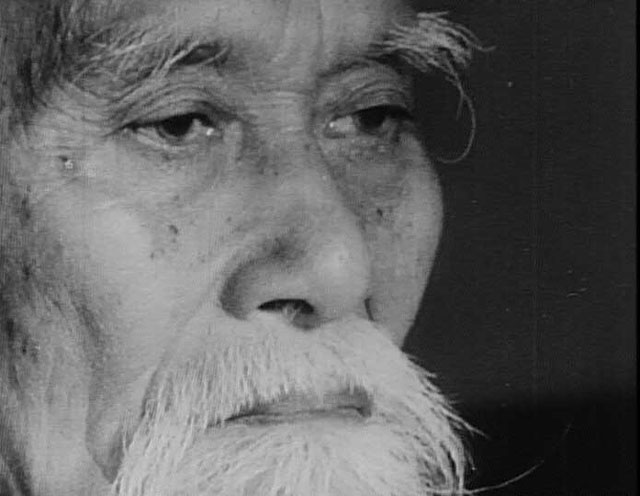
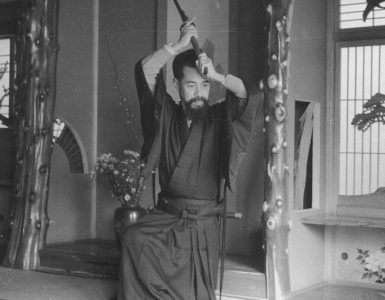
Aikido Founder Morihei Ueshiba (1883-1969)
“The contents of Kisshomaru’s books on Morihei present a family viewpoint,
and one that reflects the agenda of the Aikikai Hombu Dojo in Tokyo”
An old saying attributed to Winston Churchill is, “History is written by the victors.” I think that most people would agree with the veracity of this observation. Certainly, those who control the flow of information in a particular context will indeed influence, and ultimately arbitrate, public opinion on a given topic.

In the case of aikido and its founder, Morihei Ueshiba, I would say that this axiom certainly holds true. The main sources of information on Morihei Ueshiba in the English language are books written by his son, Kisshomaru Ueshiba, and American author John Stevens. Both have written a series of books dealing with Morihei and his writings that have been widely distributed in English and translated into several European languages.
A large percentage of these books have been published through the Kodansha Limited Company, Japan’s largest book publisher. Parenthetically, there is a historical relationship between Morihei Ueshiba and Seiji Noma, the founder of Kodansha. As Kodansha ceased its English publishing house in 2011, it is not known if other publishers will pick up the slack in producing books on Japanese martial arts including aikido.
Not surprisingly, the contents of Kisshomaru’s books on Morihei present a family viewpoint, and one that reflects the agenda of the Aikikai Hombu Dojo in Tokyo, aikido’s largest organization. Mr. Stevens’ biographical works on Morihei have have been directed towards a popular audience, and have portrayed the Founder in a flattering light as one of the greatest martial artists of all time. Stevens has also translated a number of other books such as Morihei’s 1938 manual Budo, and various spiritual writings attributed to O-Sensei.
I have noticed the impact of these publications over the years because these authors are quoted and misquoted with great frequency by legions of writers treating the topic of aikido and its founder. This tendency has been magnified exponentially by the Internet. The works of Kisshomaru and John Stevens have thus played a critical role in shaping the image of the founder that has entered into popular culture, and been embraced by a majority of aikido practitioners.
In recent years, authors such as Dr. Peter Goldsbury and Ellis Amdur have written books and articles offering alternative views that have garnered a certain amount of attention. Dr. Goldsbury, a university professor, has approached the subject by offering a social and historical context to better interpret the major events of Morihei’s life. Ellis Amdur–a colorful writer with a provocative style–has suggested various historical scenarios to explain some of the poorly understood areas of Morihei’s life and martial arts’ training. Both have made an effort to document their sources in contrast to Stevens’ writings which give little attention to this area.
On the Japanese side, Prof. Fumiaki Shishida of Waseda University has produced a number of well-researched articles that discuss aspects of Morihei’s life and teaching in the prewar era. Prof. Shishida is a student of Kenji Tomiki, and also discusses the influence of Judo Founder Jigoro Kano and the theory of competition as applied to aikido, a viewpoint espoused by Tomiki. Since Prof. Shishida’s publications are mostly academic, they have not had as wide an impact as they deserve, even though a few articles have been translated into English.
The only other major source of information on Morihei Ueshiba and the history of aikido that I am aware of is the material that we have published for the last 38 or so years, first as “Aiki News,” and now as “Aikido Journal.” One of the best gages that I have encountered that suggest that Aikido Journal has had a significant impact in this field are the amount of references in aikido-related entries of Wikipedia that cite Aiki News/Aikido Journal publications, many of which I am the author.
Little by little thanks to the Internet, other viewpoints on aikido history are gaining attention, and some of the historical accounts that have long been accepted as gospel are now being questioned. Also, a number of glaring omissions that reflect the intent to avoid or gloss over certain delicate historical topics are being addressed. I firmly believe that the next generation of aikidoka will have access to more accurate and richer materials that will help them better understand the enigmatic figure of Morihei Ueshiba and the evolution of aikido. Tomorrow’s “victors” had better have an iron grip on the Internet else their formerly unchallenged prerogative of writing history will be snatched from their hands!
_______________________________________
Click here to discover the secrets of the highest
level of aikido to accelerate your progress!
The Morihei Ueshiba Founder’s Course is O-Sensei’s video legacy starting in 1935 and covering a span of 34 years until just before his passing in 1969. Besides the more than 30 films of the Founder, the course includes three rare audio interviews of O-Sensei with complete subtitles. These are wonderfully intimate conversations with the Founder that convey his bright personality, playfulness and sincerity. In addition, the course includes a series of video documentaries by Stanley Pranin on the life of the Founder and the spread of his art worldwide.






The biggest “loss in translation” that I see has to do with Japanese selective memory about the period 1932+/- and 1945. Recommended reading for anybody who wants to take off the chrysanthemum colored glasses is “Flyboys” (http://www.amazon.com/Flyboys-A-True-Story-Courage/dp/031610728X/ref=sr_1_2?ie=UTF8&qid=1354657868&sr=8-2&keywords=flyboys ) recounting a pretty unvarnished view of Japan in the age of its militarism.
Why bother? Well, you might start by wondering why ANY martial artist would become prominent in the anterooms of power; the military, even possibly the government. We have MMA today, as well as many other fighting arts. Fighters are recognized, but their skill does not translate into positions at Annapolis, the Navy War College, or even supervision of hand-to-hand fighting skills for the FBI and CIA. There was something uniquely Japanese going on, and I doubt it had much to do with pacifism or love as perceived by young Americans in the last couple generations.
Aikido: the dish best served cold
Aikido has been presented to us as peace, love, and understanding. In the spirit of the article above I present another view. Aikido is revenge.
I don’t have the Aikido pedigree or credentials of the people mentioned in the article. However, Aikido is revenge, pure and simple. If any of you are blessed to be a father, a son, and perhaps a grandfather you are more likely to see things from my perspective.
Grant me a little latitude. It is a comment on the web. I can write a more thorough article if you MUST have references.
1. From reading about Morihei Ueshiba we can ascertain that he was somewhat neglectful of his family in pursuit of his life’s goal. I would venture to say that this would be an understatement.
2. From life’s experiences I venture that Kisshomaru’s opinion of Morihei is very different from the opinion held by Moriteru of his grandfather. This, in part, is why we have the belief that Morihei and Aikido is all about love.
3. Before we move on, consider the idea of the Japanese “public face” and “private face”.
If your reading and life experiences are such that you can accept the above as reasonable assumptions, consider that Kisshomaru lived a harder life than necessary because his father chose the path of spiritual enlightenment rather than business or financial security. For the sake of this argument, all Kisshomaru had to show for his life shared with his father was this thing later to be named Aikido.
It may not be politically correct, or PR savvy, for Kisshamaru to directly state that he resented his father’s choices and the sacrifices he endured as a result of his father’s choices.
So, Kisshamaru has the opportunity to take his father’s work. He organizes it, names it, and sells it to the public. Interestingly, Morihei is often quoted saying something to the effect of “no one is doing MY aikido”. So, Kisshomaru put’s Morihei’s picture in every dojo so he can watch for eternity.
So what happened:
1. Kisshomaru took his financially worthless birthright and provided for his family
2. Kisshomaru has his father, via a portrait, watch every living practitioner “butcher” Morihei’s aikido (I know, only I suck. You on the otherhand only enhanced the art.) He is also showing his father “this is how it’s done”
3. Kisshomaru creates the legend of his father. The father he wished he had.
One of the characteristics of Greek mythology is that the son destroys the father. Is the story of aikido not consistent with this?
Ladies and Gentlemen, Aikido is revenge.