
 Josh Gold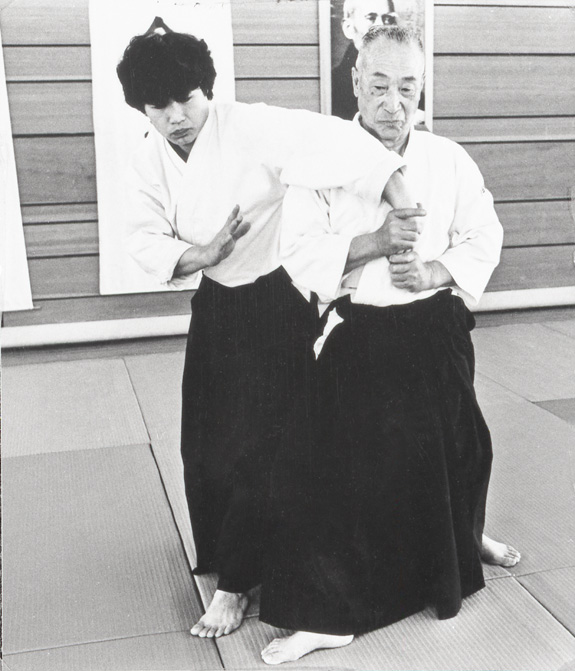
“When I faced O-Sensei, his eyes appeared large and his ‘ki’ came towards me with great energy. When facing him, all my ‘ki’ would be absorbed and my power ended up amounting to nothing.”
Dreamlike Days
A scroll hung smooth and quiet in the altar of the Kobukan Dojo. There were kamisama there and a bamboo blind neatly screened it off. Every morning the uchideshi, Rinjiro Shirata, thought, “Ueshiba Sensei’s being is exactly the same!” But when facing his teacher in the dojo, it wasn’t like that at all.
Morihei Ueshiba started advancing slowly from a long distance, yet there was still a separation of two mats. While Morihei moved another step forward, he slowly raised the arms that had been hanging down naturally to in front of his chest.
Thinking, “He’s driving into me,” Rinjiro let out a shout, “Ii eh ii!”, from the bottom of his core, readied his hand blade and shortening the distance himself, moved to strike preemptively. Mind, spirit and body were unified. Certain victory with a single stroke… He expected his hand to strike the top of Morihei’s head, but instantly Morihei moved his body and slipped behind him. He earnestly launched another cut and a fist, but all of them cut the air as if it had been prearranged. Morihei, who was weaving his way around, wasn’t hit at all; Rinjiro couldn’t even lay a hand on him.
“It’s… it’s no good!”
Even though he was the “Kobukan Prodigy,” this teacher was the only one with whom he could do nothing.
In later years, Rinjiro recalled what it was like to face Morihei, in the following way.
“When I faced O-Sensei, his eyes appeared large and his “ki” came towards me with great energy. When facing him, all my “ki” would be absorbed and my power ended up amounting to nothing. The more earnestly you faced him, the greater the effect of the “ki” from Ueshiba Sensei. It isn’t comprehensible, if one hasn’t experienced this kind of confrontation.”
Morihei was reading Rinjiro’s intentions as if they were an open book. As soon as Morihei felt the faint signals, he immediately stopped those movements, and in the next moment, he bent Rinjiro’s body like a large bow, immobilizing him. Afterwards, the finish was said to be like yonkyo, but Rinjiro didn’t even have a chance to confirm that; all he could do was endure the intense pain and struggle to somehow slip out of the technique even though he knew it was useless. Contrary to the struggle in his mind, his body didn’t even twitch.
“What terribly amazing breath power!”
Proud of the strength that could lift two bales of rice, Rinjiro shook his head as he answered an interview question, “Was (the Founder’s technique) painful?”
“Yes, really sharp. I couldn’t move. That’s the kind of thing I couldn’t understand! I still don’t understand. Even though I had confidence in my physical strength, whenever I faced Sensei, inevitably my body would end up floating in empty air, and I couldn’t do a thing. No matter what, he took everything away. Everything was completely absorbed by Sensei. That sort of ability isn’t comprehended by the practice of technique alone.”
Similarly, Rinjiro was completely puzzled by joint techniques.
“Having joint techniques applied was really painful. Sometimes nikyo was applied, and you couldn’t hold chopsticks! When it comes to something like yonkyo, it would swell up purple, over and over again, it would swell up purple. By doing that, you would reach the point where it wouldn’t swell and you wouldn’t feel the pain. Being in pain means that you have not yet had enough severe training. (ha ha ha) Well, it was that kind of time, wasn’t it!”
Rinjiro said that, not only was he captured by Morihei’s techniques, every single time he experienced intense pain.
He wondered if he’d become really strong. He was doubtful, but when Morihei went to places like the Military Staff College, the Military Police Corps, the Torpedo School and the Gunnery School to conduct training, he was always chosen as Morihei’s assistant. He never once experienced defeat in challenge matches, either. He could almost always defeat an opponent with his first strike.
With good reason, even at the Kobukan of that time, atemi was not actually used during training.
“Atemi was only explained to a certain point and we never really included it. But after all, being hit in the face and stopping a fist in front of the eyes are different, aren’t they? So suddenly when a fist comes, that thing called awareness goes in a different direction, doesn’t it! Power falls away immediately! That is the point.”
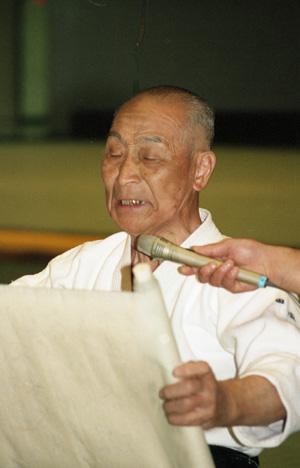
at All-Japan Aikido Demonstration, c. 1990
In nearly six years of training at the Kobukan from the end of 1931 to the end of 1937–with only about a year and a half spent on foundation training–Rinjiro began the Okayama branch of the Budo Senyokai [c. 1934] discussed previously, traveled throughout the country for outside training and when in Tokyo, went around serving as Morihei’s assistant.
“The last two years, I was residing in Osaka”
According to what Rinjiro said after the war, he took charge of the dojo, replacing Tsutomu Yukawa who was the senior student in Osaka. Yukawa came from Wakayama and is a hero of aikido history. At any rate, he had tremendous physical strength. Not only could he casually bend and straighten a long six inch nail, but he was also known to grab a bale of rice in each hand, lift them up, and hit them together like wooden clappers.
Yukawa was a judo representative of Wakayama Prefecture. At the old Hidaka Middle School where he attended, he was ranked 3rd dan, but there was no opponent in the prefecture who could face him. Believe it or not, there was also a story from his past that, driven by this momentum, he went to the headquarters of the Kodokan [Judo Headquarters] by himself and ran amuck. “He was the most excellent of Ueshiba Sensei’s students,” said Rinjiro, testifying that they learned many techniques, including their details, from him.
In the same way, Rinjiro in the uchideshi period had an especially good relationship with Gozo Shioda. Shioda once recounted the following story:
“The thing is, when night fell, Rinjiro Senpai and I used to secretly go out to play. We put our geta in our pockets so O-Sensei wouldn’t know, and with bare feet quietly escaped through the back door. Nevertheless, with his customary supernatural power, O-Sensei saw everything clearly! “Those fellows, Shirata and Shioda, are out again.” Every time we went out for some nightlife, we received a harsh scolding the next day [from Kisshomaru Ueshiba’s book Aikido Kaiso Ueshiba Morihei Den].
Later Rinjiro said that he ran with Shioda for two years. Looking back, it was a dreamlike time when it was possible to just focus on a life of the aikido they loved. Before long, Rinjiro received his draft notice. It was December, 1937.
Going to the Battlefield and Returning to His Native Land
Enlisting in Yamagata’s 32nd Infantry Regiment
Rinjiro was in the 32nd Regiment, which was a central part of the 132nd, that had been established in Manchuria, and subsequently joined Manchuria’s Unit 803. In 1939, this unit was stationed in a place called Mitsusan no Ma Ka Chi in Ando province Manchuria.
Japan issued a proclamation declaring the foundation of a new nation in Manchuria without its consent on March 1, 1932. It established the name Manshu, the era name Daido, and a five-colored national flag. The following year on March 27, 1933, Japan withdrew from the League of Nations. On February 26, 1936, the February 26th Incident occurred [aka, the 2-2-6 Incident, an attempted coup d’état by young officers in the Japanese Army]. The state of affairs had become such that it was impossible to stop Japan’s inclination toward militarism.
With the USSR as its target, the Army worked vigorously to build up its armaments. Plans were made to have 10 divisions in Manchuria, 17 divisions in the Japanese-controlled Korean peninsula, and maintain artillery and armor units to supplement them, as well as 142 aviation units by 1942. By doing this, the plan was that 41 divisions could be mobilized for wartime military operations.
However, this created a problem. They completely ran out of commissioned officers. Because officer training was limited during Taisho era (1912-1926) and the early days of Showa (1926-1989), there were not enough commissioned officers in the expanded divisions. Accordingly, in 1937, the Imperial Army tripled the usual number of pupils accepted into the 53rd class of the Army War College to about 1800, and after that more than 2000 were accepted.
Ordinary infantry regiments were composed of about 2000 men. Below that, infantry battalions were slightly less than 600. This made three battalions in each regiment. Further, there were three infantry companies of about 150 men in each battalion.
Rinjiro, who was already appointed second lieutenant in the reserves by the time he finished his initial enlistment in 1942, was promoted after reenlisting, and became the commander of the 6th Company.
The “Shirata Company,” as it was called, always had the best bayonet drills and marksmanship in the regiment. They were called “the Excellent Company,” and always took the first place in tournaments.
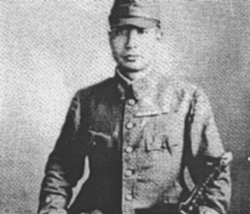
The small Sino-Japanese skirmish in the neighborhood of the Marco Polo Bridge in a western suburb of Peiking (Beijing) on July 7, 1937 [aka, “The Marco Polo Bridge Incident”] became the trigger for the Sino-Japanese War, and immediately the flames of war spread. In 1942, Rinjiro, as a special volunteer commissioned officer, tackled the Army War College entry test, and was one of only four successful applicants in his group.
Rinjiro temporarily returned to Japan and graduated the following year. He was immediately assigned back to the 168th Infantry Regiment, and this time served as commander of the 2nd Battalion. During this period, Rinjiro was married on March 10, 1942, Army Memorial Day, then took command of 600 troops, and a fierce battle unfolded in the countryside of Burma.
Fate is certainly an ironic thing. The Manchurian Unit 803, that Rinjiro formerly belonged to, achieved honorable defeat in the Battle of Okinawa. Rinjiro, who survived to the end of the war, was held with his men in the Mudon POW Camp [the setting for the movie “The Burmese Harp,” 1956] in Burma.
At this camp, there was relatively light, easy manual labor and the prisoners had plenty of free time. Occasionally, they held cultural education courses. As a temporary lecturer, Rinjiro delivered lectures that raised concrete questions of the mind based on myths, legends, and the Kojiki.
Army Major Rinjiro Shirata, who was repatriated in July, 1946 at Otake, Hiroshima, was suffering from a mild case of malaria. Rinjiro was impressed by the emergency rice feeding program for the demobilized returnees, and was said to have delivered rice specially from his hometown as a gesture of gratitude. That was really like him. People considered him a benevolent man.
Rinjiro finally arrived at his parent’s house, shaved his head smooth and recited Buddhist sutras continuously for a week. He was probably praying for the souls of his superior officers, colleagues and subordinates.
He heard that his teacher Morihei was asking why he hadn’t returned to the Aikikai Hombu. But in the chaotic postwar period, earning a livelihood in aikido or the martial arts was impossible. If he returned, it would have causes difficulties for Sensei. He would probably have ended up having to be supported financially.
Rinjiro restrained the impulse to rush to the Aikikai Hombu and bided his time while making a life with his wife and three children his first priority. He found employment with a life insurance company and received management training. He was the first manager of the Aomori branch office and then managed the Yamagata branch office. In the meantime, as things calmed down in postwar Japan, the leadership at Aikikai Hombu resumed activities.
“The Kobukan Prodigy has grown old too, hasn’t he?”
People who had known him before and during the war had deep misgivings about his return to aikido.
Rinjiro, who established the Aomori Branch of the Aikikai in 1959, became the Aomori Prison’s Aikido Shihan, and in 1962, he was certified an 8th dan by Morihei. October, 1969, saw the birth of the Yamagata Prefecture Branch dojo. Incidentally, Rinjiro was 57 at the time.
Immobilizing Tatsumi Fujinami
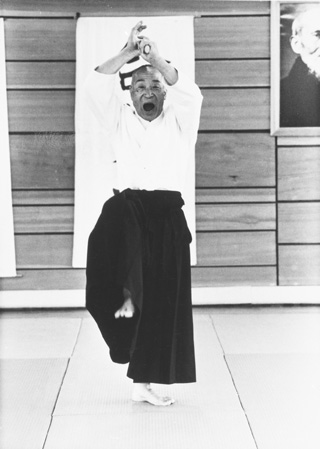 Rinjiro would sometimes just show up to practice and demonstrate smooth cuts with a heavy bokuto used for suburi. At times, when there weren’t many students, he sometimes said, “This kind of skill exists,” and demonstrate an unbelievable feat of great skill. In his later years, he also bequeathed the 75 count Misogi no Jo kata to future generations.
On September 12, 1986, there was an incident in Yamagata. The star of New Japan Pro Wrestling, Tatsumi Fujinami, came to have a professional wrestling match in the Yamagata Gymnasium, and before the match, he unexpectedly visited the adjoining Yamagata Martial Arts Hall.
He saw an old martial artist who was there by himself teaching aikido to children. We don’t know what inspired him, but seeing something, Fujinami asked to join on the spot. The old martial artist responded indifferently, “Aikido is different from pro wrestling so…” Still Fujinami persisted and maybe he wore down the old martial artist. Saying, “Because you took the trouble to come…” they faced off. The 6ft. 227lb. Fujimani was very easily thrown and his joints were completely locked up.
In contrast with Fujinami’s disbelief, the old martial artist said this afterwards, “I don’t know people like Fujinami. I thought he was a rookie.”
The old martial artist was the mature Rinjiro Shirata. Later, on May 29, 1993, this uncommon warrior passed into the divine. His age at death, 81. That same year he was awarded a 10th dan certificate from Morihei’s son, Kisshomaru Ueshiba, who had succeeded his father as the Second Doshu.
“Even in the next world, I will serve the Founder”
I dare say that Rinjiro, having concluded that he was on his deathbed, almost certainly achieved his intention.
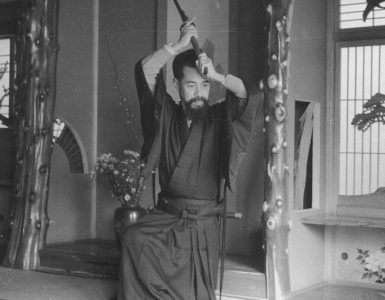
Originally published in Aikido Tankyu [Aikido Quest], Aikikai Hombu Dojo
Translation by Douglas Walker
Douglas Walker is an independent scholar and student of Japanese culture. He practices Kodokan Aikido and is shoden menkyo in Takamura ha Shindo Yoshin ryu. He lives and trains in Portland, Oregon.





Unfortunately I must have been in an earlier generation. Or maybe I have trouble counting past 21. At least two of the students, Craig and Heather, who did Aikido in Riverside, California, under the instruction of John Stevens were able to do the 75 Count Misogi no Jo Kata, and instruct others. I have much admiration for them. With Peace and Love, Ace
Very enjoyable and interesting story to read, thank you.
I wonder if I should tell anyone this.. but Wally Jay’s TWO WAY ACTION is the best way to describe the mental confusion some masters can impart to the attacker or their practice partner when at the same time the body is moving. I describe it as NO THOUGHT with THREE WAY MOTION.. too much for the body and mind to absorb, so the confusion of body and mind is unable to grasp what is happening.
Far too often I see the advanced techniques that use SMALL CIRCLE but the practitioner denies it is small circle? Well, deception is part of the puzzle. Puzzles can be put together and taken apart if you pay attention.. so Pay ATTENTION!
Your studies of physical practice are just part of what you need to learn. Realize it won’t all come to you in a year or two, it might take many decades and the maturing of the body and mind to grasp the wisdom of written words and the history of these videos that give you CLUES.. many clues .. to what you have yet to learn?
Your young body will give you different thoughts than your old body will, and the chemistry of your body and brain will change as you grow old so that you will think different thoughts, see the world differently than you did when you were young. Maybe that is why the old try to impart wisdom to the young, and the young seek to steal the power the old show as they practice their art. We live in a fantastic age of knowledge and wisdom if you can take the time to go find it.. .
I have enjoyed some seminars with Rick Stickles and John Stevens, hands on training and maybe they made some comments on and off the mat that were too honest, yet… there were both passing down words, wisdom, and training from one of their teachers.. Rinjiro Shirata. Pretty amazing when I read an article like this.. how that training is passed down teacher to student over generations, eh?
I try not to look at it that any one teacher created it.. but they gathered knowledge and compacted it into a specific training regimen. Even O’Sensei is the teacher in a long line of trial and error practices.. a trial and error practice that goes on today as people try to figure out what belongs in the style of Aikido or out of the style of Aikido?
READ the biographies of the teachers who train in a variety of different martial arts.. it was that diversity and that training that settled their CENTER, their mind and body so that when they decided Aikido would be their Main practice the decision was easy to make. That may go against the grain of some teachers to KEEP their students away from training in a variety of martial arts or studying a variety of knowledge.. but I take my lead from the history of great teachers… where you may leave aikido for a time.. but if you learn the short hand of aikido … you will come back to it time and time again. (I sound like an old record, eh? Well, there is a lot of potential in aikido that has yet to be tapped, or learned.)
Training at the Yamagata Budokan with Rinjiro Shirata and his students was pure joy. Although much of his techniques were pre-war aiki and difficult to grasp, that did not matter since he and his students were so positive and generous
of spirit. Like their teacher, they were big strong fellows with even bigger hearts.